Motivation and fit
106 of 749 researched questionsWhy this employer, this team, this programme — and why you. Almost every reported set opens here.
“Why Dyson?”
What the one-way format involves, how it is scored, and what employers actually ask — then practice it under the clock.
9,200+ candidates · 101,000+ practice sessions across Game Assessment Prep.
Candidates from 100+ universities and colleges











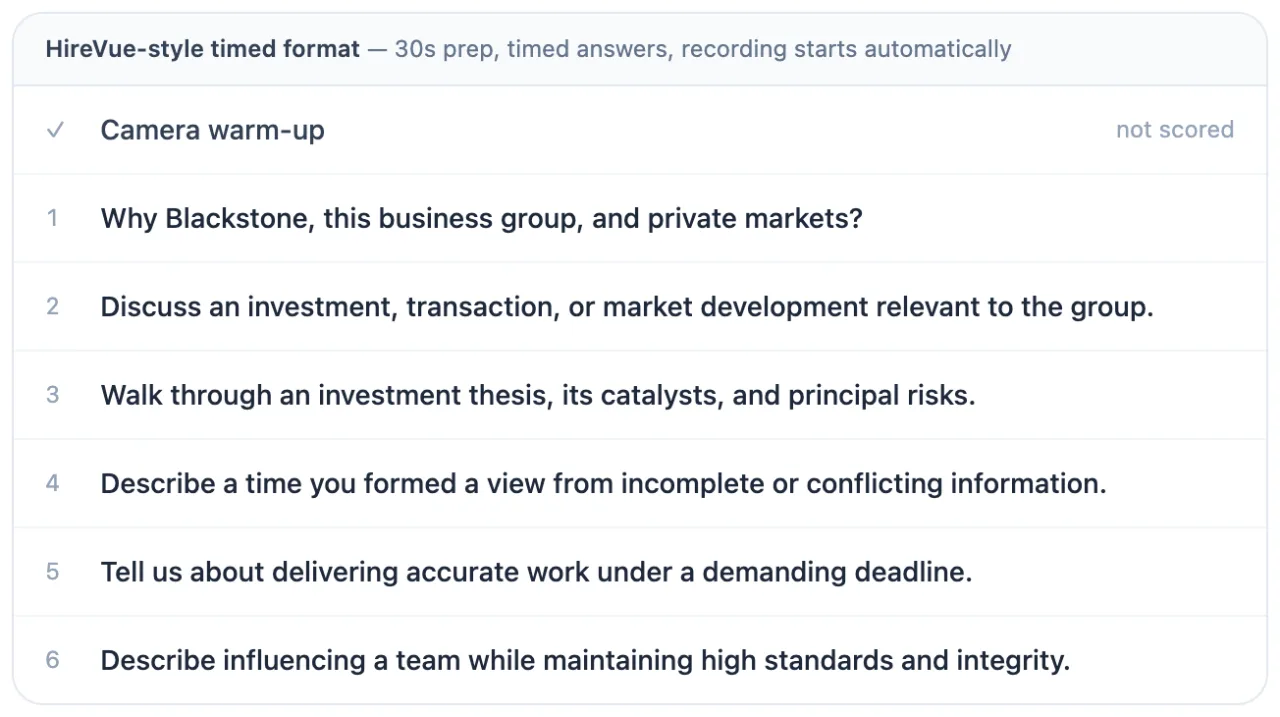
A HireVue video interview is a one-way, on-demand recording. A question appears on screen — as text or a pre-recorded clip from someone at the company — a preparation timer runs, and then the camera records your answer. There is no interviewer present and no back-and-forth. You complete it whenever you like before the deadline in your invitation, and a recruiter or hiring manager reviews the recordings afterwards.
It is almost always an early screening round, sitting between the application and any live interview. For many employers it is the first time a human engages with you at all, which is why a weak recording ends the process before your CV is really read. Some employers pair it with game-based assessments in the same invitation; others send the games separately or not at all.
These are the configurations employers most commonly document, not a HireVue standard. Timing, question count, retakes, and deadlines are all set per role by the employer — the instruction screen in your own invitation always wins.
We research video-interview questions employer by employer from official careers pages and dated candidate reports. Across 75 employers, 660 of the 749 questions in our bank are officially published or candidate-reported rather than written by us. Four themes cover nearly all of them.
Why this employer, this team, this programme — and why you. Almost every reported set opens here.
“Why Dyson?”
A specific thing you actually did: a conflict, a deadline, a failure, a time you led. The largest category by far in our research.
“Tell me about yourself.”
A hypothetical you have not lived through — how you would handle a difficult customer, a slipping deadline, a disagreement.
“How would you deal with an irate or unhappy passenger?”
Finance, engineering, and commercial roles sometimes add a market view, a recent deal, or a domain question.
“What is your understanding of the off-price business model?”
HireVue stopped using facial analysis in 2020, and its 2025 explainability statement describes assessments built on what candidates say rather than how they look. In practice, what happens to your recording varies by employer: many are reviewed by a recruiter, some are scored automatically from a transcript of your answer first, and the employer decides which.
No employer in our research publishes a pass mark, and most never tell candidates their result — you usually learn only whether you advanced. That makes the useful goal a practical one: answer the question that was asked, structure it so a reviewer can follow it, be specific, and finish inside the time limit.
Because employers keep their scoring private, we built a transparent one. Your recorded answer is transcribed and scored on relevance, structure, specificity, and concision, plus how well its length and pace fit the format — then placed on a percentile against a calibrated benchmark, so you can see where a good answer sits rather than guessing.
View a scored exampleIt names the number of questions, the preparation and answer limits, the retake policy, and the deadline. Everything below is generic until your invitation overrides it.
Themes repeat, but the motivation question is company-specific and is almost always first. Our per-company pages list the researched set with an evidence label on every question.
Reading questions is not practice. The format punishes rambling, slow starts, and answers that drift off the question — problems you only notice by recording yourself and watching it back.
Quiet room, stable connection, camera at eye level, and a technical test well before the deadline. Most employers give you one attempt at the real thing.
Researched questions, timed preparation and answers, scored feedback.
It is a one-way (on-demand) video interview: instead of talking to an interviewer, you read or watch a question on screen, get a short window to prepare, and record your answer. Nobody is on the other end while you record — a recruiter or hiring manager reviews the recordings later. Employers use it as an early screening round, usually straight after the application.
Employers configure this per role, so there is no universal setting. Across the employers we research, the most commonly documented configuration is roughly 30 seconds to prepare and 1–3 minutes to answer, with anywhere from 3 to 12 questions. Some employers officially publish their own timings — Deutsche Bank documents two minutes to prepare and two minutes to answer with a single attempt — so the instruction screen in your invitation is always the controlling source.
Sometimes, and it is set by the employer rather than by HireVue. Reported configurations range from a single attempt with no retakes to two or three attempts per question. Several employers offer unlimited practice questions before the scored ones begin. Assume one real attempt unless your invitation says otherwise.
HireVue retired facial analysis in 2020 and, since its 2025 explainability statement, describes assessments built on what you say rather than how you look. In practice most employers have humans review the recordings, sometimes assisted by automated scoring of transcribed answers. No employer we research publishes a pass mark, so the practical goal is a clear, structured, specific answer inside the time limit.
No, and it matters when you prepare. HireVue is the most common platform, but employers also use Modern Hire (acquired by HireVue in 2023), Cappfinity, Sonru, iCIMS Video Interviews, and others — and many employers never name their vendor at all. Of the 75 employers in our question bank, 19 document a recorded video round without naming HireVue. The format and the preparation are nearly identical either way.
Rehearse in the real format rather than reading questions. Record answers under a countdown, watch them back, and check the things the format punishes: rambling past the limit, opening with filler, or answering a different question than the one asked. Our mock interview does this with researched questions for a specific employer and scores each answer against a calibrated benchmark.
Record answers to researched questions for your employer in the real one-way format — timed preparation, timed answers, scored feedback, and a percentile. Your video never leaves your device.
We are an independent practice platform and are not affiliated with HireVue or any employer. Question research is paraphrased from public, dated sources and labelled by evidence.