Free AEMT Practice Test
Answer Advanced EMT questions written to the current six-domain test plan and the AEMT scope of practice, read why each answer is right, then sit a 135-question, 3-hour practice exam in the real exam’s format.
135 questions in 3 hours, weighted to the six official domains, with a score report by domain and topic and an explanation for every answer.
Or start with a free domain drill- 278 original AEMT questions with explanations
- 10 free drills by domain and topic
- 2024 test plan with the Clinical Judgment domain
At 10 p.m., an AEMT is treating a 24-year-old woman with asthma at her home who had loud wheezes, SpO2 89% and could speak only short phrases. After two nebulized albuterol treatments her chest is nearly silent, she is drowsy, SpO2 is 84% and her respiratory rate has fallen from 32 to 12; a paramedic unit is 15 minutes away. How should the AEMT interpret this reassessment?
The NREMT AEMT exam at a glance
The National Registry’s AEMT exam is a fixed-length computer test and has been the only examination for national certification since July 1, 2024, when the psychomotor exam ended and its content moved into the Clinical Judgment domain.
- Format
- Fixed length: 135 questions, 35 of them unscored pilot questions. Everyone gets the same number of questions
- Time
- 3 hours
- Question types
- Multiple choice, multiple response, build list, drag-and-drop, options box, graphical items with capnography strips and images, and scenario-based items
- Scoring
- Scaled 100 to 1,500; the passing point is 950. Every item is scored all or nothing
- Where
- Pearson VUE test centers
- Fee
- $159 per attempt
- Retakes
- Six attempts, 15 days apart; remedial education after the third failed attempt
- Skills exam
- None since July 1, 2024. Your program verifies skills through the AEMT Student Minimum Competency matrix
What the exam covers, and a free drill for each domain
The test plan in force since July 1, 2024 has six domains. Clinical Judgment is the largest, and pediatric questions appear in every domain. Each drill is ten questions with an explanation after every answer; create a free account to save your results. Each domain also has a study guide.
| Domain | Share of exam | What it tests | Practice |
|---|---|---|---|
| Airway, Respiration and Ventilation | 9–13% | Assessment and management of breathing problems within the AEMT scope: BVM, supraglottic airways, CPAP, suction, oxygen titration and capnography monitoring. | 10-question drill Study guide |
| Cardiology and Resuscitation | 11–15% | Chest pain recognition, aspirin and nitroglycerin, CPR and AED, 12-lead acquisition and transmission, shock recognition and working with ALS. | 10-question drill Study guide |
| Trauma | 7–11% | Hemorrhage control, shock, head and spinal injury, chest and abdominal trauma, burns, environmental emergencies and field triage. | 10-question drill Study guide |
| Medical, Obstetrics and Gynecology | 25–29% | Neurologic, diabetic, toxicologic, allergic, infectious and GI emergencies, behavioral emergencies, obstetrics and newborn care, and gynecology. | 10-question drill Study guide |
| EMS Operations | 6–10% | Vehicle and equipment operations, leadership and professionalism, communication and documentation, medical and legal standards, and the environment of care. | 10-question drill Study guide |
| Clinical Judgment | 31–35% | Scenario questions that move from en route to scene to post scene: recognizing and analyzing cues, forming a hypothesis, generating solutions, acting and evaluating, plus communication and leadership. | 10-question drill Study guide |
Drill by topic
Sit the full AEMT exam under the real time limit
135 questions in 3 hours, weighted to the six official domains, with a score report by domain and topic and an explanation for every answer.
Or start with a free domain drillHow the exam works
Every candidate answers the same 135 questions in 3 hours. One hundred count toward your score and 35 are unscored pilot items you cannot tell apart from the rest. You can change an answer before you submit it, but once you advance you cannot return, and anything unanswered when time runs out is marked wrong.
Scores are reported on a 100-to-1,500 scale with the passing point at 950. A score report is posted only if you do not pass, so you know which domains to study before your next attempt.
Our full practice exam uses the real format: 135 questions in 3 hours, forward-only, with each of the six domains weighted to the middle of its official range. Your report scores every domain, topic and clinical judgment step so you know what to drill next.
How to qualify for the AEMT exam
- Hold a current National Registry certification or state license at the EMT level or higher.
- Complete a state-approved AEMT course that meets the National EMS Education Standards within the past two years; since July 1, 2024 it must follow the Recommended AEMT Student Minimum Competency matrix.
- Your program director verifies your course completion on the National Registry website.
- Pass the AEMT Certification Examination. The $159 fee is charged for every attempt, and an Authorization to Test is valid for 90 days.
The National Registry ladder: EMT, AEMT, Paramedic
Each level requires the one below it. One AEMT & Paramedic pass covers both advanced exams here; the EMT practice test has its own.
AEMT
135 questions, 3 hours, fixed length
Exam fee $159
You are here
Studying for the Paramedic exam too? The same pass unlocks the Paramedic full practice exam and every Paramedic drill.
Common questions
How many questions are on the NREMT AEMT exam?
135, and you have 3 hours. Unlike the EMT and paramedic exams, the AEMT exam is not adaptive: it is a fixed-length linear test, so everyone answers the same number of questions. Thirty-five of them are unscored pilot questions, so 100 count toward your score.
What does the AEMT exam cover?
Six domains from the test plan in force since July 1, 2024: Clinical Judgment (31–35%), Medical/Obstetrics/Gynecology (25–29%), Cardiology and Resuscitation (11–15%), Airway, Respiration and Ventilation (9–13%), Trauma (7–11%) and EMS Operations (6–10%). Pediatric care is mixed into every domain.
Can I go back and change an answer?
You can change your answer before you submit it, but once you advance you cannot return to a question. Anything left unanswered when time runs out is scored as incorrect. Our practice exam works the same way.
Is there still an AEMT psychomotor exam?
Not for national certification. Since July 1, 2024 there is one examination, and your program documents your skills through the AEMT Student Minimum Competency matrix. Some states still run their own skills test for licensure, so check with your state EMS office.
How much does the AEMT exam cost, and how many times can I take it?
The application fee is $159 and is charged for every attempt. You get six attempts, at least 15 days apart, within two years of finishing your course. After three failed attempts you must complete remedial education, such as the 25-credit AEMT National Competency Component or an approved refresher course, before the fourth.
What can an AEMT do that an EMT cannot?
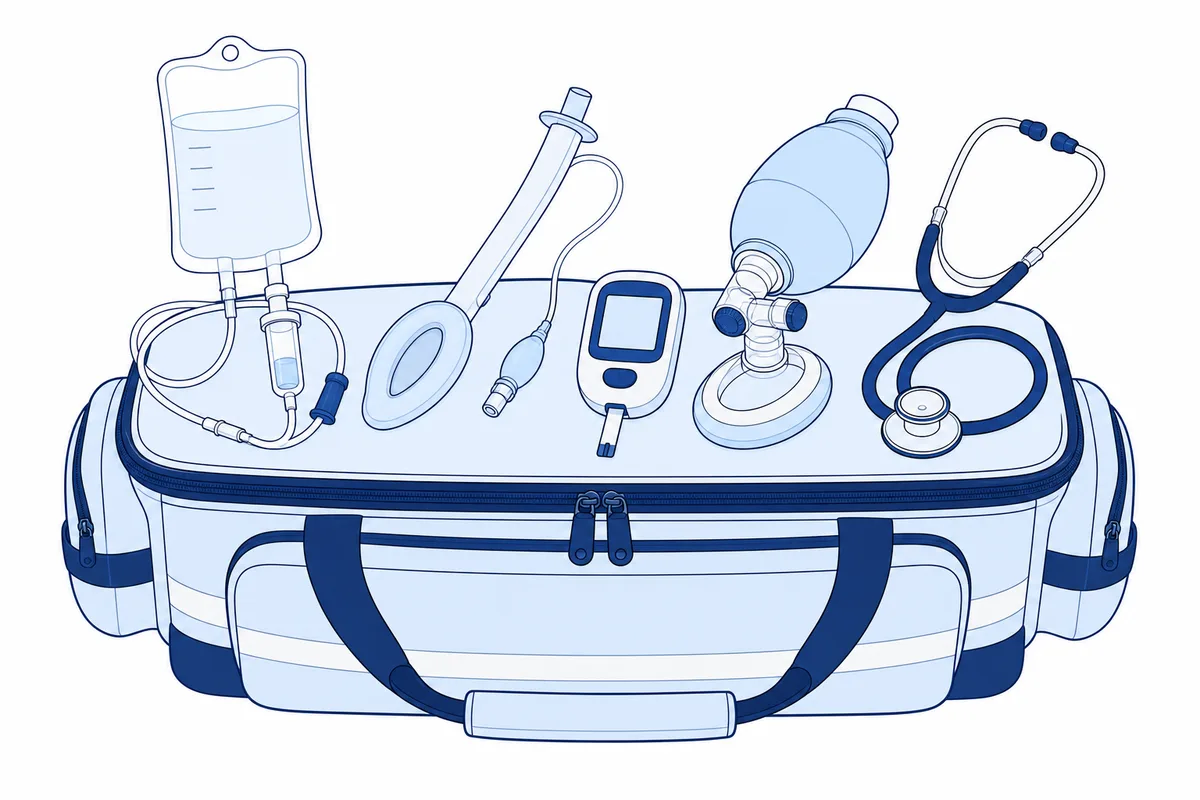
Under the National EMS Scope of Practice Model, AEMTs add supraglottic airways, peripheral IV and IO access with non-medicated fluids, waveform capnography, 12-lead acquisition and transmission, blood glucose monitoring, and a limited formulary: IV dextrose, glucagon, naloxone, IM epinephrine, agency-supplied nitroglycerin, nitrous oxide, plus the EMT medications. Intubation, rhythm interpretation, manual defibrillation and the full drug list stay with paramedics. States may add or remove skills.
What kinds of questions are on the exam?
Mostly multiple choice (one answer out of four), plus multiple response, build list, drag-and-drop, options box and graphical items such as capnography strips. Many are tied to a scenario that runs from en route to scene to post scene. Every question is scored all or nothing. Our bank uses single-answer multiple choice.
Are the questions up to date with the 2025 AHA guidelines?
Yes. Every CPR and newborn question uses facts that are the same in the 2020 and 2025 American Heart Association guidelines. We left out the topics that changed, such as choking sequences and infant compression technique, while the National Registry replaces its own conflicting questions.
Ready for exam day?
135 questions in 3 hours, weighted to the six official domains, with a score report by domain and topic and an explanation for every answer.
Or start with a free domain drillSources
- National Registry: AEMT and Paramedic Certification Examinations
- National Registry AEMT Examination Specifications (test plan)
- AEMT Candidate Handbook: About the Examination
- AEMT Candidate Handbook: Certification Process and fees
- AEMT Candidate Handbook: Candidate Responsibilities (requirements)
- National Registry: ALS Psychomotor Examination Discontinued (October 4, 2023)
- National Registry: How the 2025 AHA Guidelines Impact National Registry Certification Examinations (October 27, 2025)
- National EMS Scope of Practice Model (2019)
Original practice questions for exam preparation, written to the National EMS Education Standards, the National EMS Scope of Practice Model and the National Registry’s published AEMT test plan. Independent practice, not affiliated with or endorsed by the National Registry of Emergency Medical Technicians or Pearson VUE. Follow your local protocols and medical director in the field.