Free TMC Practice Exam
Answer NBRC Therapist Multiple-Choice questions written to the official content outline, read why each answer is right, then sit a 160-question, 3-hour mock that scores you against the CRT and RRT-eligibility cut scores.
160 questions in 3 hours, weighted to the NBRC content outline, scored against the 86 and 92 cut scores, with an explanation for every answer.
Or start with a free drill- 477 original questions with explanations and worked calculations
- 13 free drills by exam section and clinical topic
- 86/92 cut-score readout on the NBRC’s 140-question scale
At 1 minute after birth, a term newborn has a heart rate of 88/min, slow and irregular respirations, some flexion of the extremities, a grimace in response to suctioning, and a pink body with blue hands and feet. Which of the following is the 1-minute Apgar score?
The TMC exam at a glance
The Therapist Multiple-Choice Examination is the NBRC’s entry-level credentialing exam for respiratory therapists. Pass it at the low cut score and you are a Certified Respiratory Therapist (CRT); pass it at the high cut score and you can sit the Clinical Simulation Examination for the Registered Respiratory Therapist (RRT) credential.
- Format
- 160 multiple-choice questions: 140 scored and 20 unscored pretest questions
- Time
- 3 hours
- Passing
- Two cut scores on the 140 scored questions. The low cut, 86 correct, earns the CRT credential. The high cut, 92 correct, earns the CRT and makes you eligible for the Clinical Simulation Examination toward the RRT.
- Fee
- $190 for new applicants, $150 for repeat applicants
- Retakes
- Three attempts without a waiting period, then at least 120 days between attempts; you reapply and pay for each attempt
- Where
- More than 300 PSI assessment centers, Monday through Saturday
- Eligibility
- Age 18 or older and a graduate, with at least an associate degree, of a CoARC-accredited entry-into-practice respiratory therapy program (current CRTs have other routes)
- 2025 results
- 11,086 exams. New candidates: 78.5% reached the low cut and 68.2% the high cut. Repeat candidates: 48.9% and 29.4%.
- Last offered
- December 31, 2026 (NBRC Candidate Handbook). The Respiratory Therapy Examination takes effect January 1, 2027, and the CSE ends December 31, 2027.
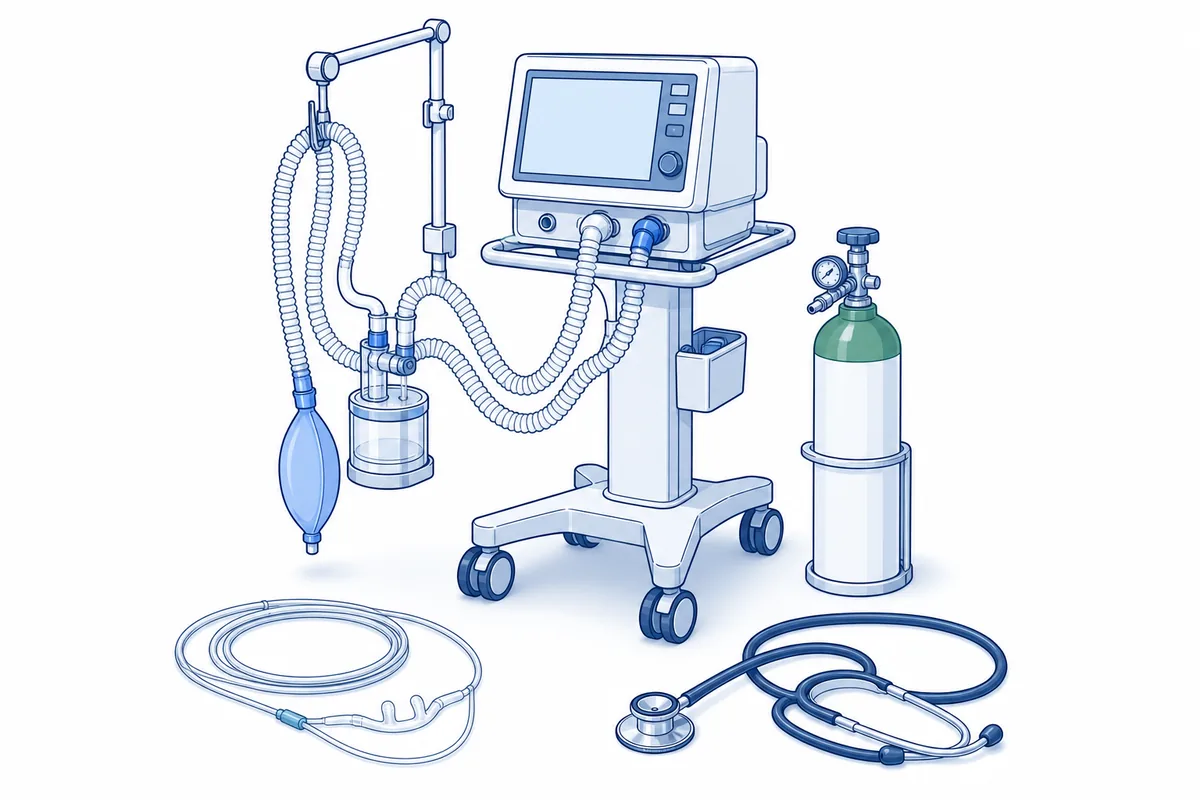
What the exam covers, with a guide and a free drill for each section
The NBRC Detailed Content Outline divides the 140 scored questions into three sections and sets how many are recall, application and analysis. Each drill is ten questions with an explanation after every answer; create a free account to save your results.
| Section | Scored questions | Recall / application / analysis | What it tests | Practice |
|---|---|---|---|---|
| I. Patient Data | 50 (36%) | 15 / 27 / 8 | Chart review, bedside assessment, diagnostic procedures and what their results mean, and which test to recommend next. | 10-question drill |
| II. Troubleshooting and Quality Control of Devices, and Infection Control | 20 (14%) | 8 / 9 / 3 | Assembling and fixing devices from cannulas to ventilators and bronchoscopes, infection prevention, and quality control of analyzers, PFT equipment, ventilators and monitors. | 10-question drill |
| III. Initiation and Modification of Interventions | 70 (50%) | 10 / 30 / 30 | Airway management, airway clearance and lung expansion, oxygen and ventilator initiation and adjustment, medications and specialty gases, changing the care plan, guidelines, emergencies, assisting with procedures, and patient education. | 10-question drill |
The outline also requires 4 pediatric (3 to 8) and 3 neonatal (2 to 5) questions among the 140.
Drill by clinical topic
Then sit the whole exam under the clock
160 questions in 3 hours, weighted to the NBRC content outline, scored against the 86 and 92 cut scores, with an explanation for every answer.
Or start with a free drillHow the TMC is scored, and how our mock reports it
The NBRC scores the 140 scored questions as a raw number correct and compares it with two cut scores. Reaching 86 earns the CRT credential. Reaching 92 earns the CRT and eligibility for the Clinical Simulation Examination, the second exam on the RRT pathway. The 20 pretest questions never count, and no sub-scores are reported.
Our full mock has 160 four-option questions in 3 hours, drawn to the outline’s proportions: 57 Patient Data, 23 Equipment and Infection Control, 80 Interventions. Every question is scored, then your total is scaled to the 140-question scale and placed against the 86 and 92 cut scores, with a breakdown by section and by topic so you know what to drill next.
The Clinical Simulation Examination is a different format: 22 branching clinical problems (20 scored) in 4 hours for a $200 fee, open to candidates who passed the TMC at the high cut, and offered through December 31, 2027. This site practices the multiple-choice TMC only.
What the NBRC says changes in 2027
In its own words, the NBRC “is transitioning to a single examination,” the Respiratory Therapy Examination, “which will be implemented in January 2027,” and is “eliminating the Clinical Simulation Examination.” The NBRC describes the new exam as 185 multiple-choice items (160 scored and 25 pretest) with a 4-hour time limit, costing $360 for new applicants and $300 for repeat applicants. Its low cut score earns the CRT credential and its high cut score earns the RRT credential. It has a breadth-of-knowledge section organized around the same content domains and cognitive levels as the TMC, and a section that assesses depth of clinical judgment, all built from independent multiple-choice items.
The NBRC Candidate Handbook lists the TMC as ending December 31, 2026, and the RT Examination as effective January 1, 2027. Candidates who pass the TMC at the high cut score before December 31, 2026, can take the CSE, which the NBRC keeps available through December 31, 2027.
Test yourself against the cut scores before the format changes
160 questions in 3 hours, weighted to the NBRC content outline, scored against the 86 and 92 cut scores, with an explanation for every answer.
Or start with a free drillCommon questions
How many questions are on the TMC exam, and how long is it?
The Therapist Multiple-Choice Examination has 160 multiple-choice questions and a 3-hour time limit. 140 questions are scored; the other 20 are unscored pretest questions mixed in so you cannot tell them apart. Every question has four answer choices.
What score do I need to pass the TMC?
The NBRC sets two cut scores on the 140 scored questions and reports raw scores, not percentages. The low cut score is 86 correct, which earns the Certified Respiratory Therapist (CRT) credential. The high cut score is 92 correct, which earns the CRT and makes you eligible for the Clinical Simulation Examination on the way to the Registered Respiratory Therapist (RRT) credential. Below 86 you reapply. No sub-scores are reported.
What does the TMC exam cover?
Three sections from the NBRC Detailed Content Outline: Patient Data (50 scored questions), Troubleshooting and Quality Control of Devices and Infection Control (20), and Initiation and Modification of Interventions (70). The outline also sets cognitive levels: 33 recall, 66 application and 41 analysis questions, and requires about 4 pediatric and 3 neonatal questions.
How much does the TMC cost, and how often can I retake it?
The fee is $190 for new applicants and $150 for repeat applicants, paid for every attempt. You can attempt the TMC three times without waiting; after that you must wait at least 120 days between attempts.
Is the TMC exam changing in 2027?
Yes. The NBRC says it "is transitioning to a single examination," the Respiratory Therapy Examination, "which will be implemented in January 2027," "eliminating the Clinical Simulation Examination." The NBRC describes it as 185 multiple-choice items (160 scored and 25 pretest) with a 4-hour time limit, $360 for new applicants and $300 for repeat applicants, with two cut scores: the low cut earns the CRT and the high cut earns the RRT. Its Candidate Handbook lists the TMC as ending December 31, 2026. Candidates who pass the TMC at the high cut score before December 31, 2026, can take the CSE through December 31, 2027. The NBRC says the new exam organizes its breadth-of-knowledge section around the same content domains and cognitive levels as the TMC.
What is the Clinical Simulation Examination?
The CSE is the second exam on the current RRT pathway, open to candidates who passed the TMC at the high cut score. The NBRC describes it as 22 branching clinical problems (20 scored and 2 pretest) in 4 hours for a $200 fee, offered through December 31, 2027. This site practices the multiple-choice TMC only; the CSE format is different and is not simulated here.
How is this practice exam like the real TMC?
Our full mock has 160 four-option questions in 3 hours, drawn to the outline’s proportions (57 Patient Data, 23 Equipment and Infection Control, 80 Interventions). You can move between questions, flag any to revisit and submit when you are done or when time runs out. Your report scales your score to the NBRC’s 140-question scale and shows where it falls against the 86 and 92 cut scores, plus a breakdown by section and topic and an explanation for every question.
How hard is the TMC?
In 2025 the NBRC administered 11,086 TMC exams. Among new candidates 78.5% reached the low cut and 68.2% reached the high cut. Among repeat candidates only 48.9% reached the low cut and 29.4% the high cut, so a first attempt prepared for the high cut is the best plan.
Where do I take the TMC, and does the NBRC offer practice?
After the NBRC accepts your application and payment you schedule at a PSI test center; the NBRC lists more than 300 assessment centers testing Monday through Saturday. The NBRC also offers a free online TMC practice examination and sells a Self-Assessment Examination with rationales. Our drills and timed mock add explanations for every answer and a cut-score readout.
Ready for exam day?
160 questions in 3 hours, weighted to the NBRC content outline, scored against the 86 and 92 cut scores, with an explanation for every answer.
Or start with a free drillMore healthcare certification practice
Sources
- NBRC: Certified Respiratory Therapist (the TMC Examination)
- NBRC: TMC Detailed Content Outline, effective January 2020 through December 31, 2026
- NBRC Candidate Handbook (revised January 26, 2026): fees, time limits, repeat attempts
- NBRC: Accuracy of a Testing Result, Part 1 (cut scores by examination)
- NBRC: 2025 Examinations in Review (volumes and pass rates)
- NBRC: Examination Changes Coming in 2027
- NBRC: Clinical Simulation Examination
- NBRC: Repeat attempt policy
Original practice questions for exam preparation, written to the NBRC’s published TMC Detailed Content Outline and standard respiratory care references. Independent practice, not affiliated with or endorsed by the National Board for Respiratory Care (NBRC) or PSI. TMC, CRT and RRT are marks of the NBRC. Follow your institution’s protocols and medical direction in practice.