Free ARDMS SPI Practice Test (Ultrasound Physics)
Ultrasound physics practice questions written to the ARDMS SPI content outline, with an explanation for every answer.
Why is power Doppler less dependent on angle than color Doppler?
383 original questions · 124 Doppler and hemodynamics questions, the largest domain · 26 artifact questions in their own drill
SPI practice questions by exam domain
The SPI content outline fixes each domain’s share of the exam. Each domain has a guide with free sample questions and a free ten-question drill with an explanation after every answer.
Ultrasound Exams (23%)
About 25 of 110 questions
Wave parameters, decibels and attenuation, impedance, reflection, refraction and scattering, the range equation, gray-scale artifacts, bioeffects, TI and MI, contrast agents, 3D/4D, extended field of view, beam steering, patient care and ergonomics.
Transducers (7%)
About 8 of 110 questions
Piezoelectric crystals, matching and backing layers, bandwidth and quality factor, what sets transducer frequency, linear, curved, phased and annular arrays, electronic focusing and steering, 2D arrays, 3D/4D and nonimaging transducers.
Image Optimization (26%)
About 29 of 110 questions
Axial, lateral, elevational and temporal resolution, PRF, PRP, pulse duration and duty factor, gain and TGC, output power, dynamic range, harmonics, compounding, persistence, zoom, pre- and postprocessing, depth, frame rate and M-mode.
Doppler (34%)
About 37 of 110 questions
The Doppler equation and angle, wall filter, sample gate, color priority and maps, aliasing and the Nyquist limit, continuous wave, pulsed wave, color, power and tissue Doppler, spectral waveforms, hemodynamics, Doppler artifacts and measurements.
Safety and QA (10%)
About 11 of 110 questions
Infection control and transducer disinfection, documenting QA checks, transducer and machine integrity, gray-scale QA with tissue-mimicking phantoms, and sensitivity, specificity, predictive values and accuracy.
Ultrasound Artifacts
26 questions · gray-scale and Doppler
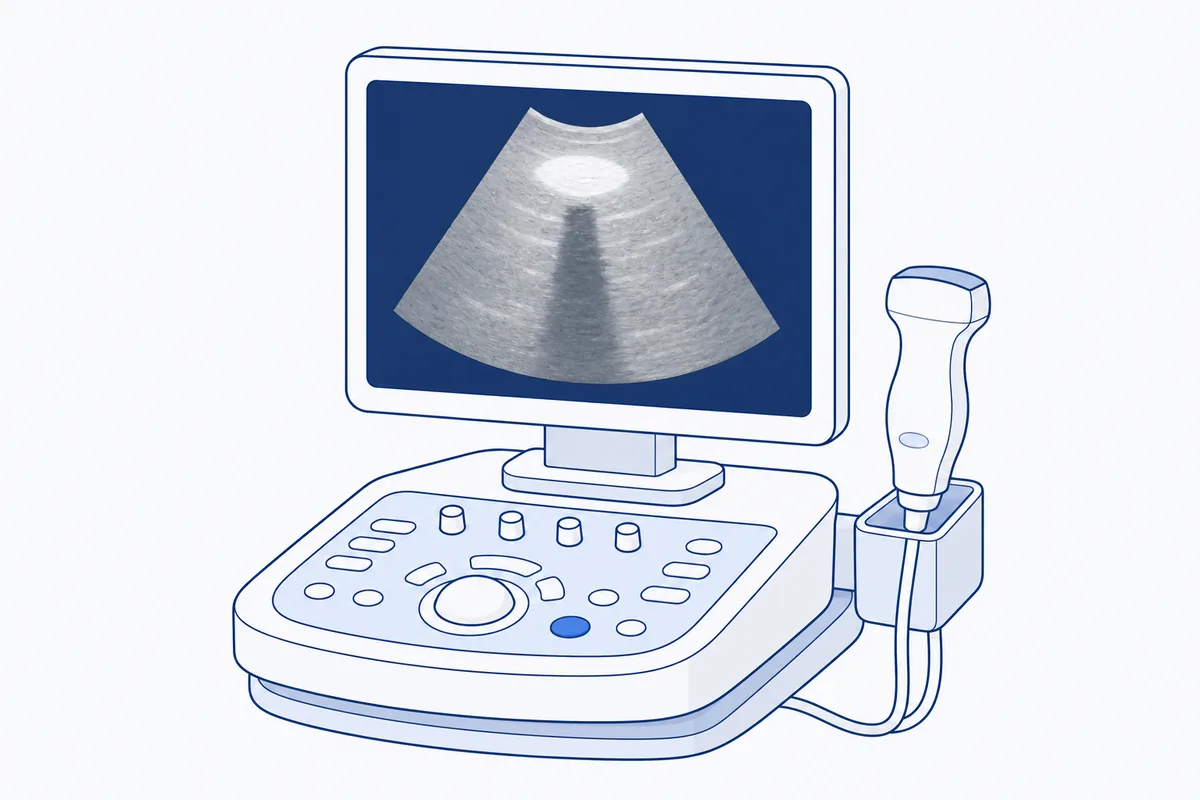
Reverberation, comet tail and ring-down, shadowing and enhancement, mirror image, refraction, speed error, side and grating lobes, slice thickness, range ambiguity, and the Doppler artifacts: mirroring, blooming, flash and twinkling.
Ready for the full exam?
110 questions in 2 hours, drawn in the outline’s share for each domain, with a score for every domain and an explanation for every answer.
Or start with a free drillThe SPI exam at a glance
Answer SPI practice questions written to the ARDMS SPI Content Outline, read the explanation for every answer, then take a timed 110-question, 2-hour practice exam in the published format with a score for every domain.
The SPI (Sonography Principles and Instrumentation) is the ultrasound physics exam that every ARDMS credential requires, alongside a specialty exam such as abdomen, OB/GYN, adult echocardiography or vascular technology. ARDMS is part of Inteleos, which runs the exam at Pearson test centers. The outline in force is version 24.1, built from the 2022 practice analysis; Inteleos has not announced a newer one (checked November 2026).
- Exam
- Sonography Principles and Instrumentation (SPI), the ultrasound physics exam of ARDMS (part of Inteleos). Passing the SPI is required for every ARDMS credential: RDMS, RDCS, RVT and RMSKS
- Format
- About 110 multiple-choice questions, plus a five-minute survey at the end
- Time
- 2 hours
- Content
- Five domains (Content Outline version 24.1, from the 2022 practice analysis): Perform Ultrasound Examinations 23%, Manage Ultrasound Transducers 7%, Optimize Sonographic Images 26%, Apply Doppler Concepts 34%, Provide Clinical Safety & Quality Assurance 10%
- Passing score
- Pass or fail, reported on a 300 to 700 scale. 555 or better passes. The scaled score is not a percentage of questions answered correctly and is not curved; the standard is set by expert panels (Modified Angoff and Bookmark methods)
- Fee
- $275, which includes a $100 nonrefundable processing fee. Test centers outside the U.S., Canada and Mexico add a $50 fee
- Where
- Pearson test centers, year-round. After approval you schedule within your 90-day eligibility window; you can reschedule up to 96 hours before your appointment
- Results
- At the test center when you finish, then in your Pearson account and Inteleos portal one week later
- Retakes
- You can reapply 72 hours after a failed attempt, with a new application and fee, but you must wait 60 days from your last exam date to sit again. Inteleos publishes no limit on the number of attempts
- Eligibility
- Several prerequisite pathways. The SPI early-entry pathway needs a graded college physics course (grade C or above) or 12 ARDMS-accepted physics CME credits from the last two years, and lets students test before graduating. You must pass the SPI and a specialty exam within five years of each other
Where the SPI fits in becoming a registered sonographer
- Meet a prerequisite pathway. Students can apply early with a graded college physics course (grade C or above) or 12 ARDMS-accepted physics CME credits.
- Apply through the Inteleos portal and pay the $275 exam fee.
- Schedule with Pearson within your 90-day eligibility window and take the exam; you see your result at the test center.
- Pass a specialty exam within five years of the SPI, in either order, to earn the RDMS, RDCS, RVT or RMSKS credential.
How to use this SPI exam prep
- Take the free mixed drill to see where you stand across all five domains.
- Drill Doppler first: Apply Doppler Concepts is 34% of the exam, a third of your score.
- Then drill image optimization (26%) and ultrasound examinations (23%), and take the artifacts drill until you can name each artifact from its cause and appearance.
- Clear the smaller domains: safety and QA (10%) and transducers (7%).
- Take the full 110-question practice exam under the 2-hour clock, then drill your two lowest domains and take it again. Each new sitting draws questions you have not seen first. The real exam passes at a scaled 555, which is not a percentage, so our results show your score by domain instead of a pass line.
Common questions
How many questions are on the SPI exam?
About 110 multiple-choice questions in two hours, followed by a five-minute survey. Inteleos does not say how many of them are unscored, so our mock scores all 110.
What score do you need to pass the SPI?
A scaled score of 555 or better on a scale of 300 to 700. Inteleos states that the scaled score is not a percentage of questions answered correctly and that the exam is not curved, so there is no published percentage to aim for. Our results show your percentage correct and your score in each domain, with no pass line.
How much does the SPI exam cost?
$275, including a $100 nonrefundable processing fee. If you test at a center outside the U.S., Canada or Mexico, add $50.
How soon can I retake the SPI?
You can submit a new application and fee 72 hours after a failed attempt, but your new eligibility starts 60 days after your last exam date, and Inteleos does not waive the 60-day wait.
Which domain is the biggest on the SPI?
Apply Doppler Concepts, at 34% of the exam, about 37 of 110 questions. Optimize Sonographic Images is 26% and Perform Ultrasound Examinations is 23%; together the three are 83% of the exam.
Can I take the SPI before I graduate?
Yes, through the SPI early-entry pathway: you need a graded college physics course (title including physics, physical principles or instrumentation, grade C or above) or 12 ARDMS-accepted physics CME credits earned in the last two years. You then have five years to pass a specialty exam.
Does ARDMS have an official SPI practice test?
Yes. Inteleos sells a 30-question, 30-minute practice test for $50 in two equivalent versions (SPIa and SPIb). Its emailed report shows how many questions you got right, not which ones. Our questions are original practice written to the SPI content outline; they are not Inteleos questions, and the full mock and drills explain every answer.
Is this SPI practice exam the same format as the real exam?
It matches the published format: 110 four-option multiple-choice questions in two hours, drawn in the outline’s share for each domain, with skip, back and mark for review. Inteleos does not publish the number of answer choices; our items use four. The result shows your score in every domain and an explanation for every question.
What is the SPI pass rate?
Inteleos reports a 72% pass rate for first-time takers and 65% overall in 2023, and 70% and 63% in 2022.
Ready for test day?
110 questions in 2 hours, drawn in the outline’s share for each domain, with a score for every domain and an explanation for every answer.
Or start with a free drillSources
- Inteleos: Sonography Principles and Instrumentation (SPI) exam page (format, scoring, fee, retakes, pass rates)
- Inteleos: SPI Content Outline, version 24.1
- Inteleos: exam fee schedule
- Inteleos: passing standard
- Inteleos: re-applicant resources (60-day wait)
- Inteleos: schedule an exam (Pearson, 90-day window)
- Inteleos: SPI and specialty exam prerequisites
- Inteleos: practice tests
Original practice questions for exam preparation, written to the ARDMS SPI Content Outline (version 24.1). They are not questions from the SPI exam or from Inteleos. Independent practice, not affiliated with or endorsed by ARDMS, APCA, Inteleos or Pearson. ARDMS and SPI are marks of their owners.