Source Water and Wells Practice Questions
Source water is 25 of the 100 questions on the California T1 and T2 exams and 15 on WPI’s Class I and II water treatment exams. Practice wells, aquifers and reservoirs.
100 questions in the official content counts, with a score for every area and an explanation for every option.
Or try the free source water drill- 34 original source water questions, every option explained
- Tested on 16 of our 25 practice exams
Which raw water characteristic is usually the first warning of a storm runoff event at a river intake?
What our source water questions cover
- The hydrologic cycle, confined and unconfined aquifers and artesian wells
- Well parts: casing, grout seal, screen, vent and sanitary cap, and abandoned wells
- Static and pumping levels, drawdown, specific capacity and falling well yield
- Reservoirs: stratification, fall turnover, algae and multiple-level intakes
- Contamination sources, groundwater under the influence of surface water and wellhead security
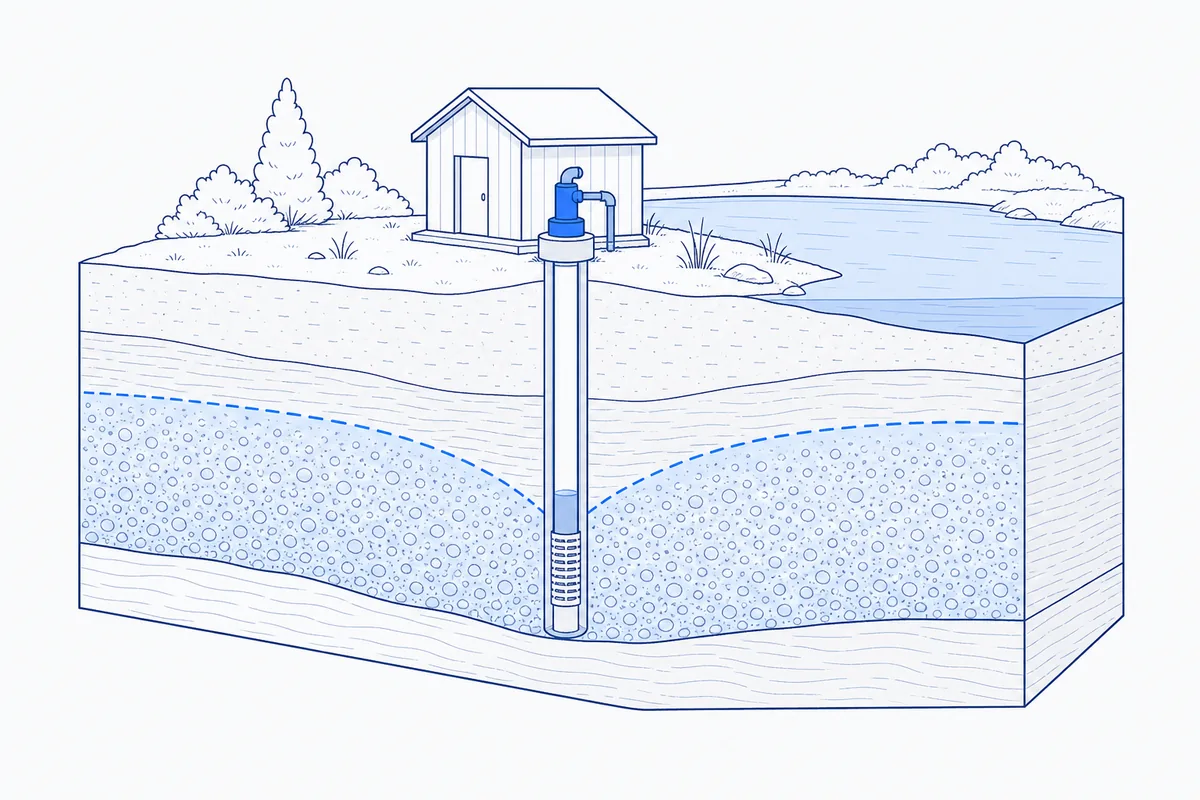
This list is our own summary, written for practice. The exam owners publish their outlines: California’s Expected Range of Knowledge, TCEQ’s Need-to-Know Criteria and WPI’s Need-to-Know Criteria.
Drill source water, then sit a full practice exam
100 questions in the official content counts, with a score for every area and an explanation for every option.
Or try the free source water drillIdeas the questions test most
- Drawdown = pumping level − static level; specific capacity = gpm ÷ drawdown.
- A confined aquifer sits between low-permeability layers and is under pressure.
- The hypolimnion goes low in oxygen in summer and releases iron, manganese and odors.
- Fall turnover mixes bottom water up to the intake.
Start the free source water drill · California T2 practice test · California T1 practice test · California T3 practice test · California T4 practice test · California D1 practice test · California D2 practice test
Common questions
How much of the California water treatment exam is source water?
The State Water Board’s Expected Range of Knowledge lists 25 Source Water questions on T1 and T2, 20 on T3 and 15 on T4, out of 100.
What does a falling specific capacity mean?
The well needs more drawdown for the same yield, often because the screen is clogging with mineral scale or bacterial growth. Rehabilitation can restore it.
100 questions in the official content counts, with a score for every area and an explanation for every option.
Or try the free source water drillMore operator topics
- Coagulation, Sedimentation and Filtration
- Water Disinfection and Chlorination
- Corrosion, Iron, Manganese and Fluoride
- Water Lab and Sampling
- Water Mains, Valves and Hydrants
- Distribution Hydraulics and Storage
- Cross-Connection and Backflow
- Drinking Water Regulations
- Water Math
- Pumps, Motors and Equipment
- Operator Safety
- Management, Records and Customer Service
Outlines used for these questions: Expected Range of Knowledge, Drinking Water Treatment Exam (rev. 4/2020, PDF) · Expected Range of Knowledge, Drinking Water Distribution Exam (rev. 4/2020, PDF) · TCEQ: Need-to-Know Criteria for public water system operators · TCEQ: What applicants for wastewater licenses need to know · WPI: 2025 Need-to-Know Criteria.
Game Assessment Prep is an independent practice site, not affiliated with or endorsed by Water Professionals International (WPI, formerly ABC), the California State Water Resources Control Board or the Texas Commission on Environmental Quality. Every question is original; none is taken from a certification exam, an official study guide or another prep provider.