Activated Sludge Practice Questions
Treatment process evaluation and adjustment is 38 to 40 questions on WPI’s Wastewater Treatment Class I and II exams, and activated sludge is the process most plants run.
100 questions in the official content counts, with a score for every area and an explanation for every option.
Or try the free activated sludge drill- 49 original activated sludge questions, every option explained
- Tested on 7 of our 25 practice exams
What is MLSS?
What our activated sludge questions cover
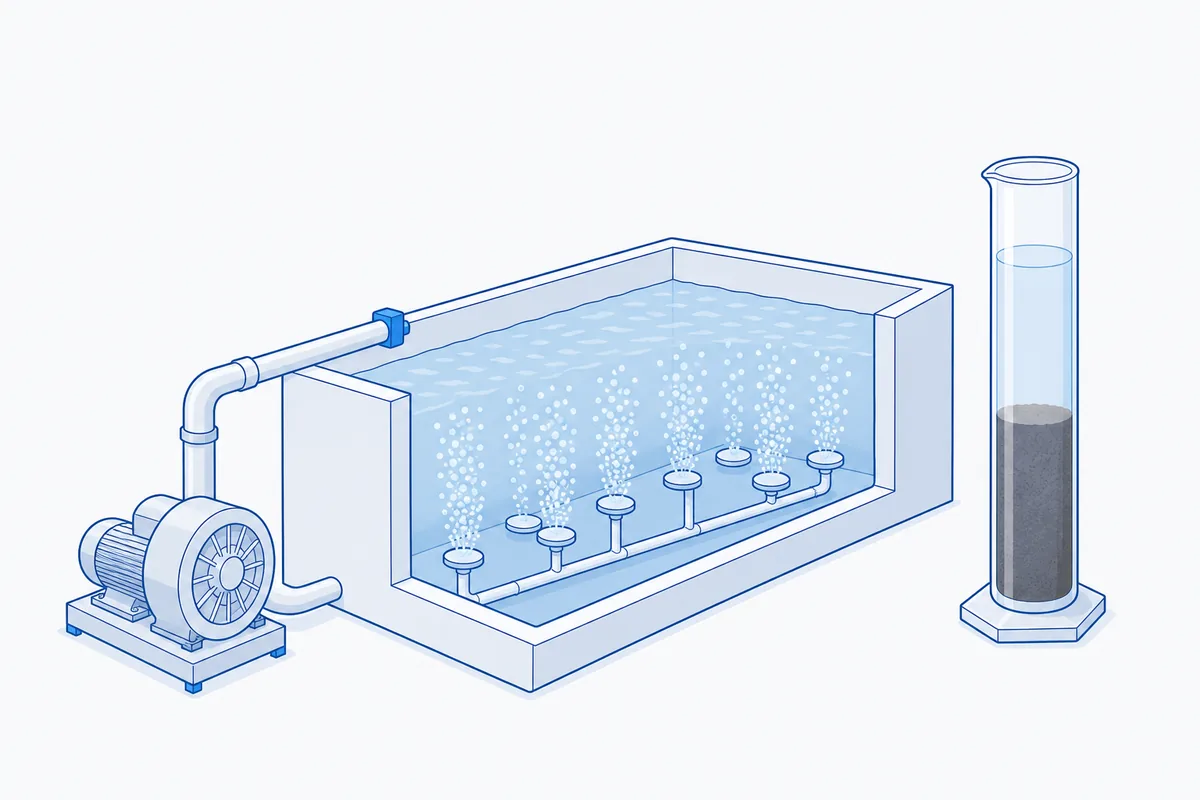
- Aeration, DO, diffusers and mixed liquor
- Return and waste activated sludge, MLSS and sludge blanket
- Settleometers, SVI, F/M and MCRT
- Bulking, rising sludge, pin floc, foams and toxic loads
- Extended aeration, oxidation ditches, SBRs, nitrification and nutrient removal
This list is our own summary, written for practice. The exam owners publish their outlines: California’s Expected Range of Knowledge, TCEQ’s Need-to-Know Criteria and WPI’s Need-to-Know Criteria.
Drill activated sludge, then sit a full practice exam
100 questions in the official content counts, with a score for every area and an explanation for every option.
Or try the free activated sludge drillIdeas the questions test most
- Wasting controls sludge age.
- Brown, greasy foam: old sludge; white, billowy foam: young sludge.
- Gas-bubble clumps in the clarifier: denitrification.
- Nitrification uses about 7.1 mg/L alkalinity per mg/L ammonia-N.
Start the free activated sludge drill · Wastewater Treatment Class I practice test · California Wastewater Grade I practice test · California Wastewater Grade II practice test · TCEQ Class D Wastewater practice test · TCEQ Class C Wastewater practice test · TCEQ Collection Class I practice test
Common questions
What is a typical aeration DO?
Many plants hold about 1 to 3 mg/L. Low DO encourages filamentous bulking and odors; nitrification needs adequate DO.
How is SVI calculated?
SVI = settled volume after 30 minutes (mL/L) × 1,000 ÷ MLSS (mg/L). About 50 to 150 is typical; high values mean poor settling.
100 questions in the official content counts, with a score for every area and an explanation for every option.
Or try the free activated sludge drillMore operator topics
Outlines used for these questions: Expected Range of Knowledge, Drinking Water Treatment Exam (rev. 4/2020, PDF) · Expected Range of Knowledge, Drinking Water Distribution Exam (rev. 4/2020, PDF) · TCEQ: Need-to-Know Criteria for public water system operators · TCEQ: What applicants for wastewater licenses need to know · WPI: 2025 Need-to-Know Criteria.
Game Assessment Prep is an independent practice site, not affiliated with or endorsed by Water Professionals International (WPI, formerly ABC), the California State Water Resources Control Board or the Texas Commission on Environmental Quality. Every question is original; none is taken from a certification exam, an official study guide or another prep provider.