Sustainable Futures Lab simulation
Two timed simulations cover both Sustainable Futures Lab formats: Project Lead for the 20-minute ranking-and-decisions run, and Team Lab for the 30-minute three-day team simulation.
What the Sustainable Futures Lab is
Sustainable Futures Lab is the newest Solve module and appears on longer invitations. An 85-minute invitation adds a 20-minute version; a 95-minute invitation adds a redesigned 30-minute version.
In the 20-minute version you lead an environmental project: rank four candidate first actions, then make twelve single-choice decisions, each followed by a screen that shows what happened. In the 30-minute version you lead a four-person research team across four workstations for three simulated days, and each day you explore, assign, support and reflect. Prep sources agree on both structures. No source publishes McKinsey’s scoring for either, so the scoring in our review is ours and is explained item by item.
How our simulation runs
Project Lead (20 minutes)
- An untimed briefing works through a decision from a sample project.
- Two briefing screens introduce the project, the team and the deadline.
- Step 1: drag four candidate first actions into priority order.
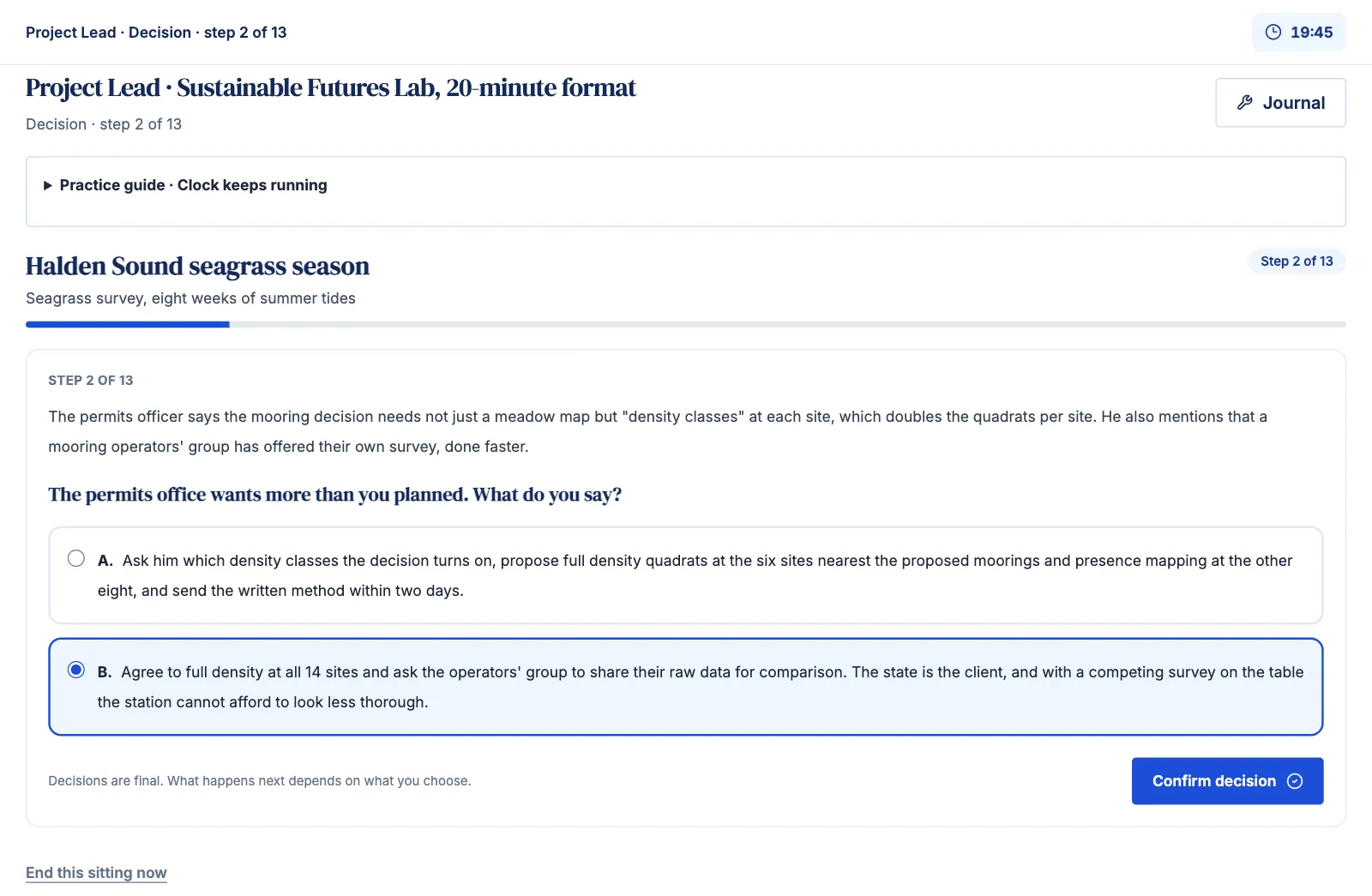
- Steps 2–13: twelve decisions in one storyline. Options grow from two to four, every choice is followed by a consequence screen, and later steps refer back to earlier choices.
- Review: your ranking against the key, the rationale for every option, and how many of your picks overreacted or did too little.
Team Lab (30 minutes)
- An untimed briefing, then one 30-minute clock that never pauses across the three days.
- Explore: ask up to three preset questions a day of a researcher or a workstation. Answers go into that day’s notes.
- Assign: place four researchers across four workstations, up to two per station, each with one of four preset reasons.
- Support: answer two requests a day, one at a time, choosing from two to four responses with no feedback.
- Reflect: rate each researcher’s state at the end of the day. Days 2 and 3 react to your earlier choices.
- Review: each researcher’s hidden strengths and preferences, the recommended placements, and the reasoning behind every check.
Start the simulation
Each card shows your account’s access. Project Lead is the third module of the 85-minute full sitting; Team Lab is the third module of the 95-minute full sitting.
Every mode, including the full sittings and the untimed warm-up drills, is on the McKinsey Solve practice page.
Project Lead and Team Lab walkthrough
Sustainable Futures Lab questions
What is the Sustainable Futures Lab in McKinsey Solve?
It is a judgment module about leading an environmental project. The 20-minute version is a ranking of four first actions followed by twelve decisions with consequence screens. The 30-minute version has you lead a four-person research team through three simulated days of exploring, assigning, supporting and reflecting.
How long is the Sustainable Futures Lab?
Candidates report 20 minutes on 85-minute invitations and 30 minutes on 95-minute invitations, each after an untimed tutorial. Project Lead runs on a 20-minute clock, and Team Lab on a 30-minute clock that never pauses between days.
What is free?
Project Lead and Team Lab each have one free attempt with an account, and the walkthroughs on this page need no account. A McKinsey Solve pass covers replays of every module simulation and the 65-, 85- and 95-minute full sittings, and saved reviews stay free.
What does the review show?
For Project Lead: your ranking against the key, the option you chose at every step beside the strongest one, and the rationale for every option. For Team Lab: each researcher’s hidden profile, the recommended placement for each day, the best response to each request, and the mood our rule implies for each researcher. McKinsey publishes no scoring formula; ours is explained beside every item.
Game Assessment Prep is independent and is not affiliated with or endorsed by McKinsey & Company. Solve, Sustainable Futures Lab and McKinsey’s other module names are referenced to explain the format; our content and scoring are original. No actual assessment questions or proprietary interface assets are reproduced.