Redrock Study simulation
Island Study is our timed simulation of the Redrock Study format. Investigate an island research program, save the data points that matter to a journal, calculate, complete the report and work six mini-cases on one 35-minute clock.
What the Redrock Study is
The Redrock Study, set on Red Rock Island, is one of the two modules on the default 65-minute Solve invitation. You work as a field researcher: read an objective, a one-page background and a few exhibits, save the data points you need to a research journal, answer calculation questions with a built-in calculator, complete a short report with a chart, and then answer six independent mini-cases.
Candidates and prep sources agree on that structure and on one 35-minute clock across the study and the cases. Reports differ on whether the materials stay visible during Analysis. In our version they stay readable, and only the data points you saved can be dragged into the calculator and the answers.
How our simulation runs
- An untimed briefing explains the four phases and the scoring, with a worked density example.
- Investigation (pacing guide 5–8 minutes): read the objective, the background and two or three exhibits. Click or drag highlighted data points into your research journal, then rename, flag and reorder them. There is no calculator in this phase.
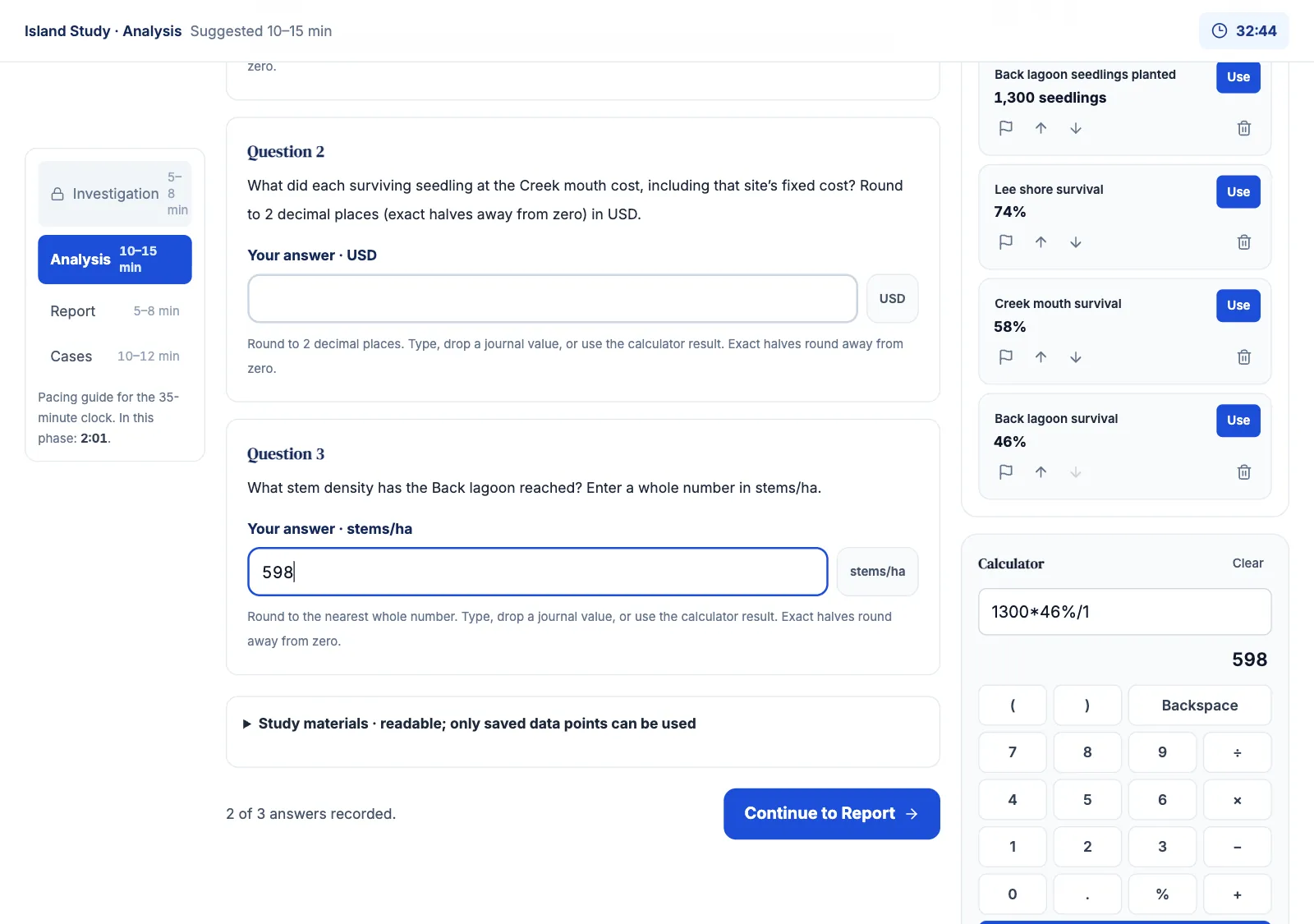
- Analysis (10–15 minutes): three questions on one screen. The calculator unlocks and logs every result at full precision; drop journal values into it and send results into the answer fields.
- Report (5–8 minutes): fill four memo blanks and a word choice or two, pick the chart type that matches the stated message, and enter the chart values with a live preview.
- Cases (10–12 minutes): six mini-cases, each with its own exhibit and one question, unlocked in order. Each phase locks when you continue to the next.
- Review: every answer beside the correct one with its steps, your memo and chart against the intended ones, and how you worked: data points saved, calculator use, revisions and minutes per phase.
Start the simulation
Each card shows your account’s access. Island Study also opens every full sitting: 65, 85 and 95 minutes.
Every mode, including the full sittings and the untimed warm-up drills, is on the McKinsey Solve practice page.
Island Study walkthrough
Redrock Study questions
What is the Redrock Study in McKinsey Solve?
It is a data-investigation module set on Red Rock Island and one of the two modules on the default 65-minute invitation. You collect data points in a research journal, answer calculation questions with a built-in calculator, complete a report with a chart, and then answer six short cases.
How long is the Redrock Study?
Candidates report 35 minutes on one clock across the study and the cases, after an untimed tutorial. Island Study runs on the same 35-minute clock, with a pacing guide of 5–8 minutes for Investigation, 10–15 for Analysis, 5–8 for the Report and 10–12 for the six cases. Your invitation states your total time.
What is free?
Your first Island Study attempt is free with an account, and the walkthrough on this page needs no account. A McKinsey Solve pass covers replays of every module simulation and the 65-, 85- and 95-minute full sittings, and saved reviews stay free.
What does the review show?
Every analysis answer, memo blank, chart and case beside the correct answer, with the calculation steps and an explanation. It also shows how you worked: which required data points you saved before Analysis, which answers came from the calculator, how often you revised, and your minutes per phase against the pacing guide. McKinsey publishes no scoring formula; ours is explained beside every item.
Game Assessment Prep is independent and is not affiliated with or endorsed by McKinsey & Company. Solve, Redrock Study and McKinsey’s other module names are referenced to explain the format; our content and scoring are original. No actual assessment questions or proprietary interface assets are reproduced.