NCCER Hand Tools Practice Questions
NCCER Core module 00103 · 13 of the 89 Core Level Test items
89 questions across the eight required Core modules in 3 hours, with a score for Hand Tools so you know where you stand.
Free Hand Tools drillWhy must chisels, punches and wedges be kept free of mushroomed heads?
Introduction to Hand Tools in NCCER Core
Introduction to Hand Tools, module 00103, is 13 of the 89 items on the NCCER Core Level Test. Questions show a task and ask which tool fits it, or ask what makes a tool unsafe to use.
- Core Level Test
- 13 of the 89 items (NCCER specification, 6th edition)
- Instruction time
- 12.5 hours in the 6th edition
- Our drill
- 10 questions from 42 Hand Tools questions, untimed, an explanation after every answer; one free attempt, unlimited with a pass
Study notes
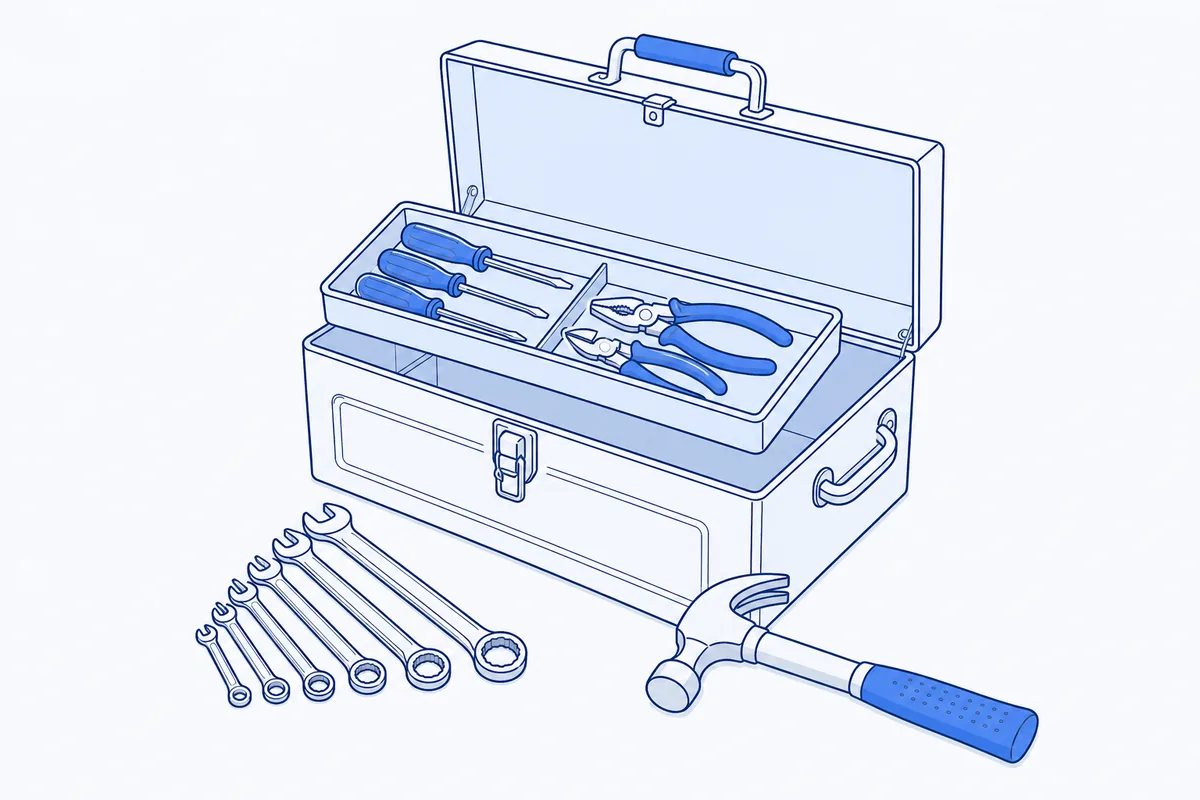
- Hammers: claw hammers drive and pull nails; ball-peen hammers strike punches and cold chisels and shape metal. Strike squarely with the face.
- OSHA rules for hand tools: wooden handles free of splinters or cracks and tight; impact tools free of mushroomed heads; wrenches with sprung jaws out of service.
- Screwdriver tips: slotted, Phillips (cross), Torx (six-point star), square (Robertson) and hex. A screwdriver is not a pry bar.
- Wrenches: combination (open end and box end the same size), adjustable (force on the fixed jaw), pipe (teeth grip round stock), torque (tightens to a specification). Six-point sockets grip the flats.
- Pliers: needle-nose for small parts, lineman’s for cutting and twisting wire, locking pliers to clamp, tongue-and-groove for larger round work.
- Levels and squares: the bubble centered means level; plumb means vertical. A framing square body is 24 × 2 inches; a combination square marks 90 and 45 degrees; a speed square lays out rafters.
- Saws and edge tools: crosscut across the grain, rip along it, coping saw for curves; hacksaw teeth point away from the handle and cut on the push stroke.
Take the full practice test under the clock
89 questions across the eight required Core modules in 3 hours, with a score for Hand Tools so you know where you stand.
Free Hand Tools drillWhat hand tools questions test
- Matching a tool to a task
- Safe use and the defects that take a tool out of service
- Tool names and the parts of common tools
How to study it
- Learn tools in families (striking, turning, gripping, measuring and layout, cutting) and one job each is best at.
- For safety questions, look for the defect: cracked handle, mushroomed head, sprung jaws, dull blade.
- Take the hand tools drill until you score 80% or better.
Common questions
How many hand tools questions are on the NCCER Core Level Test?
13 of the 89 items, about 15% of the test.
Which way do hacksaw teeth point?
Away from the handle, because a hacksaw cuts on the push stroke.
89 questions across the eight required Core modules in 3 hours, with a score for Hand Tools so you know where you stand.
Free Hand Tools drillThe other NCCER Core modules
- Basic Safety (Construction Site Safety Orientation)
- Introduction to Construction Math
- Introduction to Power Tools
- Introduction to Construction Drawings
- Introduction to Basic Rigging
- Basic Communication Skills
- Basic Employability Skills
- Introduction to Materials Handling
- NCCER Core practice test (89 questions, 3 hours)
- Mixed drill: all nine modules
Sources
- NCCER: Core Level Test specifications, 6th edition, updated March 2024 (89 items, 3 hours, closed book, passing score 70, items per module)
- NCCER: Core: Introduction to Basic Construction Skills, 6th edition (modules and electives)
- NCCER: News brief, Core Level Test now available (online only, no section retakes, fee per attempt)
- NCCER: 2024 catalog (module hours and prices)
- NCCER: Accreditation process (in-person test administration and remote proctoring)
- NCCER: Accreditation standards and test specifications
- NCCER: 2025 Annual Report (credentials earned in 2025)
Original practice questions written to the module list NCCER publishes for its Core Level Test (6th edition); they are not NCCER test questions and contain no NCCER curriculum text. Independent practice, not affiliated with or endorsed by NCCER (the National Center for Construction Education and Research). NCCER is a trademark of the National Center for Construction Education and Research.