NCCER Basic Rigging Practice Questions
NCCER Core module 00106 · Elective module, not on the Core Level Test
89 questions in 3 hours across the eight required Core modules, with a score for every module.
Free Basic Rigging drillWhich type of chain is used to make chain slings for overhead lifting?
Introduction to Basic Rigging in NCCER Core
Introduction to Basic Rigging, module 00106, is an elective in NCCER Core (7.5 hours). It is not on the Core Level Test, so programs that teach it give its own module test. Many crafts require it later. Questions cover rigging gear, hitches, inspection, the emergency stop signal and staying clear of loads.
- Core Level Test
- Not included; elective modules have their own module test
- Instruction time
- 7.5 hours in the 6th edition
- Our drill
- 10 questions from 30 Basic Rigging questions, untimed, an explanation after every answer; one free attempt, unlimited with a pass
Study notes
- Rigging gear is inspected before use on each shift. Remove web slings with cuts, burns, melting or broken stitching, and wire rope with kinks, crushing, birdcaging or too many broken wires.
- Every sling needs a readable tag with its rated load. Never load gear beyond its rating for the hitch used.
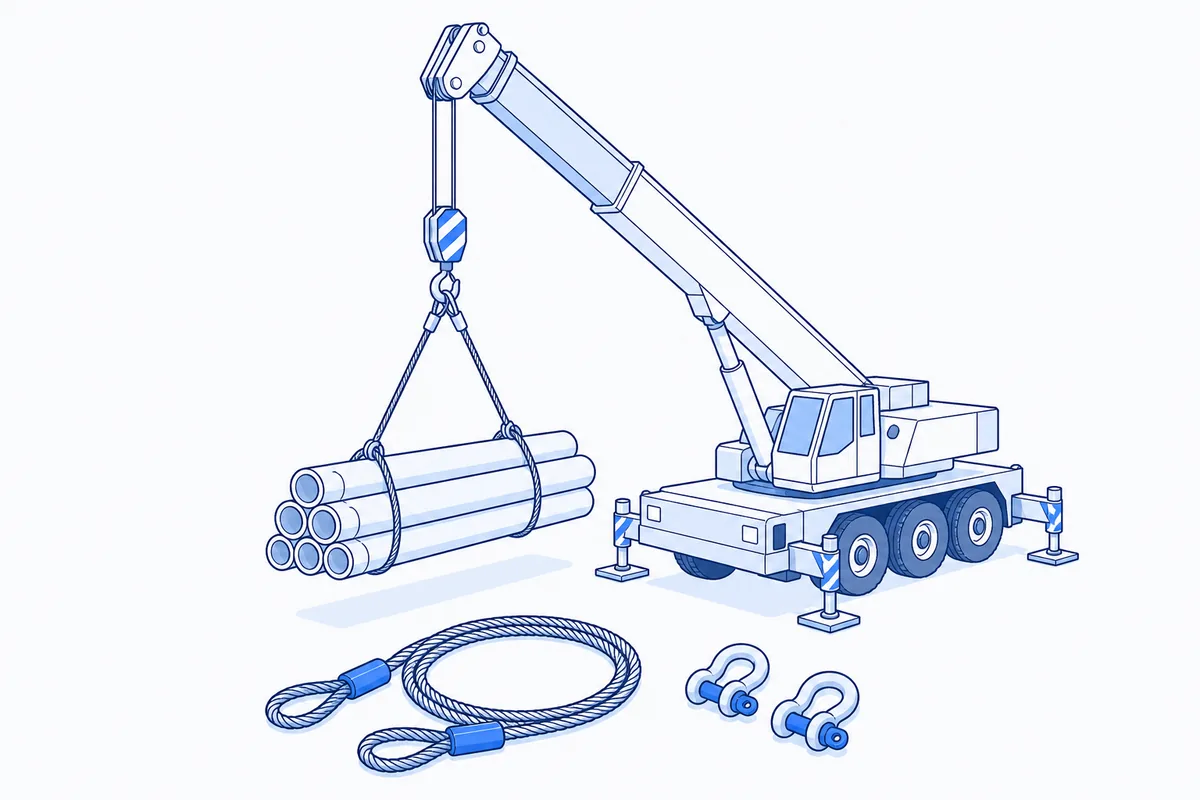
- Hitches: vertical (one leg straight to the load), choker (cinches around the load, lower rating than vertical) and basket (cradles the load; with vertical legs, twice the vertical rating).
- Sling angles: the flatter the legs, the more tension each leg carries. At 30 degrees from horizontal, each leg of a two-leg bridle carries the full load weight. ASME B30.9 bars angles under 30 degrees unless approved.
- Hooks carry the load in the bowl with the latch closed. Shackle pins are fully engaged. Plain eyebolts take straight pulls only.
- The emergency stop signal is both arms out, palms down, swung back and forth. One person signals the operator, but anyone may give a stop or emergency stop.
- Use tag lines to control swing without wrapping them on your body, put the hook over the center of gravity and never stand under a suspended load.
Take the full practice test under the clock
89 questions in 3 hours across the eight required Core modules, with a score for every module.
Free Basic Rigging drillWhat basic rigging questions test
- Naming and choosing slings, hitches and hardware
- Inspection and removal criteria
- Sling angle effects and rated loads
- Hand signals and safe behavior around lifts
How to study it
- Draw the three hitches and label which one chokes, which one cradles and which one pulls straight.
- Remember the sling-angle rule as "flatter means more tension".
- Take the basic rigging drill until you score 80% or better. It does not count toward the 89-question practice test.
Common questions
Is Basic Rigging on the NCCER Core Level Test?
No. It is an elective module (00106), and the Core Level Test covers the eight required modules. Programs that teach it use its module test.
What is the emergency stop hand signal?
Both arms extended, palms down, moved back and forth horizontally. Anyone who sees a safety problem may give it, and the operator must obey it.
89 questions in 3 hours across the eight required Core modules, with a score for every module.
Free Basic Rigging drillThe other NCCER Core modules
- Basic Safety (Construction Site Safety Orientation)
- Introduction to Construction Math
- Introduction to Hand Tools
- Introduction to Power Tools
- Introduction to Construction Drawings
- Basic Communication Skills
- Basic Employability Skills
- Introduction to Materials Handling
- NCCER Core practice test (89 questions, 3 hours)
- Mixed drill: all nine modules
Sources
- NCCER: Core Level Test specifications, 6th edition, updated March 2024 (89 items, 3 hours, closed book, passing score 70, items per module)
- NCCER: Core: Introduction to Basic Construction Skills, 6th edition (modules and electives)
- NCCER: News brief, Core Level Test now available (online only, no section retakes, fee per attempt)
- NCCER: 2024 catalog (module hours and prices)
- NCCER: Accreditation process (in-person test administration and remote proctoring)
- NCCER: Accreditation standards and test specifications
- NCCER: 2025 Annual Report (credentials earned in 2025)
Original practice questions written to the module list NCCER publishes for its Core Level Test (6th edition); they are not NCCER test questions and contain no NCCER curriculum text. Independent practice, not affiliated with or endorsed by NCCER (the National Center for Construction Education and Research). NCCER is a trademark of the National Center for Construction Education and Research.