Free HHA Competency Test Practice (Federal Subjects)
All 13 federal subjects · format and passing score set by your program or agency
60 questions in 1 hour, drawn in the federal subject counts, with a score for each part and an explanation for every answer.
Or start with a free 10-question drill434 original questions for this exam · 13 federal subjects · a 60-question timed mock
A client takes a blood thinner. Which razor should be used to shave him?
The HHA Competency Test exam at a glance
There is no single national home health aide exam. The federal rule for Medicare home health agencies, 42 CFR 484.80, lists 13 subjects every aide must be evaluated on, and a registered nurse runs the evaluation. Five skills must be watched in person; the other eight can be tested in writing or orally, so most training programs and agencies give a written test of their own. Our practice covers all 13 subjects.
- Who needs it
- Anyone who gives home health aide services for a Medicare home health agency, unless she qualifies through a state nurse aide (CNA) program and is in good standing on the registry, or through a state licensure program that meets the same rules
- Training
- At least 75 hours of classroom and supervised practical training; at least 16 classroom hours come before 16 hours of supervised practical training
- What is tested
- All 13 subject areas in 42 CFR 484.80(b)(3). Communication, temperature, pulse and respiration, personal hygiene and grooming, transfers and ambulation, and range of motion and positioning must be observed with a patient or pseudo-patient. The other eight may be tested in writing, orally or by observation
- Who gives it
- A registered nurse, through any organization except an agency barred by the rule (for example one with recent serious deficiencies). States may add their own rules
- Questions, time and pass mark
- The federal rule sets none. Each program or agency writes its own written or oral test. Our mock is 60 questions in 60 minutes, covering all 13 subjects
- Passing the evaluation
- A task rated unsatisfactory may not be done without direct RN supervision until the aide is retrained and re-evaluated. Unsatisfactory in more than one required area means the evaluation is not passed
- After you qualify
- At least 12 hours of in-service training every 12 months. A 24-month gap without paid aide work means completing a program again
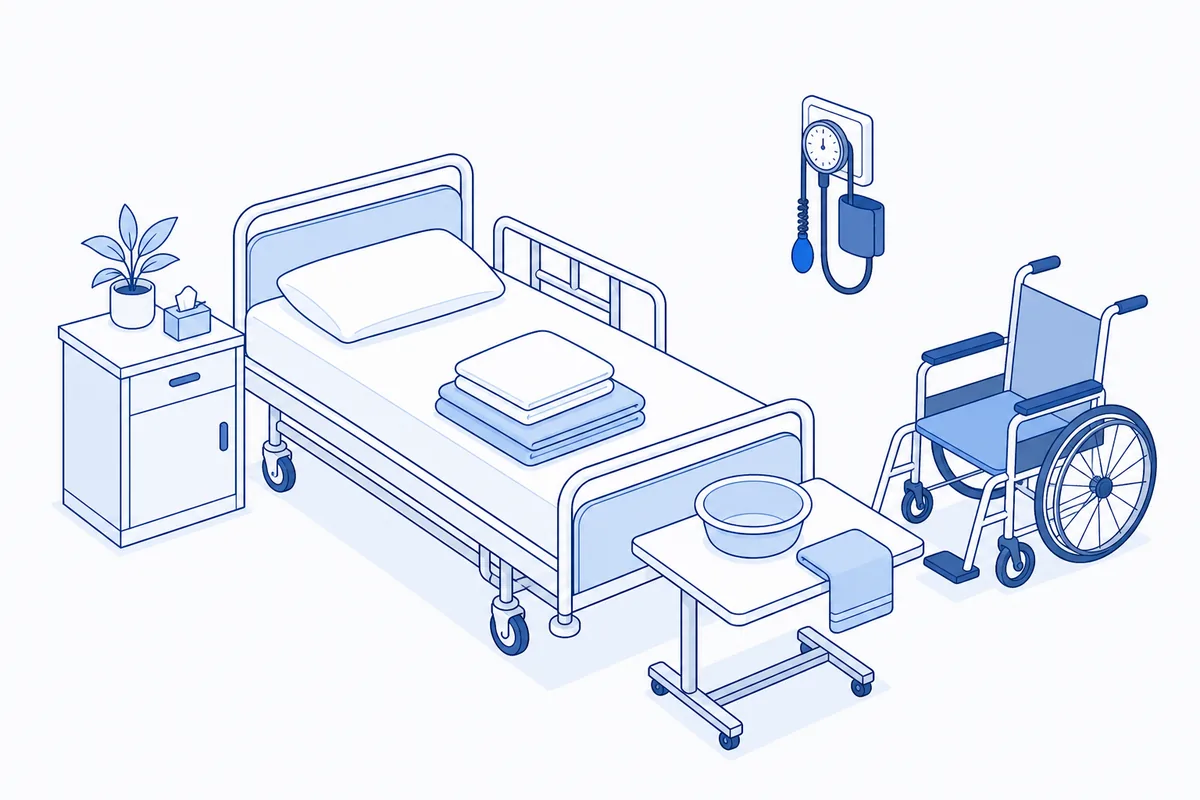
What the HHA Competency Test test covers
The federal rule lists 13 subjects but sets no question count; our 60-question mock spreads its questions across all of them as below. Each topic has a free ten-question drill.
(i) Communication skills · 4 questions
(ii) Observation, reporting and documentation · 6 questions
(iii) Temperature, pulse and respiration · 4 questions
(iv) Infection prevention and control · 6 questions
(v) Body functioning and changes to report · 5 questions
(vi) A clean, safe and healthy environment · 4 questions
(vii) Recognizing emergencies · 4 questions
(viii) Needs of the people served, privacy and property · 8 questions
(ix) Personal hygiene and grooming · 5 questions
(x) Safe transfers and ambulation · 4 questions
(xi) Range of motion and positioning · 3 questions
(xii) Nutrition and fluid intake · 4 questions
(xiii) Skin changes to report · 3 questions
How to study for the HHA Competency Test test
- Learn the 13 federal subjects. Every agency’s written test is built on them, whatever its length.
- Infection control, observation and reporting, and personal care come up most in written tests because they fill the most of the training.
- Know the limits of the role: report changes to the nurse, never change the care plan, and never give injections or take orders.
- Practice the five hands-on skills too (vital signs, personal care, transfers, range of motion, communication): they are tested by watching you.
- Take the 60-question mock, then drill your two lowest topics.
Sit the full exam under the real clock
60 questions in 1 hour, drawn in the federal subject counts, with a score for each part and an explanation for every answer.
Or start with a free 10-question drillCommon questions
Is there a national home health aide test?
No. 42 CFR 484.80 sets the training (75 hours) and the 13 subjects a competency evaluation must cover, but each training program or agency gives its own evaluation. NCCT offers a voluntary national certification, the CHHA, and a few places, such as the District of Columbia, run their own written exam.
How many questions are on the HHA competency test?
The federal rule does not set a number, a time limit or a passing score. The program or agency that gives your evaluation decides. Our mock has 60 questions in 60 minutes across all 13 federal subjects.
What is on the home health aide competency exam?
The 13 subjects in 42 CFR 484.80(b)(3): communication; observation, reporting and documentation; temperature, pulse and respiration; infection control; body functions and changes to report; a clean, safe home; emergencies; the needs of the people served; personal hygiene and grooming; transfers and walking; range of motion and positioning; nutrition and fluids; and skin changes.
Which parts are skills tests?
Communication, temperature, pulse and respiration, personal hygiene and grooming, safe transfers and ambulation, and range of motion and positioning must be evaluated by watching you work with a patient or a pseudo-patient. The rest may be tested in writing, orally or by observation.
What happens if I am rated unsatisfactory?
You may not do that task without direct RN supervision until you are retrained and pass it again. An unsatisfactory rating in more than one required area means you have not passed the evaluation.
60 questions in 1 hour, drawn in the federal subject counts, with a score for each part and an explanation for every answer.
Or start with a free 10-question drillOther home health aide tests
Sources
Original practice questions written to 42 CFR 484.80, the NCCT CHHA Detailed Test Plan, the DC HHA content outline and the Washington HCA candidate bulletin; they are not exam questions. Independent practice, not affiliated with or endorsed by CMS, NCCT, Credentia, Prometric, the DC Board of Nursing, the Washington State Department of Health or any state agency. Follow your agency’s policies, your state’s rules and the supervising nurse in practice.