Ship Handling, Meteorology and Security Practice Questions for the MCA Orals
OOW Part A: 1 of the 15 questions, 50% to pass this topic
The real MCA oral is a spoken interview with an examiner; these questions are knowledge practice for it, each with a model answer.
60 test points across every Part A topic in 40 minutes, scored against the MCA’s minimum for each topic.
Free Ship Handling, Meteorology and Security drillA ship is proceeding close to the starboard bank of a narrow channel. What is the "bank effect"?
Other (Ship Handling, Meteorology, Safety and Security) in the MCA orals
MIN 690 groups ship handling, meteorology, safety and security as the "other" topic on OOW Part A, with a 50% minimum. In the oral these come up as practical scenarios: anchoring in a crowded roadstead, a squat question in a channel or a storm approaching.
- On Part A
- 4 of the 60 test points (1 of 15 questions); you need 50%, 2 of 4
- In the oral
- The examiner can ask about any part of the syllabus, in scenarios. Say your answer out loud before you check it.
- Our drill
- 10 questions from 30 Ship Handling, Meteorology and Security questions, untimed, a model answer after every one; one free attempt, unlimited with a pass
Study notes
- Squat is the increase in draught (and change of trim) when a ship moves through shallow water; it grows roughly with the square of speed and is greater in a confined channel. Reduce speed to reduce squat.
- Interaction: ships passing close attract and repel each other and are pushed by bank effect in narrow channels (the stern is drawn to the near bank, the bow pushed away). Slow down early.
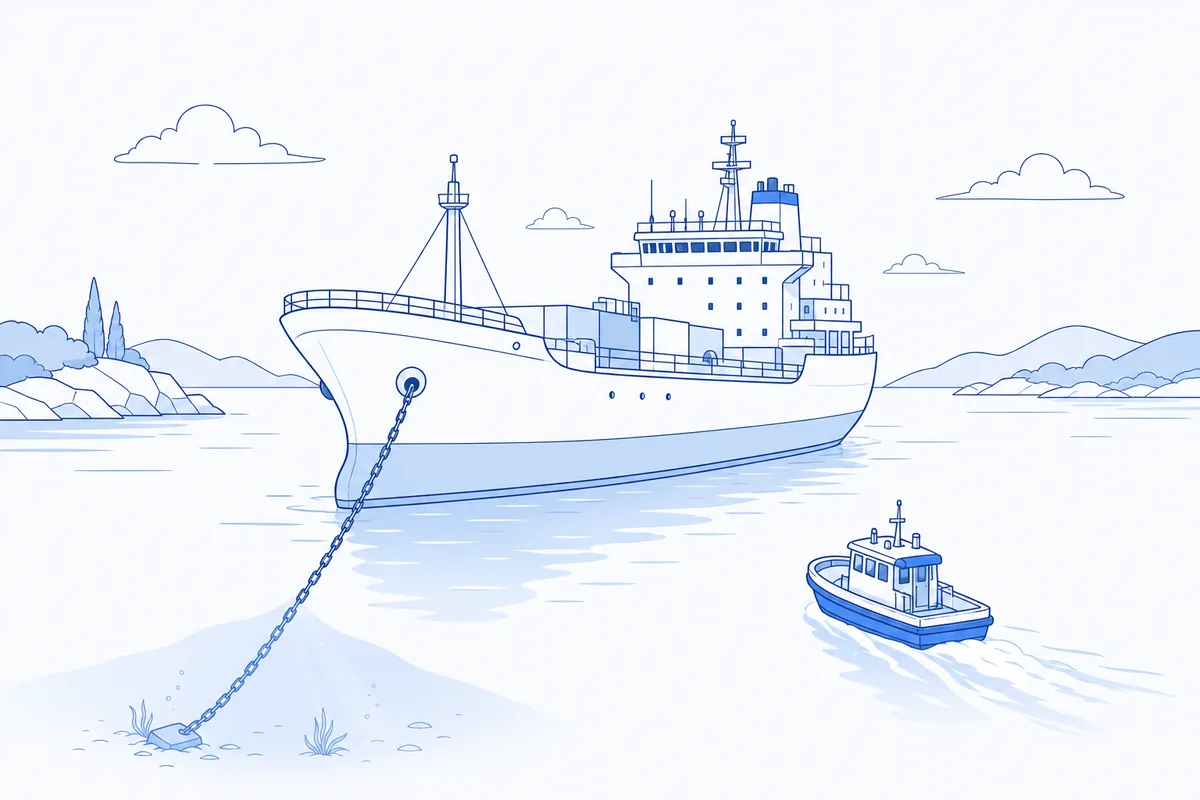
- Anchoring: approach into the wind or tide, stem the stronger of the two, and pay out enough cable for the depth, holding ground and weather. Check the position regularly for dragging.
- Pilot transfer: lee side, ladder rigged to SOLAS V/23 and the IMO requirements, an officer in contact with the bridge, lifebuoy with light and heaving line ready, and the area lit at night.
- Tropical revolving storms: falling pressure, swell from an unusual direction and a change in the wind and cloud are warnings. In the northern hemisphere, with the wind veering you are in the dangerous semicircle; put the wind fine on the starboard bow and steam away. With the wind backing (navigable semicircle) put the wind on the starboard quarter.
- Buys Ballot’s law: face the wind in the northern hemisphere and low pressure is on your right; in the southern hemisphere on your left.
- Security levels are set by the flag state (and by port states for ships in their ports). At level 2 and 3, access control, monitoring and searches increase as the ship security plan says.
Sit the Part A practice test under the clock
60 test points across every Part A topic in 40 minutes, scored against the MCA’s minimum for each topic.
Free Ship Handling, Meteorology and Security drillWhat the examiner looks for
- Ship manoeuvring characteristics, squat, interaction, anchoring, berthing and pilot transfer (MIN 653).
- Weather systems, tropical revolving storms, sources of weather information and recording.
- Ship security duties under the ISPS Code.
How to study it
- Learn the TRS avoidance rules for both hemispheres with a sketch.
- Be ready to explain squat and what you would do about it in a channel.
- Take the ship handling and meteorology drill until you score 80% or better.
Common questions
Which semicircle of a tropical storm is dangerous?
The one to the right of the storm’s track in the northern hemisphere (left in the southern), where the storm’s own movement adds to the wind speed and ships tend to be driven towards the storm’s path.
How do I reduce squat?
Reduce speed. Squat increases with speed roughly as its square and is greater in shallow and confined water.
60 test points across every Part A topic in 40 minutes, scored against the MCA’s minimum for each topic.
Free Ship Handling, Meteorology and Security drillThe other MCA orals topics
- International Collision Regulations
- IALA Systems of Buoyage
- Navigational Procedures
- Seaworthiness
- Cargo Work
- Emergency Procedures
- Communication
- Regulation
- Master: Law, Certificates and Surveys
- Master: Stability, Damage and Emergencies
- OOW Part A practice test (15 questions, 40 minutes)
- Mixed drill: every topic
Sources
- MCA: MIN 653 (M) Amendment 1, Deck Oral Exam Syllabus (OOW, Chief Mate and Master; expires 1 May 2027)
- MCA: MIN 690 Amendment 6, oral exam booking, Part A and Part B, resits and appeals
- MCA: MSF 4274, application for a deck oral examination (fees, oral pass validity)
- MCA: MIN 720 (M) Amendment 1, modernised officer qualifications and digital assessments (30 September 2026)
- MCA: MIN 654 (M) Amendment 1, Engineering and Electro-technical Officer Oral Exam Syllabus
- MCA: MSN 1781 (M+F) Amendment 3, the COLREG as applied in the UK
- IALA: Recommendation R1001, the IALA Maritime Buoyage System (Edition 2.0)
The MCA oral is a spoken interview with an MCA examiner. These are knowledge drills for it, with the model answer an examiner would expect after every question; they are not a simulation of the interview. The timed test copies the format of the OOW Part A computer-based exam. Original practice questions written from the MCA deck oral exam syllabus (MIN 653), the COLREG 1972 as applied by MSN 1781 and the IALA Maritime Buoyage System; they are not MCA questions or questions reported by candidates. The real oral is a spoken interview with an MCA examiner, and this is knowledge practice for it, not a simulation of the interview. Independent practice, not affiliated with or endorsed by the Maritime and Coastguard Agency.