Emergency Procedures Practice Questions for the MCA Orals
OOW Part A: 1 of the 15 questions, 50% to pass this topic
The real MCA oral is a spoken interview with an examiner; these questions are knowledge practice for it, each with a model answer.
60 test points across every Part A topic in 40 minutes, scored against the MCA’s minimum for each topic.
Free Emergency Procedures drillA crew member falls overboard from your ship. What is your very first action as OOW?
Emergency Procedures in the MCA orals
Emergency procedures is a 50% topic on OOW Part A and a favourite of examiners, who escalate a scenario and listen for the order of your actions. MIN 653 lists the initial responses to man overboard, collision, grounding, flooding, steering failure and a distress message, in port and at sea.
- On Part A
- 4 of the 60 test points (1 of 15 questions); you need 50%, 2 of 4
- In the oral
- The examiner can ask about any part of the syllabus, in scenarios. Say your answer out loud before you check it.
- Our drill
- 10 questions from 30 Emergency Procedures questions, untimed, a model answer after every one; one free attempt, unlimited with a pass
Study notes
- Man overboard: shout and release a lifebuoy with light and smoke on the side the person went, raise the alarm (the ship’s man overboard signal, MOB marked on ECDIS or GNSS), post a look-out to keep the person in sight, manoeuvre (Williamson, Anderson or Scharnow turn according to the situation) and send a distress or urgency message.
- Collision: general alarm, call the master, stop engines to assess (do not pull out of the other ship without assessing flooding), close watertight doors, assess damage and soundings, exchange information, render assistance and send the appropriate message.
- Grounding: stop engines, alarm, master, close watertight doors, sound all tanks and bilges, take soundings around the hull, check for pollution, and do not try to refloat until the damage and stability are known.
- Fire: raise the alarm, locate, report, contain (close doors, stop ventilation, isolate fuel and power), fight it if safe; boundary cool and keep a fire party roll call.
- Steering failure: switch to the alternative system and steering mode, inform the engine room and master, display not-under-command signals when appropriate, warn traffic and prepare emergency steering from the steering gear compartment.
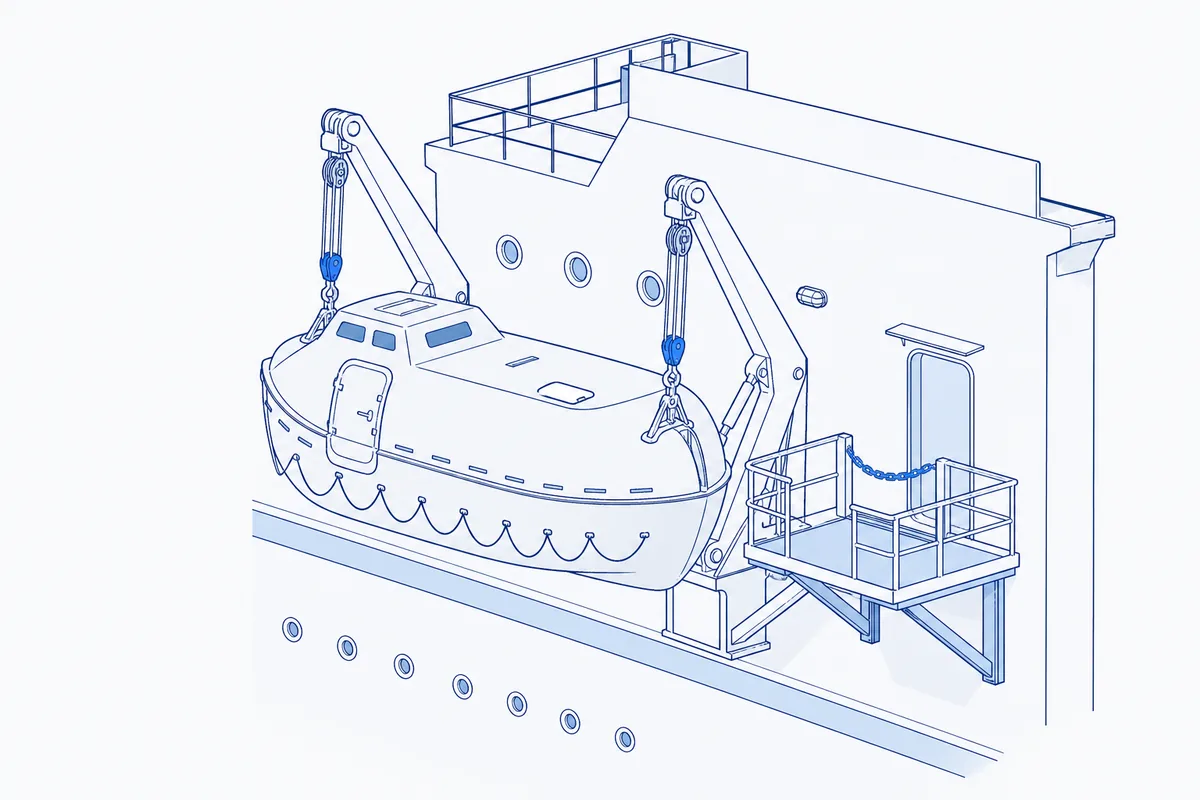
- The general emergency alarm is seven or more short blasts followed by one long blast on the whistle and the alarm bells; the order to abandon ship is given by the master. Survival craft carry EPIRB and SART; immersion suits and thermal protective aids prevent heat loss.
Sit the Part A practice test under the clock
60 test points across every Part A topic in 40 minutes, scored against the MCA’s minimum for each topic.
Free Emergency Procedures drillWhat the examiner looks for
- Initial action and its order for each emergency MIN 653 lists, including emergencies in port.
- Use and care of fire-fighting and life-saving appliances, survival craft and rescue boats.
- First aid priorities and the medical guidance on board.
How to study it
- Write each emergency as a numbered list of initial actions and say it aloud until it is automatic.
- Know the muster list for your own ship and the meaning of each alarm signal.
- Take the emergency procedures drill until you score 80% or better.
Common questions
What is the general emergency alarm signal?
Seven or more short blasts followed by one long blast on the ship’s whistle, with the electrically operated bell or klaxon (SOLAS and the LSA Code).
Which man overboard turn should I use?
It depends on the situation. The Williamson turn brings the ship back on her reciprocal track, useful at night or when the person is out of sight; the Anderson (single) turn is fastest when the person is in sight; the Scharnow turn suits a delayed action when the ship has run on.
60 test points across every Part A topic in 40 minutes, scored against the MCA’s minimum for each topic.
Free Emergency Procedures drillThe other MCA orals topics
- International Collision Regulations
- IALA Systems of Buoyage
- Navigational Procedures
- Seaworthiness
- Cargo Work
- Communication
- Regulation
- Other (Ship Handling, Meteorology, Safety and Security)
- Master: Law, Certificates and Surveys
- Master: Stability, Damage and Emergencies
- OOW Part A practice test (15 questions, 40 minutes)
- Mixed drill: every topic
Sources
- MCA: MIN 653 (M) Amendment 1, Deck Oral Exam Syllabus (OOW, Chief Mate and Master; expires 1 May 2027)
- MCA: MIN 690 Amendment 6, oral exam booking, Part A and Part B, resits and appeals
- MCA: MSF 4274, application for a deck oral examination (fees, oral pass validity)
- MCA: MIN 720 (M) Amendment 1, modernised officer qualifications and digital assessments (30 September 2026)
- MCA: MIN 654 (M) Amendment 1, Engineering and Electro-technical Officer Oral Exam Syllabus
- MCA: MSN 1781 (M+F) Amendment 3, the COLREG as applied in the UK
- IALA: Recommendation R1001, the IALA Maritime Buoyage System (Edition 2.0)
The MCA oral is a spoken interview with an MCA examiner. These are knowledge drills for it, with the model answer an examiner would expect after every question; they are not a simulation of the interview. The timed test copies the format of the OOW Part A computer-based exam. Original practice questions written from the MCA deck oral exam syllabus (MIN 653), the COLREG 1972 as applied by MSN 1781 and the IALA Maritime Buoyage System; they are not MCA questions or questions reported by candidates. The real oral is a spoken interview with an MCA examiner, and this is knowledge practice for it, not a simulation of the interview. Independent practice, not affiliated with or endorsed by the Maritime and Coastguard Agency.