Master Orals Practice Questions: Stability, Damage and Emergencies
Master Unlimited and Chief Mate oral topic (MIN 653, STCW A-II/2)
The real MCA oral is a spoken interview with an examiner; these questions are knowledge practice for it, each with a model answer.
Ten management-level questions with a model answer after every one. The first attempt is free; a pass unlocks unlimited drills in every topic.
Master: Law and Surveys drillWhy is the period just before a ship takes the blocks overall in dry dock critical for stability?
Master: Stability, Damage and Emergencies in the MCA orals
At Master level the examiner moves from the OOW’s initial actions to the master’s decisions: whether to beach a damaged ship, how to coordinate a search, how to prepare for a tow, how the ship will behave in a dry dock or in heavy weather. MIN 653 section 5 lists these under navigation, cargo and stability, and controlling the operation of the ship at management level.
- Which oral
- Master Unlimited (STCW II/2) and Chief Mate orals; there is no Part A at this level
- In the oral
- The examiner can ask about any part of the syllabus, in scenarios. Say your answer out loud before you check it.
- Our drill
- 10 questions from 36 Master: Operations questions, untimed, a model answer after every one; one free attempt, unlimited with a pass
Study notes
- Damage: assess flooding and its effect on trim, stability and hull stress using the damage stability information; consider counter-flooding, jettison, beaching on a suitable shore and the protection of the environment. Inform the company, the coastal state and the flag state.
- In dry dock, as water drains the ship lands on the blocks and an upthrust P develops at the keel; it reduces effective GM, and the critical moment is just before the ship sits on the blocks overall. Trim and GM must be checked before docking.
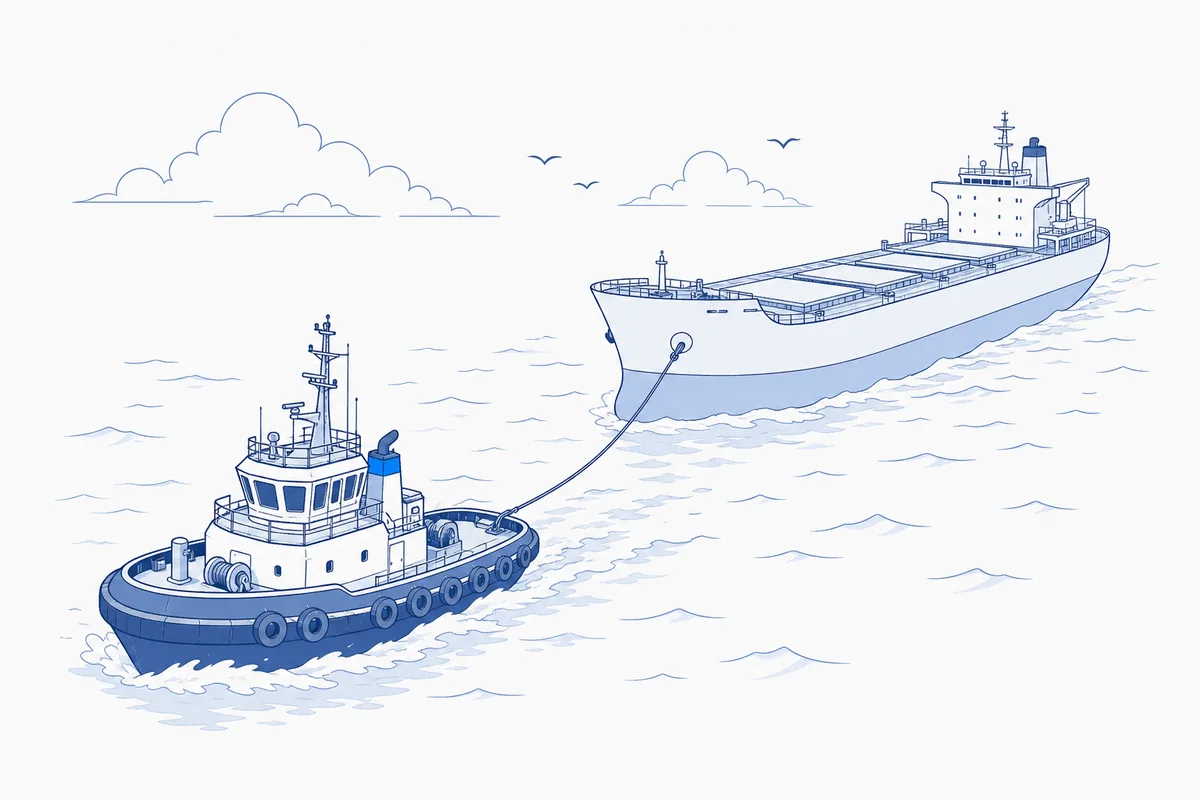
- Emergency towing: SOLAS II-1/3-4 requires emergency towing arrangements on tankers of 20,000 dwt and over and ship-specific emergency towing procedures on passenger and cargo ships; prepare the towline, connect, agree communications and speed, and keep a watch on the tow.
- Search and rescue: the on-scene coordinator (OSC) coordinates ships at the scene under the rescue coordination centre; IAMSAR Volume III gives the expanding square, sector and parallel track search patterns.
- Ice: reduce speed, avoid ice where possible, report dangerous ice (SOLAS V/31), and remove ice accretion because it raises G.
- Heavy weather: adjust course and speed to reduce slamming and synchronous rolling, avoid parametric rolling in head or following seas, and secure the ship and cargo before the weather arrives.
Practise every Master topic
Ten management-level questions with a model answer after every one. The first attempt is free; a pass unlocks unlimited drills in every topic.
Master: Law and Surveys drillWhat the examiner looks for
- Action after damage: collision, grounding, flooding, loss of rudder or propeller, including beaching and subsequent surveys (MIN 653).
- Damage stability, angle of loll and the effect of free surface at management level.
- Dry-docking and undocking, emergency towing and being towed.
- Search and rescue coordination, ice and heavy weather.
How to study it
- Practise explaining the master’s decision as well as the action: why beach rather than stay afloat, why change course rather than speed.
- Learn the three main IAMSAR search patterns and when each is used.
- Take the Master operations drill until you score 80% or better.
Common questions
Why does a ship lose stability as it lands in dry dock?
Once the keel touches the blocks, the upthrust at the blocks acts like removing weight from the keel, which effectively raises G and reduces GM. The upthrust is greatest just before the ship settles on the blocks along her length.
Who is the on-scene coordinator?
The unit designated to coordinate search and rescue at a specific area, often the first ship to arrive or the best equipped, acting under the rescue coordination centre.
Ten management-level questions with a model answer after every one. The first attempt is free; a pass unlocks unlimited drills in every topic.
Master: Law and Surveys drillThe other MCA orals topics
- International Collision Regulations
- IALA Systems of Buoyage
- Navigational Procedures
- Seaworthiness
- Cargo Work
- Emergency Procedures
- Communication
- Regulation
- Other (Ship Handling, Meteorology, Safety and Security)
- Master: Law, Certificates and Surveys
- OOW Part A practice test (15 questions, 40 minutes)
- Mixed drill: every topic
Sources
- MCA: MIN 653 (M) Amendment 1, Deck Oral Exam Syllabus (OOW, Chief Mate and Master; expires 1 May 2027)
- MCA: MIN 690 Amendment 6, oral exam booking, Part A and Part B, resits and appeals
- MCA: MSF 4274, application for a deck oral examination (fees, oral pass validity)
- MCA: MIN 720 (M) Amendment 1, modernised officer qualifications and digital assessments (30 September 2026)
- MCA: MIN 654 (M) Amendment 1, Engineering and Electro-technical Officer Oral Exam Syllabus
- MCA: MSN 1781 (M+F) Amendment 3, the COLREG as applied in the UK
- IALA: Recommendation R1001, the IALA Maritime Buoyage System (Edition 2.0)
The MCA oral is a spoken interview with an MCA examiner. These are knowledge drills for it, with the model answer an examiner would expect after every question; they are not a simulation of the interview. The timed test copies the format of the OOW Part A computer-based exam. Original practice questions written from the MCA deck oral exam syllabus (MIN 653), the COLREG 1972 as applied by MSN 1781 and the IALA Maritime Buoyage System; they are not MCA questions or questions reported by candidates. The real oral is a spoken interview with an MCA examiner, and this is knowledge practice for it, not a simulation of the interview. Independent practice, not affiliated with or endorsed by the Maritime and Coastguard Agency.