TExES 904 Life Science

Competencies 011–014 of the Core Subjects EC–6: Science (904). The competencies TEA lists, how they are tested and practice questions with explanations.

45 questions on the real 55-minute clock, with a score by competency group and an explanation for every answer.

Or start the free Life Science drill

What the TEA framework lists

  • Competency 011: structure and function of living things, life cycles and human body systems
  • Competency 012: reproduction and heredity, inherited and learned traits
  • Competency 013: adaptations and change over time
  • Competency 014: organisms and the environment, food webs and ecosystems

Summarized from the TExES Core Subjects EC–6 (391) preparation manual, Section 3: exam framework, Competencies 011–014. The grouping of competencies into drill sets is ours.

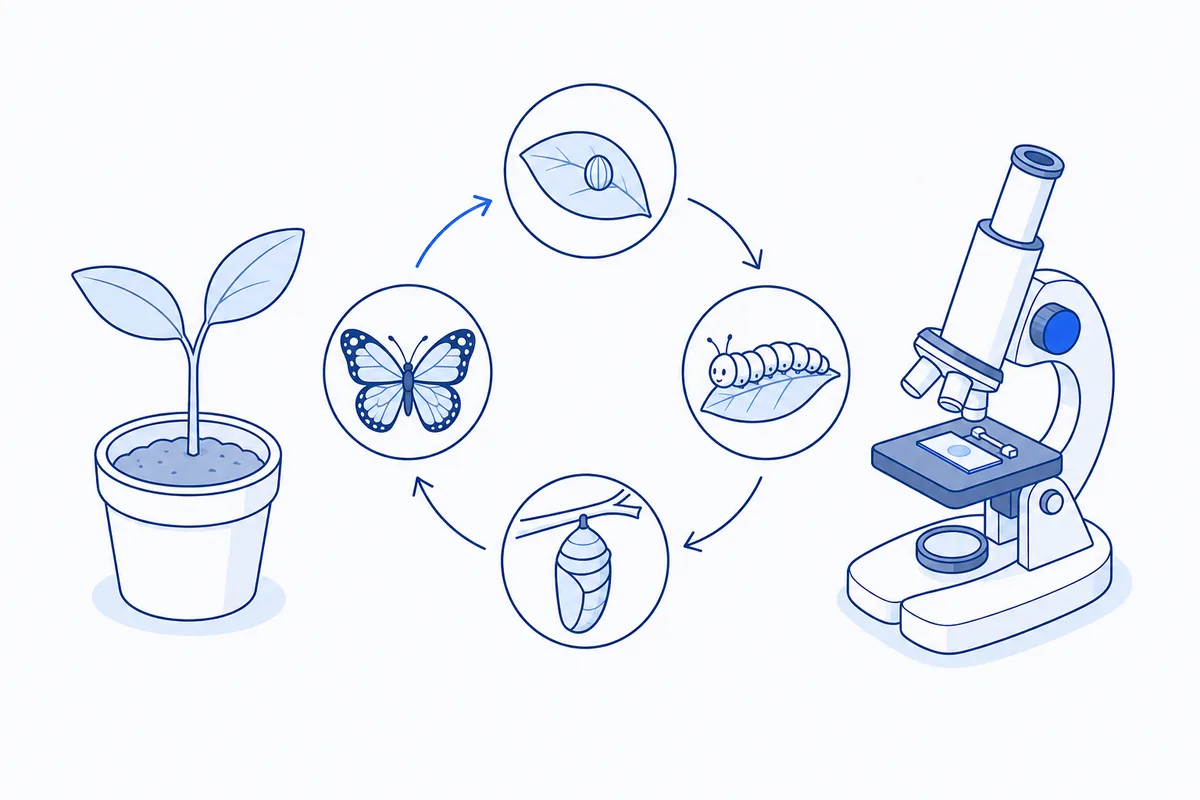
Line drawing of a seedling, the four stages of a butterfly life cycle and a microscope

How Life Science is tested

Questions cover plant and animal structures, life cycles, inherited traits, adaptations, food chains and webs, and how changes ripple through an ecosystem. TEA lists the competencies without weights, so our practice test spreads its questions evenly across them.

TExES 904 Life Science practice questions

Answer each question, then open the explanation.

Question 1

In a food chain of grass → rabbit → hawk, the rabbit is

  1. A.a decomposer.
  2. B.a producer.
  3. C.a secondary consumer.
  4. D.a primary consumer.
Show the answer and explanation

Answer: D: a primary consumer.

The rabbit eats the producer (grass), so it is a primary consumer. The hawk, which eats the rabbit, is a secondary consumer.

Question 2

Which of these is a learned behavior?

  1. A.A dog sitting on command
  2. B.A spider spinning a web
  3. C.A bird migrating in winter
  4. D.A baby crying when hungry
Show the answer and explanation

Answer: A: A dog sitting on command

Sitting on command is learned through training. Web spinning, crying when hungry and migration are inherited (instinctive) behaviors.

Question 3

Which organ of the respiratory system is where oxygen enters the blood?

  1. A.The lungs
  2. B.The kidneys
  3. C.The liver
  4. D.The stomach
Show the answer and explanation

Answer: A: The lungs

In the lungs, oxygen passes from tiny air sacs into the blood, and carbon dioxide passes out to be exhaled.

Question 4

A population of moths lives on trees whose bark becomes darker from pollution. Over many generations, more dark moths survive. This is an example of

  1. A.photosynthesis.
  2. B.natural selection.
  3. C.metamorphosis.
  4. D.learned behavior.
Show the answer and explanation

Answer: B: natural selection.

Dark moths are better camouflaged on dark bark, so they survive and reproduce more, increasing the trait in the population: natural selection.

Take the full test under the real clock

45 questions on the real 55-minute clock, with a score by competency group and an explanation for every answer.

Or start the free Life Science drill

Common questions

How many Life Science questions are on the TExES 904?

TEA lists the competencies of the TExES 904 without weights or question counts. Our 45-question practice test spreads its questions evenly across the competencies, which gives Life Science 10 questions.

What does Life Science cover on the TExES 904?

Competency 011: structure and function of living things, life cycles and human body systems; Competency 012: reproduction and heredity, inherited and learned traits; Competency 013: adaptations and change over time; Competency 014: organisms and the environment, food webs and ecosystems.

How should I study Life Science for the TExES 904?

Questions cover plant and animal structures, life cycles, inherited traits, adaptations, food chains and webs, and how changes ripple through an ecosystem. TEA lists the competencies without weights, so our practice test spreads its questions evenly across them.

TExES is a trademark of the Texas Education Agency. Original independent practice questions written to the published TExES exam frameworks; not affiliated with or endorsed by the Texas Education Agency or Pearson.