NPTE Cardiopulmonary Practice Questions
One area of FSBPT’s content outline · 22–27 of the 180 scored questions
225 questions across the whole content outline in 5 hours, with a score for Cardiopulmonary so you know where you stand.
Free Cardiopulmonary drillWhich assessment best describes the effectiveness of a patient's cough before airway clearance treatment?
Cardiovascular and Pulmonary Systems on the NPTE-PT
The cardiovascular and pulmonary systems carry 22–27 of the 180 scored questions on the NPTE-PT. FSBPT splits them into physical therapy examination (7–8), foundations for evaluation, differential diagnosis and prognosis (7–9) and interventions (8–10). Questions ask what an abnormal exercise response means, which condition a set of findings points to, and how to prescribe and progress aerobic training, breathing exercises and airway clearance safely.
- Share of the exam
- Cardiovascular & Pulmonary Systems 22–27 of the 180 scored questions (FSBPT outline, effective January 2024)
- On our mock exam
- 25 scored questions, inside FSBPT’s range
- Our drill
- 10 questions from 78 cardiopulmonary questions, untimed, an explanation after every answer; one free attempt, unlimited with a pass
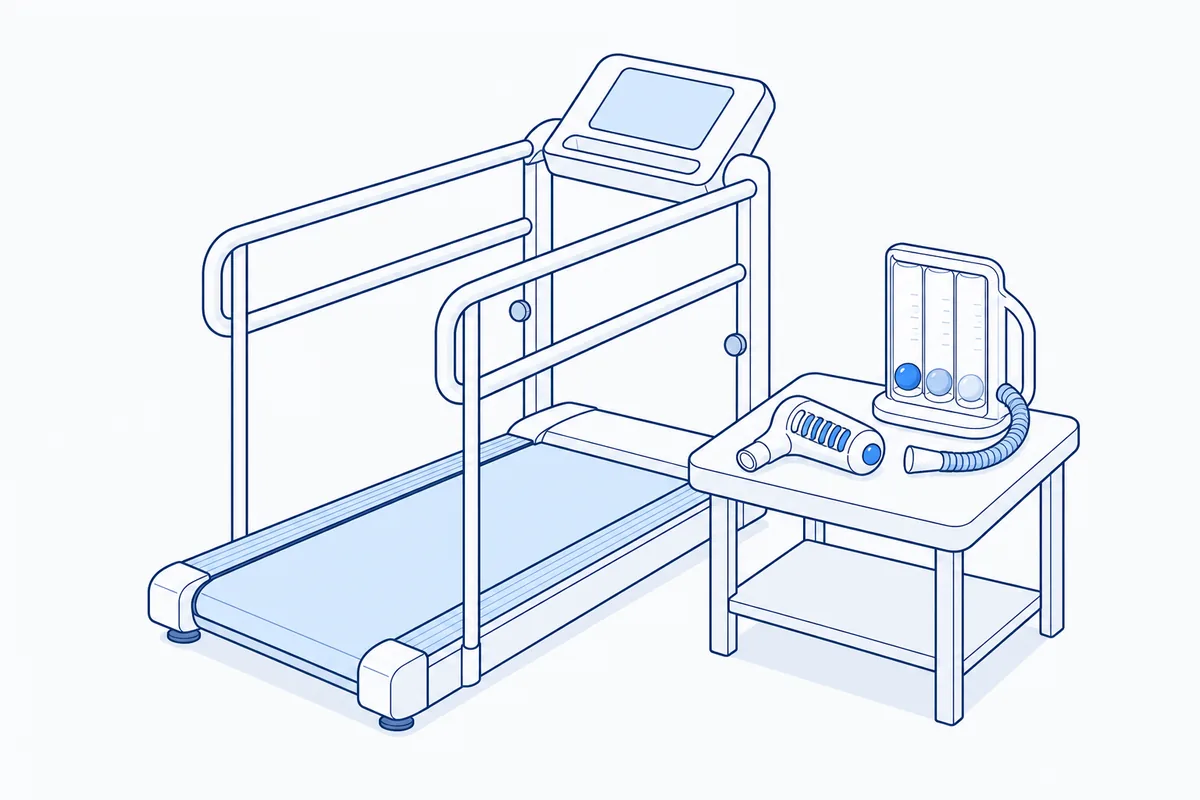
What Cardiovascular and Pulmonary Systems questions test
- Examination: vital signs and exercise response, the six-minute walk test, auscultation of heart and breath sounds, percussion, chest wall excursion, ECG rhythms, ankle-brachial index and dyspnea scales
- Conditions and differential diagnosis: coronary disease and atypical angina, heart failure by side and NYHA class, valve disease, COPD versus restrictive disease, asthma, cystic fibrosis, pneumothorax, pulmonary embolism, DVT and peripheral arterial disease
- Medical management: beta blockers, nitrates, anticoagulants and INR, troponin and hemoglobin, chest imaging, sternotomy and ventricular assist devices
- Interventions: exercise prescription with heart rate reserve and perceived exertion, cardiac rehab phases, pulmonary rehab, airway clearance, breathing strategies, inspiratory muscle training and early ICU mobility
- Responses that mean stop: falling systolic pressure with more work, new arrhythmia, chest pain, desaturation below the ordered target and signs of heart failure decompensation
Sit the full exam under the real clock
225 questions across the whole content outline in 5 hours, with a score for Cardiopulmonary so you know where you stand.
Free Cardiopulmonary drillHow to study it
- Memorize the ACSM indications for stopping exercise, including a systolic drop of more than 10 mm Hg with rising workload and pressures above 250/115 mm Hg.
- Practice the Karvonen formula until it is automatic, and switch to perceived exertion for patients on beta blockers or after heart transplant.
- Learn breath sounds and percussion notes as pairs with their conditions: bronchial sounds with consolidation, dull note with effusion, hyperresonance with pneumothorax.
- Take the cardiopulmonary drill and the lab values drill until you score 80% or better.
Common questions
How many cardiopulmonary questions are on the NPTE?
FSBPT’s outline assigns 22–27 of the 180 scored questions to the cardiovascular and pulmonary systems: 7–8 on examination, 7–9 on foundations for evaluation, differential diagnosis and prognosis, and 8–10 on interventions.
Do I need to read ECGs for the NPTE?
You should recognize common rhythms and findings that change treatment, such as atrial fibrillation, heart blocks and ST changes. The outline lists cardiovascular tests and measures and other medical tests under the cardiovascular and pulmonary systems.
225 questions across the whole content outline in 5 hours, with a score for Cardiopulmonary so you know where you stand.
Free Cardiopulmonary drillThe other NPTE-PT content areas
- Musculoskeletal System
- Neuromuscular and Nervous Systems
- Integumentary System
- Other Systems and System Interactions
- Equipment, Devices and Technologies
- Therapeutic Modalities
- Safety and Protection
- Professional Responsibilities and Research
- Special tests drill
- Lab values and vital signs drill
- NPTE-PT practice exam (225 questions, 5 hours)
Sources
- FSBPT: NPTE Candidate Handbook (version 2025.02): format, timing, scoring, fees, testing limits, results
- FSBPT: NPTE-PT Test Content Outline, effective January 2024
- FSBPT: NPTE Content (outlines in effect since January 2024)
- FSBPT: Future test dates (2027 PT dates)
- FSBPT: Retake Exam
- FSBPT: Practice Exam and Assessment Tool (PEAT)
Original practice questions for exam preparation, written to the NPTE-PT Test Content Outline (effective January 2024). They are not NPTE questions or recalled questions. Independent practice, not affiliated with or endorsed by the Federation of State Boards of Physical Therapy (FSBPT) or Prometric. NPTE is a registered trademark of FSBPT.