FE Other Disciplines Thermodynamics and Heat Transfer

Knowledge area 14 of the FE Other Disciplines exam: 9–14 of the 110 questions. The subtopics NCEES lists, how they are tested and worked practice problems with solutions.

110 questions on the real 5 hours 20 minutes clock, weighted to the NCEES specifications, with a score by knowledge area and a worked solution for every answer.

Or start the free Thermodynamics and Heat Transfer drill

What the specification lists

  • Thermodynamic laws (e.g., first law, second law)
  • Thermodynamic equilibrium
  • Thermodynamic properties (e.g., entropy, enthalpy, heat capacity)
  • Thermodynamic processes (e.g., isothermal, adiabatic, reversible, irreversible)
  • Heat transfer (e.g., conduction, convection, radiation)
  • Mass and energy balances
  • Property and phase diagrams (e.g., T-s, P-h, P-v)
  • Combustion and combustion products (e.g., CO, CO₂, NOx, ash, particulates)
  • Psychrometrics (e.g., relative humidity, wet bulb)

From the NCEES FE Other Disciplines CBT exam specifications, knowledge area 14.

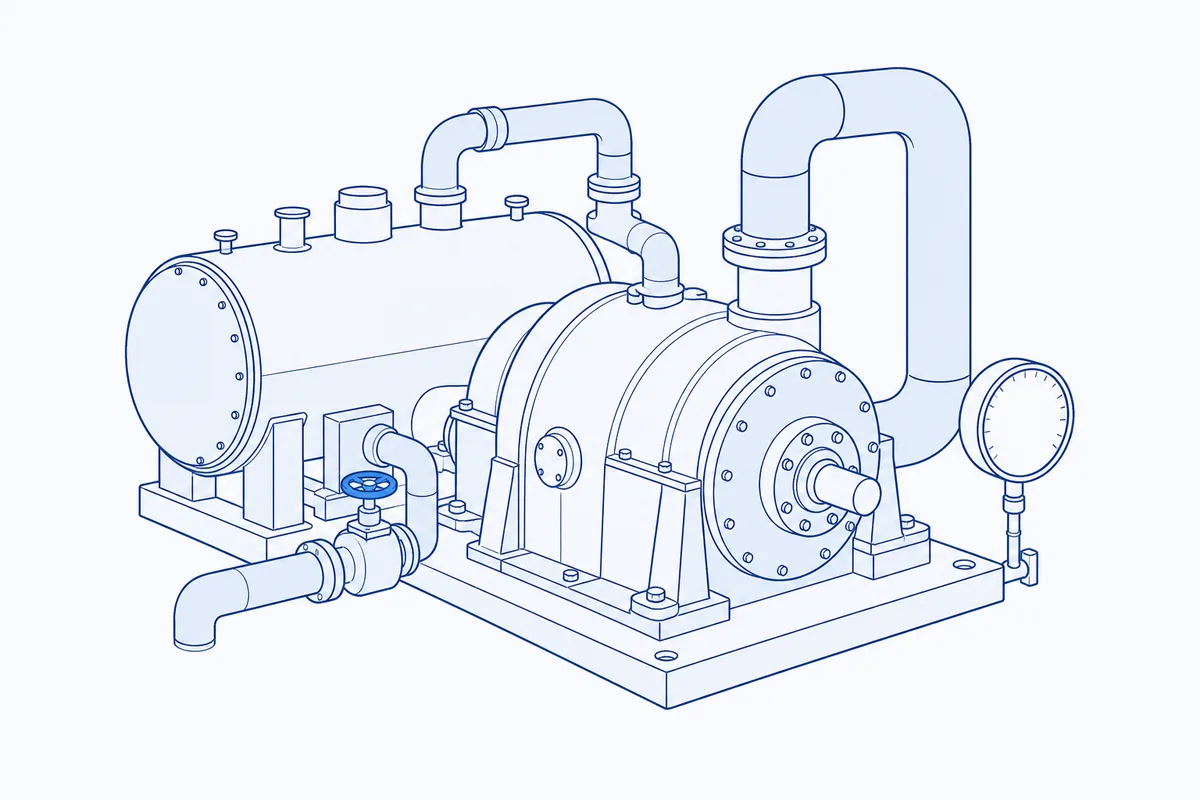
Line drawing of a steam turbine, a boiler drum and a pressure gauge

How Thermodynamics and Heat Transfer is tested

Thermodynamics questions are first-law energy balances on closed systems and on turbines, compressors, nozzles and throttles, ideal-gas processes, cycle efficiencies and COPs, psychrometrics and combustion. Learn to read steam tables and the psychrometric chart quickly; the Reference Handbook section on thermodynamics carries the tables and charts. Heat transfer questions use thermal-resistance networks for conduction and convection, the Stefan–Boltzmann law for radiation, lumped-capacitance transients and heat-exchanger LMTD and effectiveness methods. Set the problem up as resistances in series or parallel and the arithmetic stays short.

On exam day the relationships you need are in the Reference Handbook sections on Thermodynamics and Heat Transfer. The handbook is the only reference allowed, so practice finding each formula in it rather than memorizing a separate sheet.

FE Other Disciplines Thermodynamics and Heat Transfer practice problems

Work each problem with your calculator and the handbook, then open the solution.

Problem 1 · Psychrometrics

Air at 30°C and 60% relative humidity (vapor partial pressure 2.548 kPa) flows over a cooling coil whose surface is at 24°C. Saturation pressures of water are 2.339 kPa at 20°C, 2.488 kPa at 21°C, 2.645 kPa at 22°C, and 2.986 kPa at 24°C. Will moisture condense on the coil?

  1. A.Yes, because the coil surface is colder than the air's dry-bulb temperature
  2. B.No, because the coil surface is above the air's dew point of about 21.4°C
  3. C.Yes, because the relative humidity is above 50%
  4. D.No, because the air's relative humidity is below 100%
Show the answer and solution

Answer: B: No, because the coil surface is above the air's dew point of about 21.4°C

The dew point is the temperature at which P_sat equals the vapor pressure, 2.548 kPa. Interpolating between 21°C and 22°C gives 21 + (2.548 − 2.488)/(2.645 − 2.488) = 21.4°C. The 24°C coil is warmer than that, so no condensation forms.

Psychrometrics · Reference Handbook: Thermodynamics

Problem 2 · Laws of thermodynamics

An inventor claims a heat engine that receives 100 kW of heat from a source at 600°C, rejects heat to surroundings at 40°C, and produces 70 kW of power. How should the claim be evaluated?

  1. A.Possible, because energy is conserved as long as the engine rejects 30 kW
  2. B.Impossible, because 70% exceeds the Carnot limit of about 64% for these temperatures
  3. C.Impossible, because no heat engine can exceed 50% thermal efficiency
  4. D.Possible, because 70% is below the Carnot limit of about 93% for these temperatures
Show the answer and solution

Answer: B: Impossible, because 70% exceeds the Carnot limit of about 64% for these temperatures

η_Carnot = 1 − T_L/T_H = 1 − 313.15/873.15 = 0.641. A 70% efficiency would violate the second law, even though the energy balance (100 = 70 + 30) closes.

Laws of thermodynamics · Reference Handbook: Thermodynamics

Problem 3 · Performance of components

Air enters an adiabatic nozzle at 400 K with a velocity of 20 m/s and leaves at 350 K. Take c_p = 1.005 kJ/(kg·K). The exit velocity is most nearly:

  1. A.22.4 m/s
  2. B.225 m/s
  3. C.269 m/s
  4. D.318 m/s
Show the answer and solution

Answer: D: 318 m/s

Energy balance: V2²/2 = V1²/2 + c_p(T1 − T2). V2 = √[20² + 2(1,005)(50)] = √100,900 = 318 m/s. c_p must be in J/(kg·K) so the units match m²/s²; leaving it in kJ/(kg·K) gives only 22.4 m/s.

Performance of components · Reference Handbook: Thermodynamics

Problem 4 · Energy transfers

A piston-cylinder device contains 2.0 kg of air that is heated at constant pressure from 300 K to 500 K. Take c_p = 1.005 kJ/(kg·K), c_v = 0.718 kJ/(kg·K), and R = 0.287 kJ/(kg·K). The heat added is most nearly:

  1. A.115 kJ
  2. B.287 kJ
  3. C.402 kJ
  4. D.517 kJ
Show the answer and solution

Answer: C: 402 kJ

For a constant-pressure process, Q = ΔU + W = mΔh = mc_pΔT = 2.0(1.005)(200) = 402 kJ. Of this, ΔU = 287 kJ and the boundary work is 115 kJ.

Energy transfers · Reference Handbook: Thermodynamics

More FE Other Disciplines practice problems from every knowledge area

Sit the full exam under the real clock

110 questions on the real 5 hours 20 minutes clock, weighted to the NCEES specifications, with a score by knowledge area and a worked solution for every answer.

Or start the free Thermodynamics and Heat Transfer drill

Common questions

How many Thermodynamics and Heat Transfer questions are on the FE Other Disciplines exam?

The NCEES FE Other Disciplines specification lists 9–14 questions on Thermodynamics and Heat Transfer, out of 110. Every examinee gets the same number per knowledge area.

What does Thermodynamics and Heat Transfer cover on the FE Other Disciplines exam?

Thermodynamic laws (e.g., first law, second law); Thermodynamic equilibrium; Thermodynamic properties (e.g., entropy, enthalpy, heat capacity); Thermodynamic processes (e.g., isothermal, adiabatic, reversible, irreversible); Heat transfer (e.g., conduction, convection, radiation); Mass and energy balances; Property and phase diagrams (e.g., T-s, P-h, P-v); Combustion and combustion products (e.g., CO, CO₂, NOx, ash, particulates); Psychrometrics (e.g., relative humidity, wet bulb).

Where are the Thermodynamics and Heat Transfer formulas on exam day?

In the NCEES FE Reference Handbook, which appears on screen during the exam: the Thermodynamics and Heat Transfer sections. Practice with your free copy from MyNCEES so you know where each relationship sits.

Original independent practice questions written to the published NCEES exam specifications. Not affiliated with or endorsed by NCEES (National Council of Examiners for Engineering and Surveying).