FE Other Disciplines Chemistry

Knowledge area 3 of the FE Other Disciplines exam: 5–8 of the 110 questions. The subtopics NCEES lists, how they are tested and worked practice problems with solutions.

110 questions on the real 5 hours 20 minutes clock, weighted to the NCEES specifications, with a score by knowledge area and a worked solution for every answer.

Or start the free Chemistry drill

What the specification lists

  • Oxidation and reduction (e.g., reactions, corrosion control)
  • Acids and bases (e.g., pH, buffers)
  • Chemical reactions (e.g., stoichiometry, equilibrium, bioconversion)

From the NCEES FE Other Disciplines CBT exam specifications, knowledge area 3.

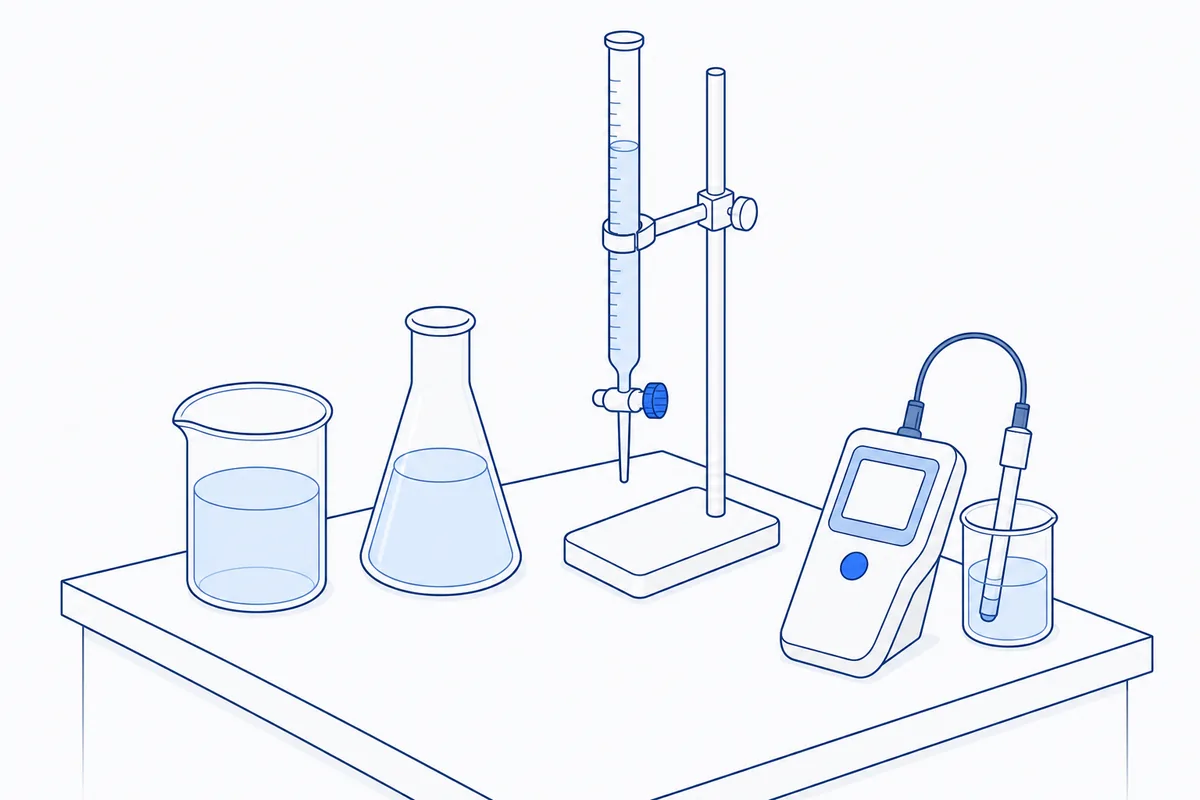
Line drawing of laboratory glassware: a beaker, an Erlenmeyer flask, a burette and a pH meter

How Chemistry is tested

Chemistry questions are stoichiometry, pH and acid-base equilibria, oxidation-reduction and corrosion. Balance the equation first, then convert to moles; most wrong answers come from skipping that step.

On exam day the relationships you need are in the Reference Handbook section on Chemistry and Biology. The handbook is the only reference allowed, so practice finding each formula in it rather than memorizing a separate sheet.

FE Other Disciplines Chemistry practice problems

Work each problem with your calculator and the handbook, then open the solution.

Problem 1 · Chemical reactions

Ethane burns completely in oxygen: C2H6 + O2 → CO2 + H2O. When the equation is balanced with the smallest whole-number coefficients, the coefficient of O2 is:

  1. A.2
  2. B.4
  3. C.6
  4. D.7
Show the answer and solution

Answer: D: 7

Balance C and H first: C2H6 + O2 → 2CO2 + 3H2O, which needs 7/2 O2. Doubling to clear the fraction gives 2C2H6 + 7O2 → 4CO2 + 6H2O.

Chemical reactions · Reference Handbook: Chemistry and Biology

Problem 2 · Acids and bases

A sulfuric acid solution has a concentration of 0.0025 mol/L. Assume both protons dissociate completely. The pH of the solution is most nearly:

  1. A.2.30
  2. B.2.60
  3. C.5.30
  4. D.11.7
Show the answer and solution

Answer: A: 2.30

[H⁺] = 2(0.0025) = 0.0050 mol/L. pH = −log10(0.0050) = 2.30.

Acids and bases · Reference Handbook: Chemistry and Biology

Problem 3 · Oxidation and reduction

Select all that apply.

A buried steel pipeline must be protected against corrosion. Which of the following measures reduce corrosion of the steel? Select all that apply.

  1. A.Connecting magnesium or zinc sacrificial anodes to the pipe
  2. B.Connecting the pipe to the negative terminal of an impressed-current rectifier
  3. C.Applying a dielectric protective coating to the pipe
  4. D.Bonding the pipe directly to buried copper ground rods
  5. E.Connecting the pipe to the positive terminal of an impressed-current rectifier
Show the answer and solution

Answer: A: Connecting magnesium or zinc sacrificial anodes to the pipe; B: Connecting the pipe to the negative terminal of an impressed-current rectifier; C: Applying a dielectric protective coating to the pipe

Cathodic protection makes the steel the cathode, either with more active sacrificial metals (Mg, Zn) or with an impressed current that drives electrons into the pipe. Coatings isolate the steel from the electrolyte. Coupling steel to a more noble metal, or making it the anode, accelerates corrosion.

Oxidation and reduction · Reference Handbook: Chemistry and Biology

Problem 4 · Oxidation and reduction

A zinc strip is placed in a copper(II) sulfate solution, and the reaction Zn + Cu²⁺ → Zn²⁺ + Cu occurs. Which statement is correct?

  1. A.Copper(II) ions are oxidized because they gain electrons
  2. B.Copper(II) ions act as the reducing agent
  3. C.Zinc is reduced because its charge changes
  4. D.Zinc is oxidized because it loses electrons
Show the answer and solution

Answer: D: Zinc is oxidized because it loses electrons

Oxidation is loss of electrons: Zn → Zn²⁺ + 2e⁻. Cu²⁺ gains those electrons and is reduced to Cu, so Cu²⁺ is the oxidizing agent and zinc is the reducing agent.

Oxidation and reduction · Reference Handbook: Chemistry and Biology

More FE Other Disciplines practice problems from every knowledge area

Sit the full exam under the real clock

110 questions on the real 5 hours 20 minutes clock, weighted to the NCEES specifications, with a score by knowledge area and a worked solution for every answer.

Or start the free Chemistry drill

Common questions

How many Chemistry questions are on the FE Other Disciplines exam?

The NCEES FE Other Disciplines specification lists 5–8 questions on Chemistry, out of 110. Every examinee gets the same number per knowledge area.

What does Chemistry cover on the FE Other Disciplines exam?

Oxidation and reduction (e.g., reactions, corrosion control); Acids and bases (e.g., pH, buffers); Chemical reactions (e.g., stoichiometry, equilibrium, bioconversion).

Where are the Chemistry formulas on exam day?

In the NCEES FE Reference Handbook, which appears on screen during the exam: the Chemistry and Biology section. Practice with your free copy from MyNCEES so you know where each relationship sits.

Original independent practice questions written to the published NCEES exam specifications. Not affiliated with or endorsed by NCEES (National Council of Examiners for Engineering and Surveying).