FE Other Disciplines Materials

Knowledge area 11 of the FE Other Disciplines exam: 6–9 of the 110 questions. The subtopics NCEES lists, how they are tested and worked practice problems with solutions.

110 questions on the real 5 hours 20 minutes clock, weighted to the NCEES specifications, with a score by knowledge area and a worked solution for every answer.

Or start the free Materials drill

What the specification lists

  • Physical (phase diagrams) properties of materials (e.g., alloy phase diagrams, phase equilibrium, and phase change)
  • Mechanical properties of materials
  • Chemical properties of materials
  • Thermal properties of materials
  • Electrical properties of materials
  • Material selection

From the NCEES FE Other Disciplines CBT exam specifications, knowledge area 11.

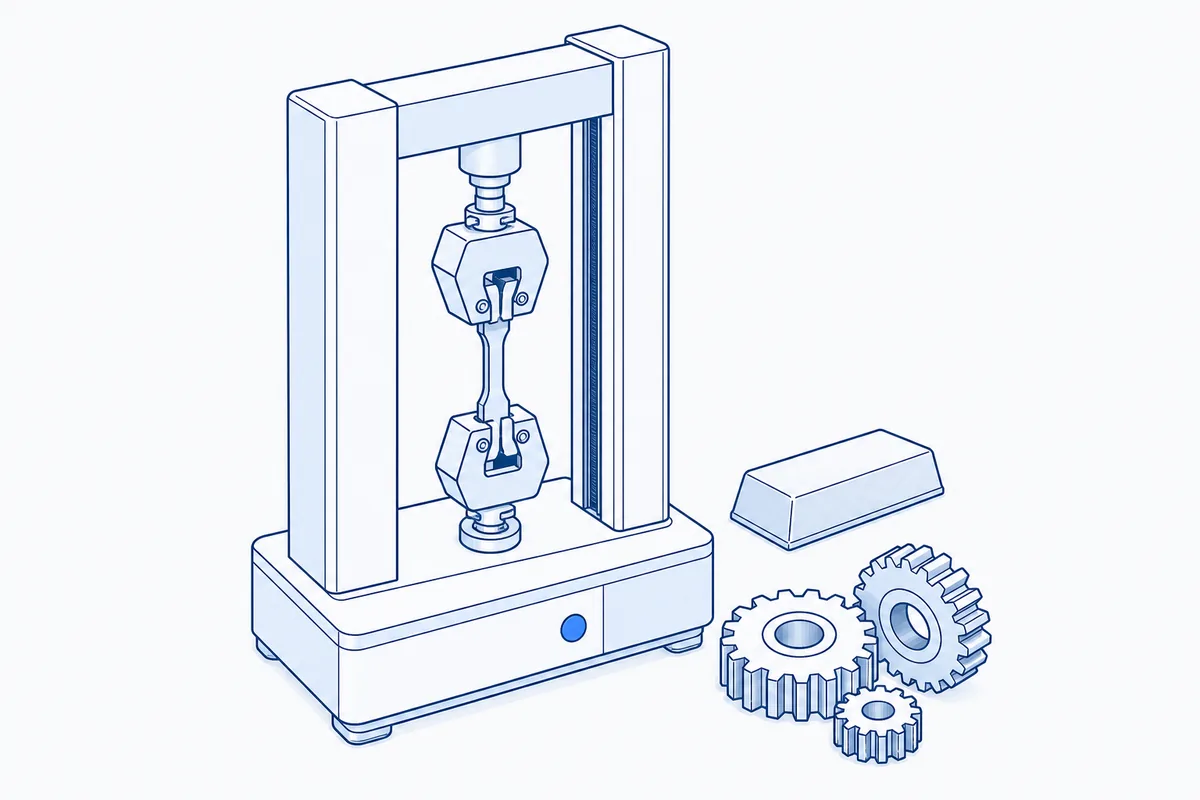
Line drawing of a tensile test machine gripping a metal specimen, with gears and an alloy ingot

How Materials is tested

Materials questions mix definitions with short calculations: reading a stress-strain curve, phase diagrams and the lever rule, heat treatment, corrosion and the galvanic series, fatigue and creep, and composite properties by the rule of mixtures.

On exam day the relationships you need are in the Reference Handbook section on Materials Science/Structure of Matter. The handbook is the only reference allowed, so practice finding each formula in it rather than memorizing a separate sheet.

FE Other Disciplines Materials practice problems

Work each problem with your calculator and the handbook, then open the solution.

Problem 1 · Materials selection

A beam of fixed length must meet a specified bending stiffness at minimum mass. Its square cross section may be sized freely, so mass is minimized by the material with the largest value of E^(1/2)/ρ. Candidate properties are: carbon steel E = 200 GPa, ρ = 7.85 g/cm³; aluminum alloy E = 70 GPa, ρ = 2.70 g/cm³; titanium alloy E = 114 GPa, ρ = 4.43 g/cm³; magnesium alloy E = 45 GPa, ρ = 1.77 g/cm³. The best choice is:

  1. A.Carbon steel
  2. B.Aluminum alloy
  3. C.Titanium alloy
  4. D.Magnesium alloy
Show the answer and solution

Answer: D: Magnesium alloy

E^(1/2)/ρ in (GPa)^(1/2)/(g/cm³): steel √200/7.85 = 1.80; aluminum √70/2.70 = 3.10; titanium √114/4.43 = 2.41; magnesium √45/1.77 = 3.79. Magnesium has the largest index and gives the lightest beam. Choosing by E alone (steel) or by E/ρ (which is nearly equal for all four metals) misses that a freely sized bending section rewards low density more than high modulus.

Materials selection · Reference Handbook: Materials Science/Structure of Matter

Problem 2 · Corrosion mechanisms and control

Select all that apply.

A designer must join aluminum panels to a stainless steel frame in a wet outdoor environment. Which of the following measures reduce galvanic corrosion of the joint? Select all that apply.

  1. A.Electrically insulate the two metals from each other with nonconductive washers and sleeves
  2. B.Choose a pair of metals that lie close together in the galvanic series for this environment
  3. C.Make the exposed area of the anodic metal large relative to the cathodic metal
  4. D.Paint only the anodic metal and leave the cathodic metal bare
  5. E.Fasten the panels with small fasteners made of a metal more anodic than both the panels and the frame
Show the answer and solution

Answer: A: Electrically insulate the two metals from each other with nonconductive washers and sleeves; B: Choose a pair of metals that lie close together in the galvanic series for this environment; C: Make the exposed area of the anodic metal large relative to the cathodic metal

Galvanic attack needs electrical contact, an electrolyte and a potential difference. Insulating the metals breaks the circuit, a closely matched pair lowers the driving potential, and a large anode-to-cathode area ratio spreads the corrosion current so the penetration rate is low. If only one metal is coated it should be the cathode, and fasteners should be the more noble component, never a small anode.

Corrosion mechanisms and control · Reference Handbook: Materials Science/Structure of Matter

Problem 3 · Nonferrous metals

Select all that apply.

Which of the following wrought aluminum alloys are strengthened by precipitation (age) hardening heat treatment? Select all that apply.

  1. A.1100
  2. B.2024
  3. C.3003
  4. D.5052
  5. E.6061
  6. F.7075
Show the answer and solution

Answer: B: 2024; E: 6061; F: 7075

The 2xxx (Al-Cu), 6xxx (Al-Mg-Si) and 7xxx (Al-Zn) series form strengthening precipitates during solution treatment, quench and aging, as in tempers such as 2024-T3, 6061-T6 and 7075-T6. The 1xxx, 3xxx and 5xxx series have no such precipitation response and gain strength only by strain hardening (H tempers).

Nonferrous metals · Reference Handbook: Materials Science/Structure of Matter

Problem 4 · Phase diagrams, phase transformation, and heat treating

A medium-carbon steel gear is austenitized and water quenched, leaving a fully martensitic structure that is very hard but brittle. It is then reheated to 400°C, held, and cooled. The main effect of this second treatment is to:

  1. A.Increase toughness and ductility at the cost of some hardness and strength
  2. B.Remove carbon from the surface so that the core can be hardened
  3. C.Raise the hardness further by converting more austenite to martensite
  4. D.Restore a coarse pearlite structure identical to that of a fully annealed steel
Show the answer and solution

Answer: A: Increase toughness and ductility at the cost of some hardness and strength

Reheating quenched martensite below the eutectoid temperature is tempering. Carbon diffuses out of the strained martensite to form fine carbide particles in a ferrite matrix (tempered martensite), relieving quench stresses. Hardness and strength drop somewhat while toughness and ductility rise, and higher tempering temperatures push further in that direction.

Phase diagrams, phase transformation, and heat treating · Reference Handbook: Materials Science/Structure of Matter

More FE Other Disciplines practice problems from every knowledge area

Sit the full exam under the real clock

110 questions on the real 5 hours 20 minutes clock, weighted to the NCEES specifications, with a score by knowledge area and a worked solution for every answer.

Or start the free Materials drill

Common questions

How many Materials questions are on the FE Other Disciplines exam?

The NCEES FE Other Disciplines specification lists 6–9 questions on Materials, out of 110. Every examinee gets the same number per knowledge area.

What does Materials cover on the FE Other Disciplines exam?

Physical (phase diagrams) properties of materials (e.g., alloy phase diagrams, phase equilibrium, and phase change); Mechanical properties of materials; Chemical properties of materials; Thermal properties of materials; Electrical properties of materials; Material selection.

Where are the Materials formulas on exam day?

In the NCEES FE Reference Handbook, which appears on screen during the exam: the Materials Science/Structure of Matter section. Practice with your free copy from MyNCEES so you know where each relationship sits.

Original independent practice questions written to the published NCEES exam specifications. Not affiliated with or endorsed by NCEES (National Council of Examiners for Engineering and Surveying).