FE Other Disciplines Strength of Materials

Knowledge area 10 of the FE Other Disciplines exam: 9–14 of the 110 questions. The subtopics NCEES lists, how they are tested and worked practice problems with solutions.

110 questions on the real 5 hours 20 minutes clock, weighted to the NCEES specifications, with a score by knowledge area and a worked solution for every answer.

Or start the free Strength of Materials drill

What the specification lists

  • Stress types (e.g., normal, shear)
  • Combined loading–principle of superposition
  • Stress and strain caused by axial loads, bending loads, torsion, or transverse shear forces
  • Shear and moment diagrams
  • Analysis of beams, trusses, frames, and columns
  • Loads and deformations (e.g., axial-extension, torque-angle of twist, moment-rotation)
  • Stress transformation and principal stresses, including stress-based yielding and fracture criteria (e.g., Mohr’s circle, maximum normal stress, Tresca, von Mises)
  • Material failure (e.g., Euler buckling, creep, fatigue, brittle fracture, stress concentration factors, factor of safety, and allowable stress)

From the NCEES FE Other Disciplines CBT exam specifications, knowledge area 10.

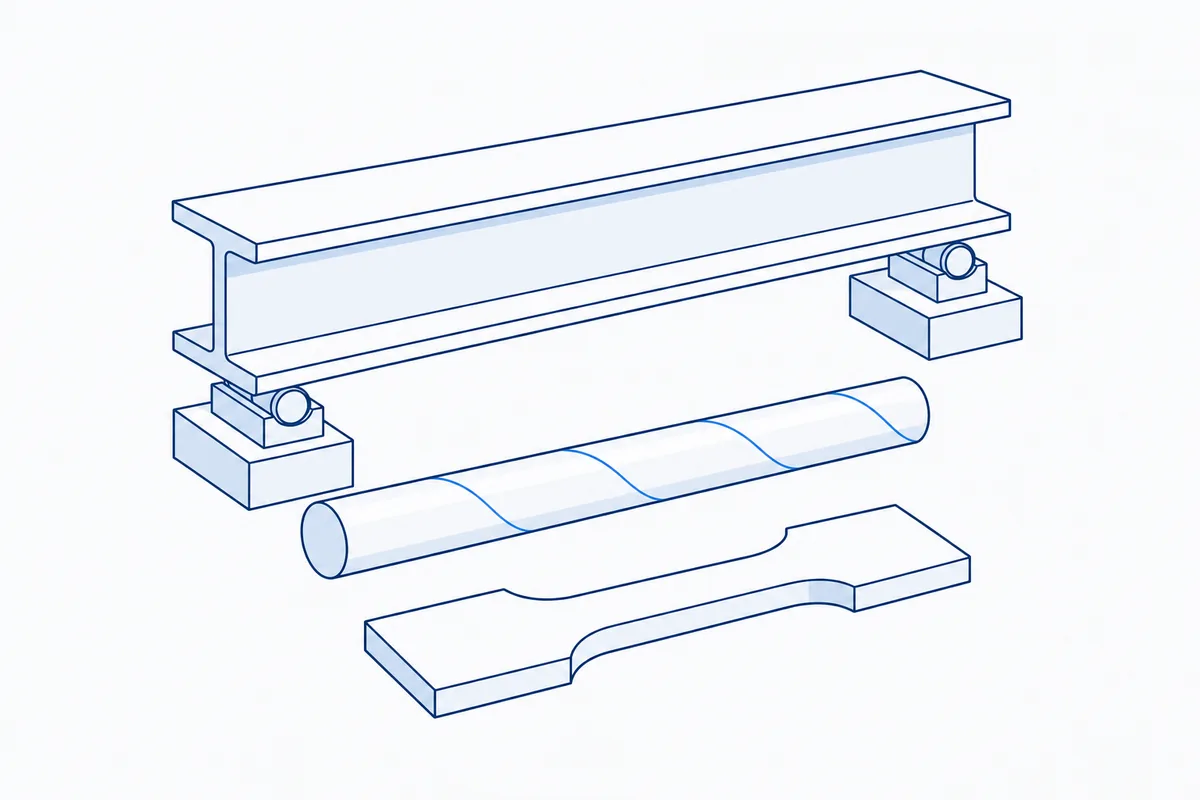
Line drawing of a steel I-beam bending slightly over two supports beside a twisted shaft and a test coupon

How Strength of Materials is tested

Mechanics of materials questions are short stress and deformation calculations: axial, torsion, bending, transverse shear, thermal, combined stress and column buckling. Know which formula applies to which loading and keep units consistent; the Reference Handbook section on mechanics of materials lists the beam deflection cases and the stress formulas.

On exam day the relationships you need are in the Reference Handbook section on Mechanics of Materials. The handbook is the only reference allowed, so practice finding each formula in it rather than memorizing a separate sheet.

FE Other Disciplines Strength of Materials practice problems

Work each problem with your calculator and the handbook, then open the solution.

Problem 1 · Stress and strain caused by torsional loads

A solid circular steel shaft 50 mm in diameter transmits a torque of 1.5 kN·m. The maximum shear stress in the shaft is most nearly:

  1. A.30.6 MPa
  2. B.61.1 MPa
  3. C.122 MPa
  4. D.489 MPa
Show the answer and solution

Answer: B: 61.1 MPa

τ = Tc/J with J = πd⁴/32 and c = d/2, so τ = 16T/(πd³) = 16(1500 N·m)/[π(0.050 m)³] = 61.1 MPa. Using the full diameter as c doubles the result to 122 MPa.

Stress and strain caused by torsional loads · Reference Handbook: Mechanics of Materials

Problem 2 · Deformations

A steel cantilever 2.0 m long carries a 5 kN point load at its free end. Use E = 200 GPa and I = 8.0 × 10⁶ mm⁴. Neglecting self-weight, the tip deflection is most nearly:

  1. A.0.521 mm
  2. B.3.13 mm
  3. C.8.33 mm
  4. D.25.0 mm
Show the answer and solution

Answer: C: 8.33 mm

For an end-loaded cantilever δ = PL³/(3EI) = 5000(2.0)³/[3(200 × 10⁹)(8.0 × 10⁻⁶)] = 0.00833 m = 8.33 mm. Note I = 8.0 × 10⁶ mm⁴ = 8.0 × 10⁻⁶ m⁴.

Deformations · Reference Handbook: Mechanics of Materials

Problem 3 · Failure theories and analysis

Select all that apply.

A designer must predict the onset of yielding in a ductile steel shaft under combined bending and torsion. Which of the following failure theories are appropriate for this purpose? Select all that apply.

  1. A.Maximum shear stress (Tresca) theory
  2. B.Distortion energy (von Mises) theory
  3. C.Maximum normal stress theory
  4. D.Modified Mohr theory for materials with unequal tensile and compressive strengths
Show the answer and solution

Answer: A: Maximum shear stress (Tresca) theory; B: Distortion energy (von Mises) theory

Yielding of ductile metals is governed by shear-driven slip, which the Tresca and von Mises criteria capture; von Mises matches test data closely and Tresca is slightly conservative. The maximum normal stress and modified Mohr theories are intended for brittle materials such as cast iron and can badly overpredict the capacity of a ductile part in torsion.

Failure theories and analysis · Reference Handbook: Mechanics of Materials

Problem 4 · Stress and strain caused by temperature changes

An aluminum bar 1.2 m long sits between two rigid walls with a 0.5 mm gap at one end at room temperature. The bar is then heated 60°C. Use α = 23 × 10⁻⁶ /°C and E = 70 GPa. The compressive stress in the bar is most nearly:

  1. A.29.2 MPa
  2. B.67.4 MPa
  3. C.96.6 MPa
  4. D.126 MPa
Show the answer and solution

Answer: B: 67.4 MPa

Free expansion δ_T = αΔT·L = (23 × 10⁻⁶)(60)(1200 mm) = 1.656 mm. The first 0.5 mm closes the gap, so the walls suppress 1.156 mm: σ = E(δ_T − gap)/L = 70,000(1.156)/1200 = 67.4 MPa. Ignoring the gap gives EαΔT = 96.6 MPa.

Stress and strain caused by temperature changes · Reference Handbook: Mechanics of Materials

More FE Other Disciplines practice problems from every knowledge area

Sit the full exam under the real clock

110 questions on the real 5 hours 20 minutes clock, weighted to the NCEES specifications, with a score by knowledge area and a worked solution for every answer.

Or start the free Strength of Materials drill

Common questions

How many Strength of Materials questions are on the FE Other Disciplines exam?

The NCEES FE Other Disciplines specification lists 9–14 questions on Strength of Materials, out of 110. Every examinee gets the same number per knowledge area.

What does Strength of Materials cover on the FE Other Disciplines exam?

Stress types (e.g., normal, shear); Combined loading–principle of superposition; Stress and strain caused by axial loads, bending loads, torsion, or transverse shear forces; Shear and moment diagrams; Analysis of beams, trusses, frames, and columns; Loads and deformations (e.g., axial-extension, torque-angle of twist, moment-rotation); Stress transformation and principal stresses, including stress-based yielding and fracture criteria (e.g., Mohr’s circle, maximum normal stress, Tresca, von Mises); Material failure (e.g., Euler buckling, creep, fatigue, brittle fracture, stress concentration factors, factor of safety, and allowable stress).

Where are the Strength of Materials formulas on exam day?

In the NCEES FE Reference Handbook, which appears on screen during the exam: the Mechanics of Materials section. Practice with your free copy from MyNCEES so you know where each relationship sits.

Original independent practice questions written to the published NCEES exam specifications. Not affiliated with or endorsed by NCEES (National Council of Examiners for Engineering and Surveying).