FE Other Disciplines Safety, Health, and Environment

Knowledge area 6 of the FE Other Disciplines exam: 6–9 of the 110 questions. The subtopics NCEES lists, how they are tested and worked practice problems with solutions.

110 questions on the real 5 hours 20 minutes clock, weighted to the NCEES specifications, with a score by knowledge area and a worked solution for every answer.

Or start the free Safety, Health, and Environment drill

What the specification lists

  • Industrial hygiene (e.g., carcinogens, toxicology, exposure limits, radiation exposure, biohazards, half-life)
  • Basic safety equipment (e.g., pressure-relief valves, emergency shutoffs, fire prevention and control, personal protective equipment)
  • Gas detection and monitoring (e.g., O₂, CO, CO₂, CH₄, H₂S, radon)
  • Electrical safety
  • Confined space entry and ventilation rates
  • Hazard communications (e.g., SDS, proper labeling, concentrations, fire ratings, safety equipment)

From the NCEES FE Other Disciplines CBT exam specifications, knowledge area 6.

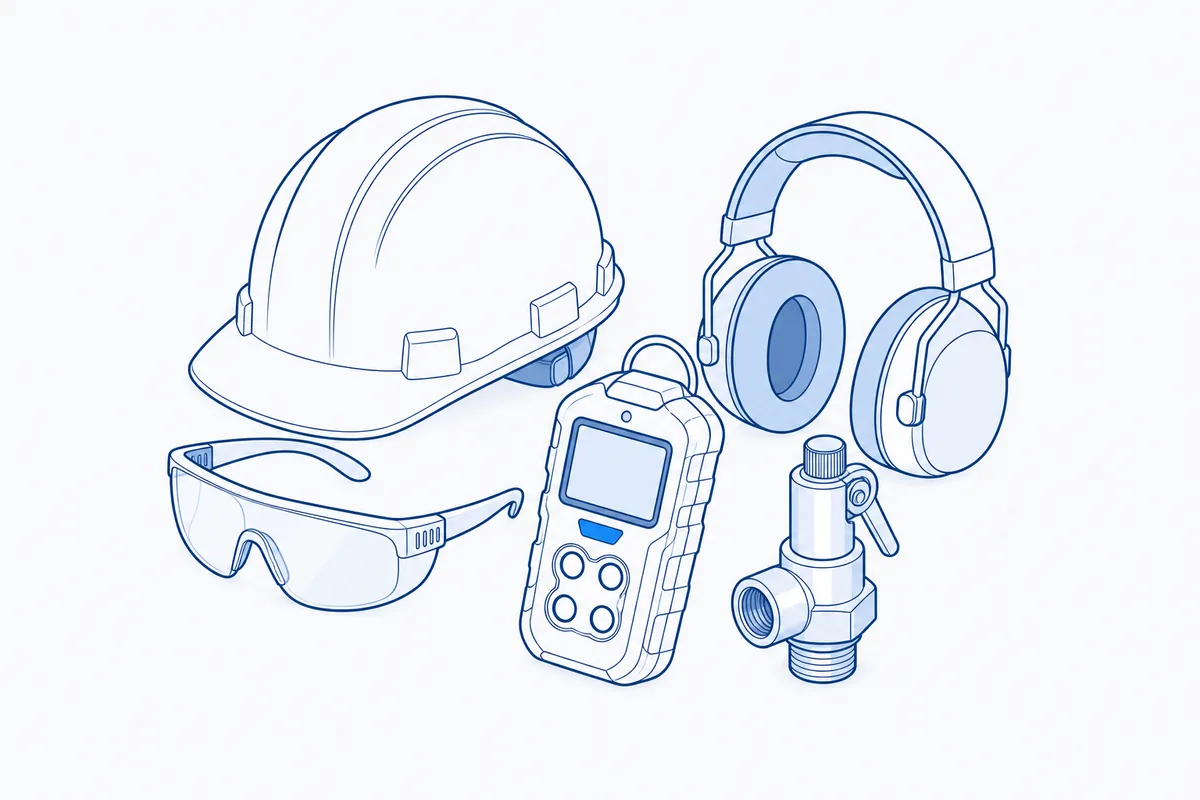
Line drawing of a hard hat, safety glasses, a gas detector and a pressure-relief valve

How Safety, Health, and Environment is tested

Safety, health and environment questions test practical knowledge: exposure limits and time-weighted averages, radioactive decay, oxygen-deficient and toxic atmospheres, confined space ventilation, electrical safety, PPE and hazard communication (SDS and labeling). The Reference Handbook section on safety covers the calculations.

On exam day the relationships you need are in the Reference Handbook section on Safety. The handbook is the only reference allowed, so practice finding each formula in it rather than memorizing a separate sheet.

FE Other Disciplines Safety, Health, and Environment practice problems

Work each problem with your calculator and the handbook, then open the solution.

Problem 1 · Basic safety equipment

A single pressure-relief valve protects a pressure vessel. Its set pressure should generally be no higher than:

  1. A.The vessel's hydrostatic test pressure
  2. B.The vessel's maximum allowable working pressure (MAWP)
  3. C.The vessel's normal operating pressure
  4. D.Twice the vessel's normal operating pressure
Show the answer and solution

Answer: B: The vessel's maximum allowable working pressure (MAWP)

A relief valve is set at or below the MAWP so the vessel is relieved before its rated pressure is exceeded. The set pressure is kept above normal operating pressure so the valve does not lift or leak in service.

Basic safety equipment · Reference Handbook: Safety

Problem 2 · Gas detection and monitoring

Before a tank entry, an attendant's meter reads 19.0% oxygen by volume. Under OSHA definitions, how is this atmosphere classified?

  1. A.Acceptable, because normal air contains only about 19% oxygen
  2. B.Oxygen-deficient, because it is below 19.5% oxygen
  3. C.Acceptable, because it is above 16% oxygen
  4. D.Oxygen-enriched, because it is within 2% of normal air
Show the answer and solution

Answer: B: Oxygen-deficient, because it is below 19.5% oxygen

OSHA defines an oxygen-deficient atmosphere as one containing less than 19.5% oxygen by volume and an oxygen-enriched atmosphere as more than 23.5%. At 19.0%, the space must be ventilated or entered with supplied-air respiratory protection, and the cause of the deficiency investigated.

Gas detection and monitoring · Reference Handbook: Safety

Problem 3 · Electrical safety

Select all that apply.

A technician will service a motor-driven conveyor. Which steps belong to a proper lockout/tagout procedure? Select all that apply.

  1. A.Isolate the equipment from all energy sources at the energy-isolating devices
  2. B.Apply the technician's own lock and tag to each energy-isolating device
  3. C.Release or restrain stored energy, such as springs, capacitors, and raised parts
  4. D.Verify isolation, for example by attempting a start and testing for voltage, before beginning work
  5. E.Rely on the conveyor's control-circuit stop button as the means of isolation
  6. F.Have a coworker remove the technician's lock at shift change if the work is unfinished
Show the answer and solution

Answer: A: Isolate the equipment from all energy sources at the energy-isolating devices; B: Apply the technician's own lock and tag to each energy-isolating device; C: Release or restrain stored energy, such as springs, capacitors, and raised parts; D: Verify isolation, for example by attempting a start and testing for voltage, before beginning work

Lockout/tagout requires shutting down, isolating every energy source at a true isolating device, applying personal locks and tags, dissipating stored energy, and verifying a zero-energy state before work starts.

Electrical safety · Reference Handbook: Safety

Problem 4 · Industrial hygiene

During an 8-hour shift, a worker is exposed to a solvent vapor at 80 ppm for 2 hours, 40 ppm for 3 hours, and 10 ppm for 3 hours. The 8-hour time-weighted average exposure is most nearly:

  1. A.38.8 ppm
  2. B.43.3 ppm
  3. C.103 ppm
  4. D.310 ppm
Show the answer and solution

Answer: A: 38.8 ppm

TWA = Σ(C·t)/8 = (80·2 + 40·3 + 10·3)/8 = (160 + 120 + 30)/8 = 38.8 ppm. Each concentration must be weighted by its duration.

Industrial hygiene · Reference Handbook: Safety

More FE Other Disciplines practice problems from every knowledge area

Sit the full exam under the real clock

110 questions on the real 5 hours 20 minutes clock, weighted to the NCEES specifications, with a score by knowledge area and a worked solution for every answer.

Or start the free Safety, Health, and Environment drill

Common questions

How many Safety, Health, and Environment questions are on the FE Other Disciplines exam?

The NCEES FE Other Disciplines specification lists 6–9 questions on Safety, Health, and Environment, out of 110. Every examinee gets the same number per knowledge area.

What does Safety, Health, and Environment cover on the FE Other Disciplines exam?

Industrial hygiene (e.g., carcinogens, toxicology, exposure limits, radiation exposure, biohazards, half-life); Basic safety equipment (e.g., pressure-relief valves, emergency shutoffs, fire prevention and control, personal protective equipment); Gas detection and monitoring (e.g., O₂, CO, CO₂, CH₄, H₂S, radon); Electrical safety; Confined space entry and ventilation rates; Hazard communications (e.g., SDS, proper labeling, concentrations, fire ratings, safety equipment).

Where are the Safety, Health, and Environment formulas on exam day?

In the NCEES FE Reference Handbook, which appears on screen during the exam: the Safety section. Practice with your free copy from MyNCEES so you know where each relationship sits.

Original independent practice questions written to the published NCEES exam specifications. Not affiliated with or endorsed by NCEES (National Council of Examiners for Engineering and Surveying).