FE Other Disciplines Statics

Knowledge area 8 of the FE Other Disciplines exam: 9–14 of the 110 questions. The subtopics NCEES lists, how they are tested and worked practice problems with solutions.

110 questions on the real 5 hours 20 minutes clock, weighted to the NCEES specifications, with a score by knowledge area and a worked solution for every answer.

Or start the free Statics drill

What the specification lists

  • Vector analysis
  • Force systems (e.g., resultants, concurrent, distributed)
  • Force couple systems
  • Equilibrium of rigid bodies (e.g., support reactions)
  • Internal forces in rigid bodies (e.g., trusses, frames, machines)
  • Area properties (e.g., centroids, moments of inertia, radius of gyration, parallel axis theorem)
  • Static friction
  • Free-body diagrams
  • Weight and mass computations (e.g., slug, lbm, lbf, kg, N, ton, dyne, g, gc)

From the NCEES FE Other Disciplines CBT exam specifications, knowledge area 8.

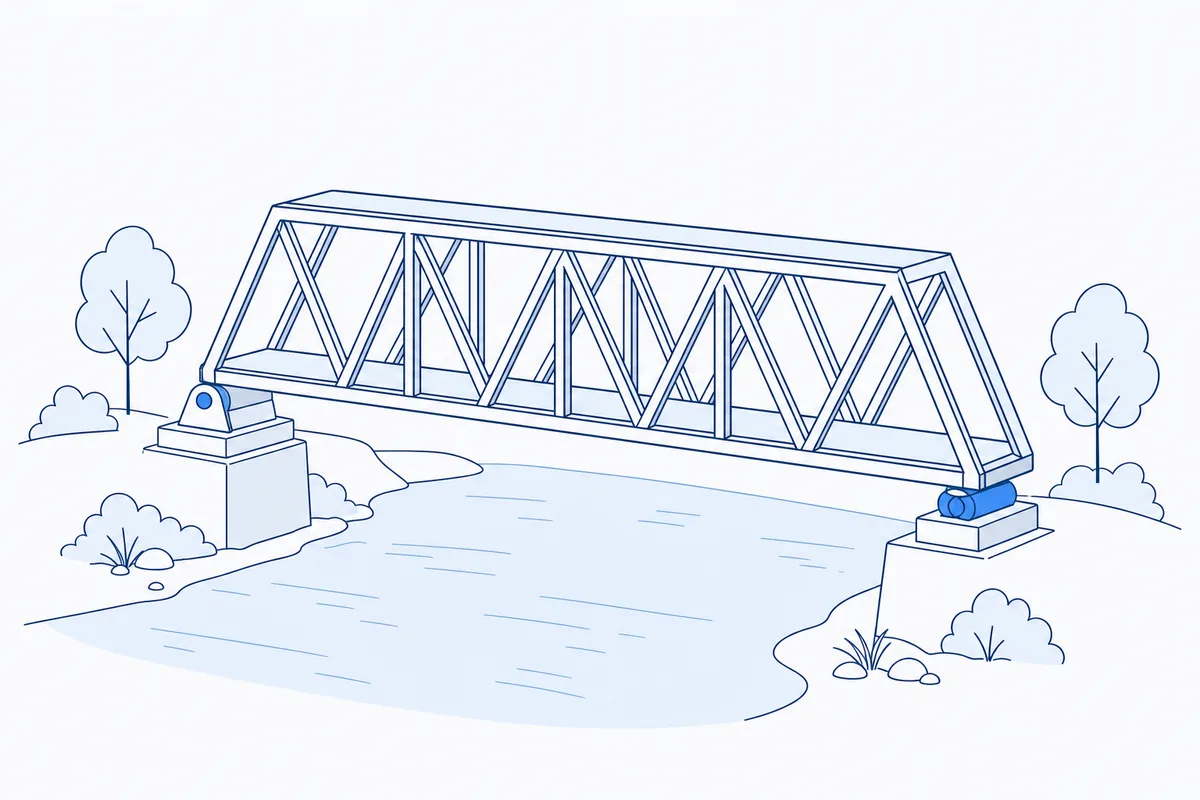
Line drawing of a steel truss bridge resting on a pin and a roller support

How Statics is tested

Statics questions ask for support reactions, truss member forces, centroids, moments of inertia and friction limits. Draw the free-body diagram first, take moments about the point that removes the most unknowns, and check units. The Reference Handbook section on statics lists centroids and moments of inertia of common shapes.

On exam day the relationships you need are in the Reference Handbook section on Statics. The handbook is the only reference allowed, so practice finding each formula in it rather than memorizing a separate sheet.

FE Other Disciplines Statics practice problems

Work each problem with your calculator and the handbook, then open the solution.

Problem 1 · Area moments of inertia

A rectangle is 4 in wide and 10 in tall. Find its moment of inertia about a horizontal axis located 2 in below its bottom edge. Enter the value in in⁴ to the nearest whole number.

Fill in the blank: answer in in⁴.

Show the answer and solution

Answer: 2293 in⁴ (accepted 2268 to 2318)

I_c = 4(10)³/12 = 333.3 in⁴ and A = 40 in². The centroid is 5 + 2 = 7 in above the axis, so I = 333.3 + 40(7)² = 333.3 + 1,960 = 2,293 in⁴.

Area moments of inertia · Reference Handbook: Statics

Problem 2 · Static friction

A symmetric wedge has faces that each make 6° with its centerline. It is driven into a log by a force P along the centerline. When the wedge is about to move further in, the wood exerts a normal force of 5.0 kN on each face, and the coefficient of friction on both faces is 0.20. Neglect the wedge's weight. The force P is most nearly:

  1. A.1.05 kN
  2. B.1.52 kN
  3. C.2.00 kN
  4. D.3.03 kN
Show the answer and solution

Answer: D: 3.03 kN

Along the centerline, each face contributes a normal-force component N sin 6° and a friction component μN cos 6°, both opposing insertion. P = 2N(sin 6° + 0.20 cos 6°) = 2(5.0)(0.1045 + 0.1989) = 3.03 kN.

Static friction · Reference Handbook: Statics

Problem 3 · Concurrent force systems

A 400 lbf sign hangs from a ring held by two cables. Cable A runs up and to the left at 30° above the horizontal; cable B runs up and to the right at 45° above the horizontal. The tension in cable B is most nearly:

  1. A.254 lbf
  2. B.283 lbf
  3. C.293 lbf
  4. D.359 lbf
Show the answer and solution

Answer: D: 359 lbf

ΣFx = 0: T_A cos 30° = T_B cos 45°. ΣFy = 0: T_A sin 30° + T_B sin 45° = 400. Substituting T_A = 0.8165 T_B gives T_B(0.4082 + 0.7071) = 400, so T_B = 359 lbf and T_A = 293 lbf. The steeper cable carries more of the weight.

Concurrent force systems · Reference Handbook: Statics

Problem 4 · Vector analysis

A 600 N cable force acts at point A (0, 0, 0) and is directed toward point B (3, 4, 12) m. The z component of the force is most nearly:

  1. A.46.2 N
  2. B.138 N
  3. C.185 N
  4. D.554 N
Show the answer and solution

Answer: D: 554 N

The length AB = √(3² + 4² + 12²) = 13 m, so the unit vector is (3, 4, 12)/13. Fz = 600(12/13) = 554 N. The 600 N must be multiplied by the direction cosine 12/13, not just divided by the length.

Vector analysis · Reference Handbook: Statics

More FE Other Disciplines practice problems from every knowledge area

Sit the full exam under the real clock

110 questions on the real 5 hours 20 minutes clock, weighted to the NCEES specifications, with a score by knowledge area and a worked solution for every answer.

Or start the free Statics drill

Common questions

How many Statics questions are on the FE Other Disciplines exam?

The NCEES FE Other Disciplines specification lists 9–14 questions on Statics, out of 110. Every examinee gets the same number per knowledge area.

What does Statics cover on the FE Other Disciplines exam?

Vector analysis; Force systems (e.g., resultants, concurrent, distributed); Force couple systems; Equilibrium of rigid bodies (e.g., support reactions); Internal forces in rigid bodies (e.g., trusses, frames, machines); Area properties (e.g., centroids, moments of inertia, radius of gyration, parallel axis theorem); Static friction; Free-body diagrams; Weight and mass computations (e.g., slug, lbm, lbf, kg, N, ton, dyne, g, gc).

Where are the Statics formulas on exam day?

In the NCEES FE Reference Handbook, which appears on screen during the exam: the Statics section. Practice with your free copy from MyNCEES so you know where each relationship sits.

Original independent practice questions written to the published NCEES exam specifications. Not affiliated with or endorsed by NCEES (National Council of Examiners for Engineering and Surveying).