FE Other Disciplines Fluid Mechanics

Knowledge area 12 of the FE Other Disciplines exam: 12–18 of the 110 questions. The subtopics NCEES lists, how they are tested and worked practice problems with solutions.

110 questions on the real 5 hours 20 minutes clock, weighted to the NCEES specifications, with a score by knowledge area and a worked solution for every answer.

Or start the free Fluid Mechanics drill

What the specification lists

  • Fluid properties (e.g., Newtonian, non-Newtonian, liquids and gases)
  • Dimensionless numbers (e.g., Reynolds number, Froude number, Mach number)
  • Laminar and turbulent flow
  • Fluid statics (e.g., hydrostatic head)
  • Energy, impulse, and momentum equations (e.g., Bernoulli equation)
  • Pipe and duct flow and friction losses (e.g., pipes, valves, fittings, laminar, transitional and turbulent flow)
  • Open-channel flow (e.g., Manning’s equation, drag)
  • Fluid transport systems (e.g., series and parallel operations)
  • Flow measurement (e.g., pitot tube, venturi meter, weir)
  • Turbomachinery (e.g., pumps, turbines, fans, compressors)
  • Ideal gas law (e.g., mixtures of nonreactive gases)
  • Real gas law (e.g., z factor)

From the NCEES FE Other Disciplines CBT exam specifications, knowledge area 12.

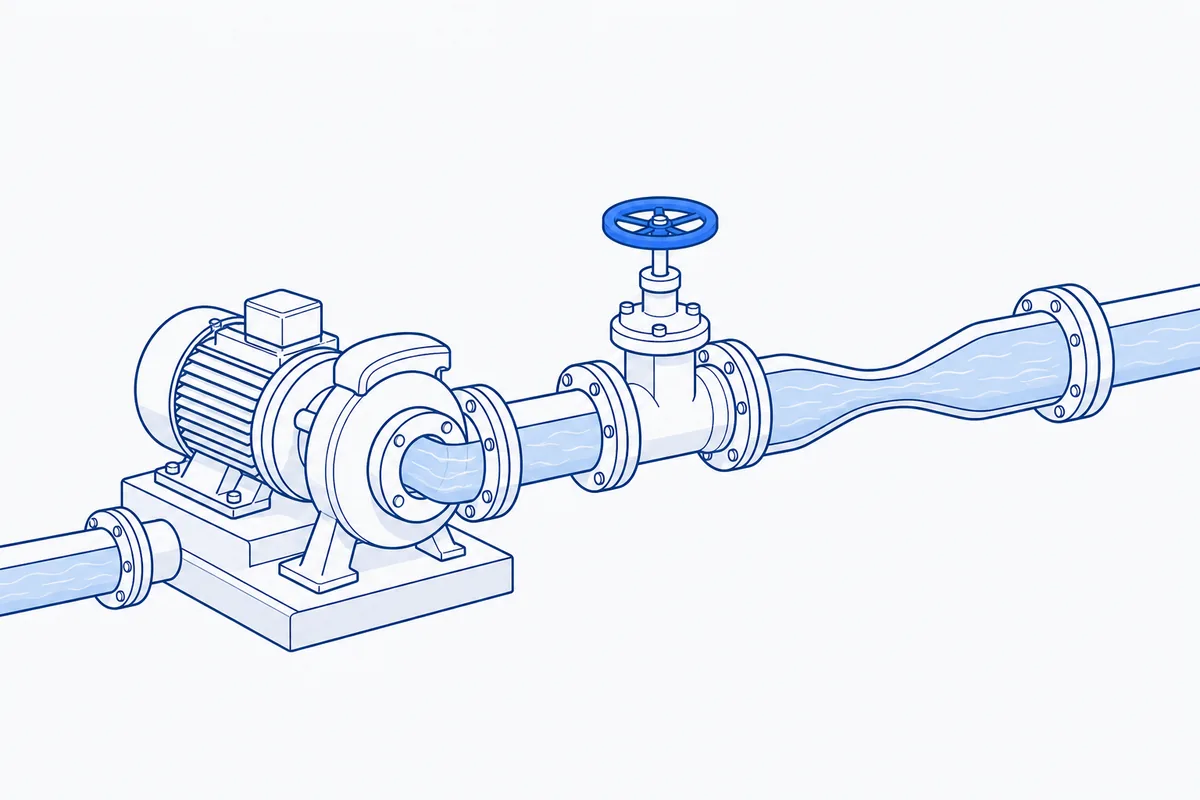
Line drawing of a centrifugal pump, a pipe with a valve and a venturi meter

How Fluid Mechanics is tested

Fluid mechanics questions cover hydrostatic pressure and forces, buoyancy, continuity, the energy (Bernoulli) equation with losses, momentum forces, pipe flow and flow meters. Write the energy equation between two points before doing anything else, and watch gauge versus absolute pressure and head versus pressure units.

On exam day the relationships you need are in the Reference Handbook section on Fluid Mechanics. The handbook is the only reference allowed, so practice finding each formula in it rather than memorizing a separate sheet.

FE Other Disciplines Fluid Mechanics practice problems

Work each problem with your calculator and the handbook, then open the solution.

Problem 1 · Flow measurement

A venturi meter in a 200 mm water line has a 100 mm throat and a discharge coefficient of 0.98. The pressure difference between the inlet and the throat is 40 kPa. Take ρ = 1000 kg/m³. Enter the flow rate in L/s, to one decimal place.

Fill in the blank: answer in L/s.

Show the answer and solution

Answer: 71.1 L/s (accepted 70.1 to 72.1)

β = 100/200 = 0.5, so 1 − β⁴ = 0.9375. Q = C_dA₂√[2Δp/(ρ(1 − β⁴))] = 0.98(0.007854)√[80/0.9375] = 0.98(0.007854)(9.238) = 0.0711 m³/s = 71.1 L/s.

Flow measurement · Reference Handbook: Fluid Mechanics

Problem 2 · Fluid properties

A clean glass tube with an inside diameter of 1.2 mm stands vertically in water at 20°C. The surface tension is 0.0728 N/m, the contact angle is 0°, and γ = 9.81 kN/m³. The capillary rise is most nearly:

  1. A.12.4 mm
  2. B.24.7 mm
  3. C.49.5 mm
  4. D.243 mm
Show the answer and solution

Answer: B: 24.7 mm

h = 4σ cos θ/(γd) = 4(0.0728)(1)/[9810(0.0012)] = 0.0247 m = 24.7 mm. The formula 2σ cos θ/(γr) is equivalent and uses the radius; mixing the radius into the diameter form doubles the answer to 49.5 mm.

Fluid properties · Reference Handbook: Fluid Mechanics

Problem 3 · Fluid statics

A vertical rectangular sluice gate is 2.0 m wide and 3.0 m tall. Its top edge is 1.5 m below the free water surface, and water is on one side only. Take γ = 9.81 kN/m³. Enter the resultant hydrostatic force on the gate in kN, to the nearest kN.

Fill in the blank: answer in kN.

Show the answer and solution

Answer: 176.6 kN (accepted 174.6 to 178.6)

The centroid of the gate is 1.5 + 3.0/2 = 3.0 m deep, and the gate area is 6.0 m². F = γh_cA = 9.81(3.0)(6.0) = 176.6 kN. The pressure at the centroid, not at either edge, gives the average pressure on a plane surface.

Fluid statics · Reference Handbook: Fluid Mechanics

Problem 4 · Basic hydraulics

A rectangular channel 4.0 m wide carries 12 m³/s. Take g = 9.81 m/s². The critical depth is most nearly:

  1. A.0.67 m
  2. B.0.77 m
  3. C.0.97 m
  4. D.2.45 m
Show the answer and solution

Answer: C: 0.97 m

q = Q/b = 12/4.0 = 3.0 m²/s, and y_c = (q²/g)^(1/3) = (9.0/9.81)^(1/3) = 0.97 m. Using the total discharge instead of q (the discharge per meter of width) gives 2.45 m.

Basic hydraulics · Reference Handbook: Civil Engineering

More FE Other Disciplines practice problems from every knowledge area

Sit the full exam under the real clock

110 questions on the real 5 hours 20 minutes clock, weighted to the NCEES specifications, with a score by knowledge area and a worked solution for every answer.

Or start the free Fluid Mechanics drill

Common questions

How many Fluid Mechanics questions are on the FE Other Disciplines exam?

The NCEES FE Other Disciplines specification lists 12–18 questions on Fluid Mechanics, out of 110. Every examinee gets the same number per knowledge area.

What does Fluid Mechanics cover on the FE Other Disciplines exam?

Fluid properties (e.g., Newtonian, non-Newtonian, liquids and gases); Dimensionless numbers (e.g., Reynolds number, Froude number, Mach number); Laminar and turbulent flow; Fluid statics (e.g., hydrostatic head); Energy, impulse, and momentum equations (e.g., Bernoulli equation); Pipe and duct flow and friction losses (e.g., pipes, valves, fittings, laminar, transitional and turbulent flow); Open-channel flow (e.g., Manning’s equation, drag); Fluid transport systems (e.g., series and parallel operations); Flow measurement (e.g., pitot tube, venturi meter, weir); Turbomachinery (e.g., pumps, turbines, fans, compressors); Ideal gas law (e.g., mixtures of nonreactive gases); Real gas law (e.g., z factor).

Where are the Fluid Mechanics formulas on exam day?

In the NCEES FE Reference Handbook, which appears on screen during the exam: the Fluid Mechanics section. Practice with your free copy from MyNCEES so you know where each relationship sits.

Original independent practice questions written to the published NCEES exam specifications. Not affiliated with or endorsed by NCEES (National Council of Examiners for Engineering and Surveying).