FE Civil Water Resources and Environmental Engineering

Knowledge area 10 of the FE Civil exam: 10–15 of the 110 questions. The subtopics NCEES lists, how they are tested and worked practice problems with solutions.

110 questions on the real 5 hours 20 minutes clock, weighted to the NCEES specifications, with a score by knowledge area and a worked solution for every answer.

Or start the free Water Resources and Environmental Engineering drill

What the specification lists

  • Basic hydrology (e.g., infiltration, rainfall, runoff, watersheds)
  • Basic hydraulics (e.g., Manning equation, Bernoulli theorem, open-channel flow)
  • Pumps
  • Water distribution systems
  • Flood control (e.g., dams, routing, spillways)
  • Stormwater (e.g., detention, routing, quality)
  • Collection systems (e.g., wastewater, stormwater)
  • Groundwater (e.g., flow, wells, drawdown)
  • Water quality (e.g., ground and surface, basic water chemistry)
  • Testing and standards (e.g., water, wastewater, air, noise)
  • Water and wastewater treatment (e.g., biological processes, softening, drinking water treatment)

From the NCEES FE Civil CBT exam specifications, knowledge area 10.

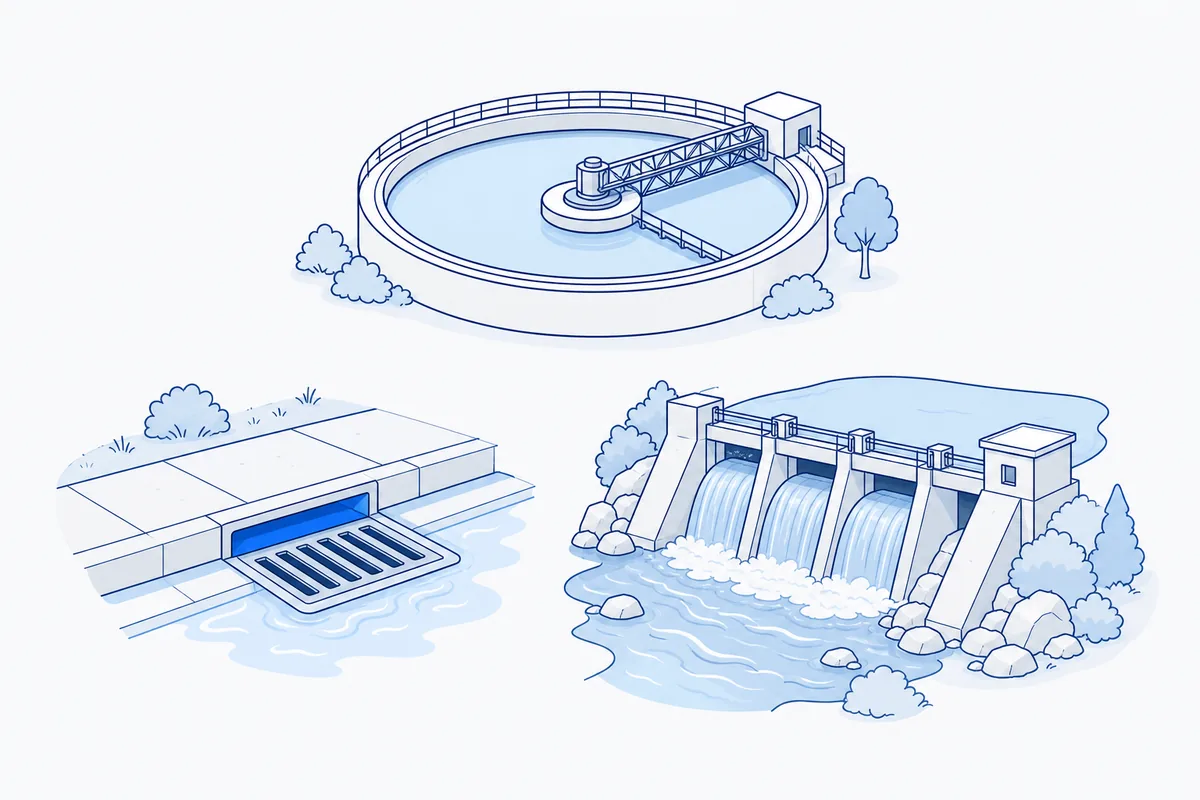
Line drawing of a water treatment clarifier, a storm drain inlet and a river with a small dam

How Water Resources and Environmental Engineering is tested

Water resources and environmental questions are the largest civil block. Expect the rational method, Manning’s equation, Hazen-Williams, pump power, well drawdown, BOD and dissolved oxygen, detention time and overflow rate. The Reference Handbook sections on civil engineering and environmental engineering carry these relationships.

On exam day the relationships you need are in the Reference Handbook sections on Civil Engineering and Environmental Engineering and Fluid Mechanics. The handbook is the only reference allowed, so practice finding each formula in it rather than memorizing a separate sheet.

FE Civil Water Resources and Environmental Engineering practice problems

Work each problem with your calculator and the handbook, then open the solution.

Problem 1 · Water and wastewater treatment

A water plant treats 12 MGD. The chlorine demand of the water is 2.8 mg/L, and a free residual of 0.5 mg/L is required. Take 8.34 lb/(MG·mg/L). Enter the required chlorine feed rate in lb/day, to the nearest lb/day.

Fill in the blank: answer in lb/day.

Show the answer and solution

Answer: 330 lb/day (accepted 326 to 334)

Dose = demand + residual = 2.8 + 0.5 = 3.3 mg/L. Feed = 3.3(12)(8.34) = 330 lb/day. The demand is consumed by reactions in the water, so the residual remains only if the demand is satisfied first.

Water and wastewater treatment · Reference Handbook: Environmental Engineering

Problem 2 · Collection systems

An 18 in diameter concrete storm sewer (n = 0.013) is laid on a slope of 0.004. Using Manning's equation in U.S. units, Q = (1.486/n)AR^(2/3)S^(1/2), the full-flow capacity is most nearly:

  1. A.4.47 ft³/s
  2. B.6.64 ft³/s
  3. C.10.5 ft³/s
  4. D.16.7 ft³/s
Show the answer and solution

Answer: B: 6.64 ft³/s

For a full circular pipe, A = π(1.5)²/4 = 1.767 ft² and R = D/4 = 0.375 ft. Q = (1.486/0.013)(1.767)(0.375)^(2/3)(0.004)^(1/2) = 114.3(1.767)(0.520)(0.0632) = 6.64 ft³/s. The hydraulic radius of a full circle is D/4, not the geometric radius D/2.

Collection systems · Reference Handbook: Civil Engineering

Problem 3 · Basic hydraulics

A rectangular concrete channel 3.0 m wide carries water at a uniform depth of 1.2 m. Manning's n = 0.015 and the bed slope is 0.002. Using Manning's equation in SI units, V = (1/n)R^(2/3)S^(1/2), the discharge is most nearly:

  1. A.0.37 m³/s
  2. B.8.19 m³/s
  3. C.9.68 m³/s
  4. D.12.2 m³/s
Show the answer and solution

Answer: B: 8.19 m³/s

A = 3.0(1.2) = 3.6 m², P = 3.0 + 2(1.2) = 5.4 m, and R = A/P = 0.667 m. Q = (1/0.015)(3.6)(0.667)^(2/3)(0.002)^(1/2) = 66.7(3.6)(0.763)(0.0447) = 8.19 m³/s. The 1.486 constant converts the equation to U.S. units and does not belong in an SI calculation.

Basic hydraulics · Reference Handbook: Civil Engineering

Problem 4 · Pumps

A pump's head curve is H = 60 − 2,000Q², and the system curve is H = 20 + 3,000Q², with H in m and Q in m³/s. The flow at the operating point is most nearly:

  1. A.0.063 m³/s
  2. B.0.089 m³/s
  3. C.0.115 m³/s
  4. D.0.141 m³/s
Show the answer and solution

Answer: B: 0.089 m³/s

At the operating point the two curves give the same head: 60 − 2,000Q² = 20 + 3,000Q², so 40 = 5,000Q² and Q = 0.089 m³/s. The head there is 60 − 2,000(0.008) = 44.0 m.

Pumps · Reference Handbook: Civil Engineering

More FE Civil practice problems from every knowledge area

Sit the full exam under the real clock

110 questions on the real 5 hours 20 minutes clock, weighted to the NCEES specifications, with a score by knowledge area and a worked solution for every answer.

Or start the free Water Resources and Environmental Engineering drill

Common questions

How many Water Resources and Environmental Engineering questions are on the FE Civil exam?

The NCEES FE Civil specification lists 10–15 questions on Water Resources and Environmental Engineering, out of 110. Every examinee gets the same number per knowledge area.

What does Water Resources and Environmental Engineering cover on the FE Civil exam?

Basic hydrology (e.g., infiltration, rainfall, runoff, watersheds); Basic hydraulics (e.g., Manning equation, Bernoulli theorem, open-channel flow); Pumps; Water distribution systems; Flood control (e.g., dams, routing, spillways); Stormwater (e.g., detention, routing, quality); Collection systems (e.g., wastewater, stormwater); Groundwater (e.g., flow, wells, drawdown); Water quality (e.g., ground and surface, basic water chemistry); Testing and standards (e.g., water, wastewater, air, noise); Water and wastewater treatment (e.g., biological processes, softening, drinking water treatment).

Where are the Water Resources and Environmental Engineering formulas on exam day?

In the NCEES FE Reference Handbook, which appears on screen during the exam: the Civil Engineering and Environmental Engineering and Fluid Mechanics sections. Practice with your free copy from MyNCEES so you know where each relationship sits.

Original independent practice questions written to the published NCEES exam specifications. Not affiliated with or endorsed by NCEES (National Council of Examiners for Engineering and Surveying).