FE Civil Structural Engineering

Knowledge area 11 of the FE Civil exam: 10–15 of the 110 questions. The subtopics NCEES lists, how they are tested and worked practice problems with solutions.

110 questions on the real 5 hours 20 minutes clock, weighted to the NCEES specifications, with a score by knowledge area and a worked solution for every answer.

Or start the free Structural Engineering drill

What the specification lists

  • Analysis of statically determinant beams, columns, trusses, and frames
  • Deflection of statically determinant beams, trusses, and frames
  • Column analysis (e.g., buckling, boundary conditions)
  • Structural determinacy and stability analysis of beams, trusses, and frames
  • Elementary statically indeterminate structures
  • Loads, load combinations, and load paths (e.g., dead, live, lateral, influence lines and moving loads, tributary areas)
  • Design of steel components (e.g., codes and design philosophies, beams, columns, tension members, connections)
  • Design of reinforced concrete components (e.g., codes and design philosophies, beams, columns)

From the NCEES FE Civil CBT exam specifications, knowledge area 11.

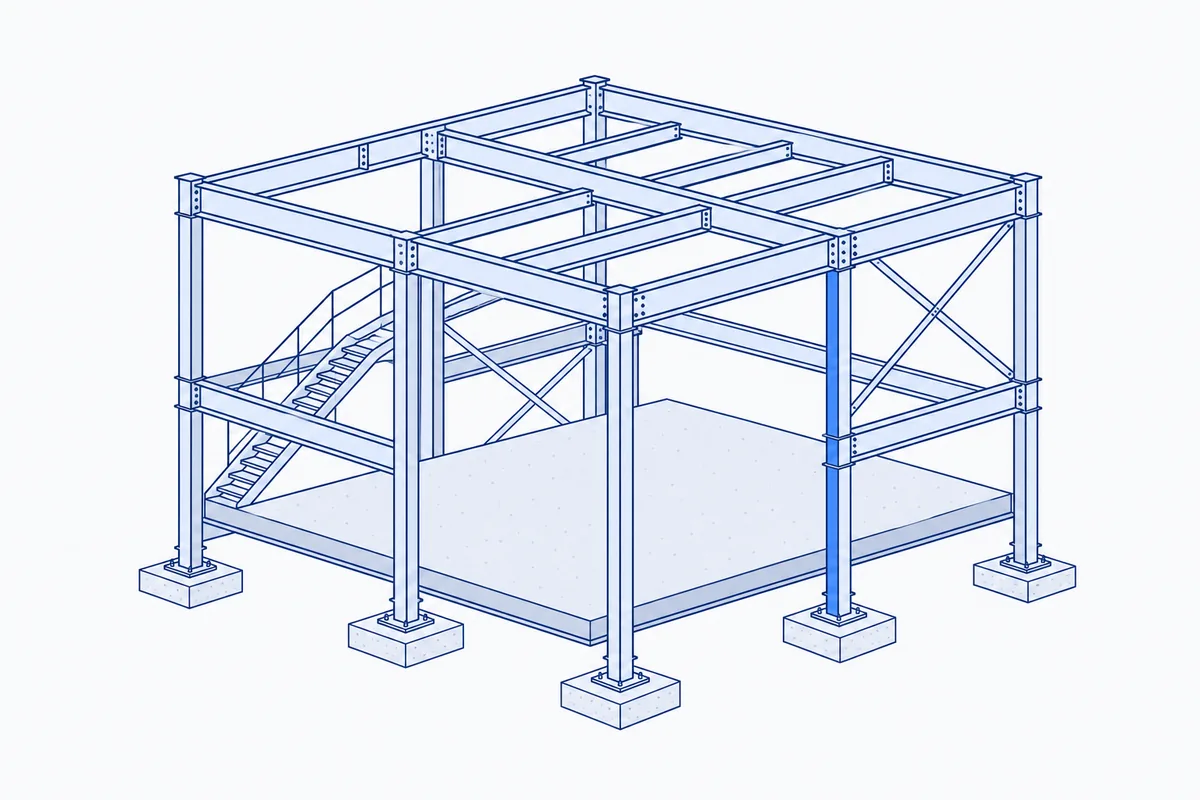
Line drawing of a building frame of steel columns and beams with a concrete floor slab

How Structural Engineering is tested

Structural questions cover determinate analysis, deflections, column buckling, determinacy and stability, load combinations and tributary areas, and basic steel and reinforced concrete design checks. Know the LRFD resistance factors and the rectangular stress block cold.

On exam day the relationships you need are in the Reference Handbook sections on Civil Engineering and Mechanics of Materials. The handbook is the only reference allowed, so practice finding each formula in it rather than memorizing a separate sheet.

FE Civil Structural Engineering practice problems

Work each problem with your calculator and the handbook, then open the solution.

Problem 1 · Deflection of statically determinant beams, trusses, and frames

A W21×68 steel beam (I = 1,480 in⁴) spans 30 ft between simple supports and carries a 24 kip concentrated load at midspan. Use E = 29,000 ksi and neglect self-weight. The midspan deflection is most nearly:

  1. A.0.136 in.
  2. B.0.340 in.
  3. C.0.544 in.
  4. D.8.70 in.
Show the answer and solution

Answer: C: 0.544 in.

For a simply supported beam with a midspan point load, δ = PL³/(48EI) = 24(360)³/[48(29,000)(1,480)] = 0.544 in. The span must be in inches (30 ft = 360 in.) to match E in ksi and I in in⁴.

Deflection of statically determinant beams, trusses, and frames · Reference Handbook: Civil Engineering

Problem 2 · Structural determinacy and stability analysis of beams, trusses, and frames

A continuous beam is fixed at its left end A and rests on rollers at B and C. An internal hinge is located within span AB. All loads are in the plane of the beam. The degree of static indeterminacy of the beam is:

  1. A.0
  2. B.1
  3. C.2
  4. D.3
Show the answer and solution

Answer: B: 1

Reactions: fixed support 3 + two rollers 1 + 1 = 5 unknowns. Equations: 3 equilibrium equations plus 1 condition equation (zero moment) at the internal hinge = 4. Degree of indeterminacy = 5 − 4 = 1. Ignoring the hinge gives 2.

Structural determinacy and stability analysis of beams, trusses, and frames · Reference Handbook: Civil Engineering

Problem 3 · Loads, load combinations, and load paths (e.g., dead, live, lateral, influence lines and moving loads, tributary areas)

An interior column supports one floor level framed with bays of 25 ft × 30 ft on all sides. The floor dead load is 90 psf and the live load is 80 psf. Considering only 1.4D and 1.2D + 1.6L and ignoring live-load reduction, the factored axial load on the column is most nearly:

  1. A.94.5 kips
  2. B.128 kips
  3. C.177 kips
  4. D.708 kips
Show the answer and solution

Answer: C: 177 kips

An interior column's tributary area is half a bay in each direction on every side, which totals one full bay: 25 × 30 = 750 ft². w_u = 1.2(90) + 1.6(80) = 236 psf (1.4D = 126 psf does not govern). P_u = 236(750) = 177,000 lb = 177 kips.

Loads, load combinations, and load paths (e.g., dead, live, lateral, influence lines and moving loads, tributary areas) · Reference Handbook: Civil Engineering

Problem 4 · Design of steel components (e.g., codes and design philosophies, beams, columns, tension members, connections)

A W18×50 beam of A992 steel (Fy = 50 ksi; Zx = 101 in³, Sx = 88.9 in³) is compact and fully braced against lateral-torsional buckling. Its LRFD design flexural strength, φMn = 0.90FyZx, is most nearly:

  1. A.333 kip·ft
  2. B.379 kip·ft
  3. C.421 kip·ft
  4. D.4,550 kip·ft
Show the answer and solution

Answer: B: 379 kip·ft

φMn = 0.90FyZx = 0.90(50)(101) = 4,545 kip·in. ÷ 12 = 379 kip·ft. For a compact, fully braced section the nominal moment is the plastic moment, which uses Zx; Sx gives the smaller yield moment.

Design of steel components (e.g., codes and design philosophies, beams, columns, tension members, connections) · Reference Handbook: Civil Engineering

More FE Civil practice problems from every knowledge area

Sit the full exam under the real clock

110 questions on the real 5 hours 20 minutes clock, weighted to the NCEES specifications, with a score by knowledge area and a worked solution for every answer.

Or start the free Structural Engineering drill

Common questions

How many Structural Engineering questions are on the FE Civil exam?

The NCEES FE Civil specification lists 10–15 questions on Structural Engineering, out of 110. Every examinee gets the same number per knowledge area.

What does Structural Engineering cover on the FE Civil exam?

Analysis of statically determinant beams, columns, trusses, and frames; Deflection of statically determinant beams, trusses, and frames; Column analysis (e.g., buckling, boundary conditions); Structural determinacy and stability analysis of beams, trusses, and frames; Elementary statically indeterminate structures; Loads, load combinations, and load paths (e.g., dead, live, lateral, influence lines and moving loads, tributary areas); Design of steel components (e.g., codes and design philosophies, beams, columns, tension members, connections); Design of reinforced concrete components (e.g., codes and design philosophies, beams, columns).

Where are the Structural Engineering formulas on exam day?

In the NCEES FE Reference Handbook, which appears on screen during the exam: the Civil Engineering and Mechanics of Materials sections. Practice with your free copy from MyNCEES so you know where each relationship sits.

Original independent practice questions written to the published NCEES exam specifications. Not affiliated with or endorsed by NCEES (National Council of Examiners for Engineering and Surveying).