FE Civil Geotechnical Engineering

Knowledge area 12 of the FE Civil exam: 10–15 of the 110 questions. The subtopics NCEES lists, how they are tested and worked practice problems with solutions.

110 questions on the real 5 hours 20 minutes clock, weighted to the NCEES specifications, with a score by knowledge area and a worked solution for every answer.

Or start the free Geotechnical Engineering drill

What the specification lists

  • Index properties and soil classifications
  • Phase relations
  • Laboratory and field tests
  • Effective stress
  • Stability of retaining structures (e.g., active/passive/at-rest pressure)
  • Shear strength
  • Bearing capacity
  • Foundation types (e.g., spread footings, deep foundations, wall footings, mats)
  • Consolidation and differential settlement
  • Slope stability (e.g., fills, embankments, cuts, dams)
  • Soil stabilization (e.g., chemical additives, geosynthetics)

From the NCEES FE Civil CBT exam specifications, knowledge area 12.

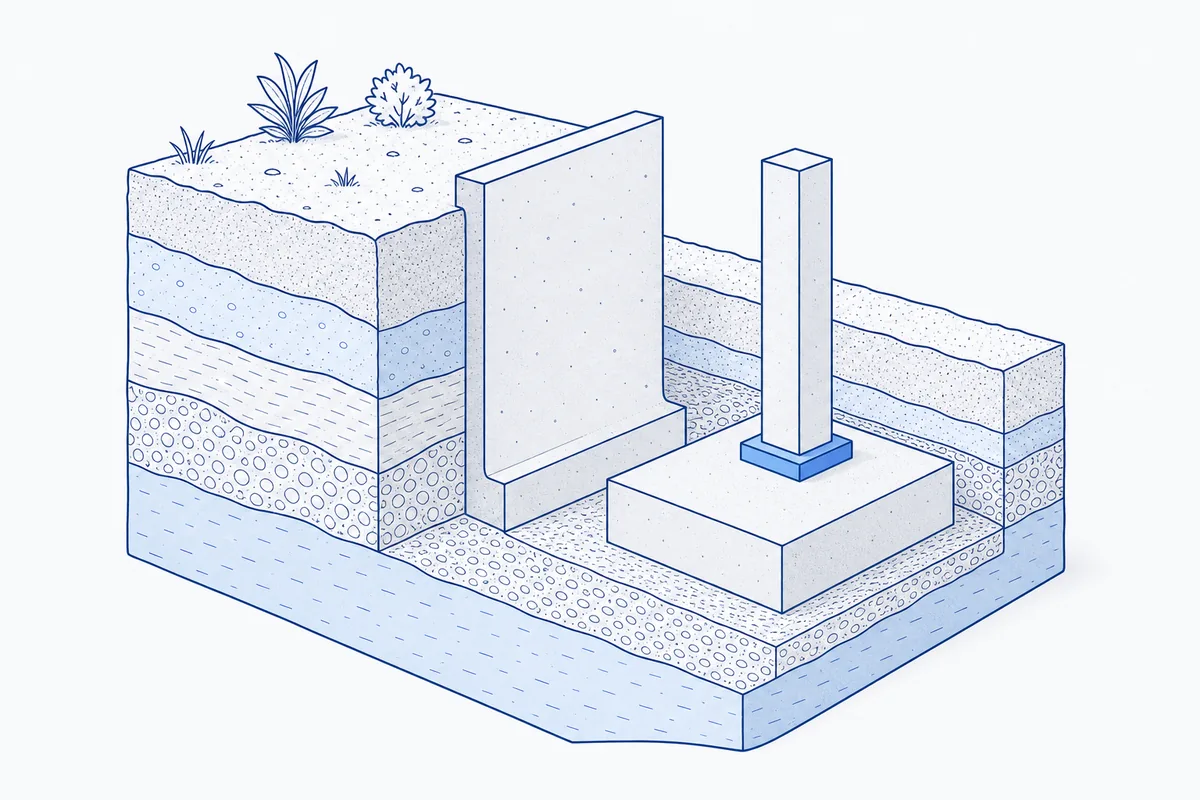
Line drawing of a soil profile cut with layered strata, a retaining wall and a spread footing

How Geotechnical Engineering is tested

Geotechnical questions are phase relations, classification, effective stress, lateral earth pressure, shear strength, bearing capacity, consolidation settlement and slope stability. Phase-diagram problems are free points once you can move between void ratio, porosity, water content and unit weight.

On exam day the relationships you need are in the Reference Handbook section on Civil Engineering. The handbook is the only reference allowed, so practice finding each formula in it rather than memorizing a separate sheet.

FE Civil Geotechnical Engineering practice problems

Work each problem with your calculator and the handbook, then open the solution.

Problem 1 · Laboratory and field tests

In a constant-head permeability test on a sand specimen 10 cm in diameter and 15 cm long, a head difference of 60 cm across the specimen produces 600 cm³ of outflow in 240 s. The hydraulic conductivity is most nearly:

  1. A.0.000531 cm/s
  2. B.0.00199 cm/s
  3. C.0.00625 cm/s
  4. D.0.00796 cm/s
Show the answer and solution

Answer: D: 0.00796 cm/s

A = π(10)²/4 = 78.54 cm². k = QL/(Aht) = 600(15)/[78.54(60)(240)] = 7.96 × 10⁻³ cm/s, typical of a fine to medium sand.

Laboratory and field tests · Reference Handbook: Civil Engineering

Problem 2 · Shear strength

A saturated silty clay has effective-stress strength parameters c' = 10 kPa and φ' = 28°. On a potential failure plane, the total normal stress is 150 kPa and the pore water pressure is 50 kPa. The shear strength on that plane is most nearly:

  1. A.46.9 kPa
  2. B.53.2 kPa
  3. C.56.9 kPa
  4. D.63.2 kPa
Show the answer and solution

Answer: D: 63.2 kPa

σ' = 150 − 50 = 100 kPa. τf = c' + σ' tan φ' = 10 + 100 tan 28° = 10 + 53.17 = 63.2 kPa. Effective-stress parameters must be paired with the effective normal stress, not the total stress.

Shear strength · Reference Handbook: Civil Engineering

Problem 3 · Soil stabilization (e.g., chemical additives, geosynthetics)

Select all that apply.

A nonwoven geotextile is placed between a soft silty subgrade and a crushed-stone base course for a haul road. Which of the following functions can the geotextile perform in this application? Select all that apply.

  1. A.Separation, keeping the subgrade fines from pumping into the stone
  2. B.Filtration, letting water pass while retaining soil particles
  3. C.In-plane drainage of water within the fabric
  4. D.Raising the plasticity index of the subgrade
  5. E.Acting as an impermeable barrier that blocks all water flow
Show the answer and solution

Answer: A: Separation, keeping the subgrade fines from pumping into the stone; B: Filtration, letting water pass while retaining soil particles; C: In-plane drainage of water within the fabric

Geotextiles perform separation, filtration, drainage (transmissivity, especially nonwovens), reinforcement and protection. Here separation and filtration preserve the base course's thickness and drainage capacity. Geomembranes, not geotextiles, serve as liquid barriers.

Soil stabilization (e.g., chemical additives, geosynthetics) · Reference Handbook: Civil Engineering

Problem 4 · Phase relations

An undisturbed tube sample has a volume of 1.000 × 10⁻³ m³ and a mass of 1.95 kg. After oven drying its mass is 1.68 kg. The specific gravity of solids is 2.68 and ρw = 1,000 kg/m³. Enter the void ratio to three decimal places.

Fill in the blank: answer in .

Show the answer and solution

Answer: 0.595 (accepted 0.589 to 0.601)

Dry density ρd = 1.68/1.000 × 10⁻³ = 1680 kg/m³. Volume of solids = 1.68/(2.68 × 1000) = 0.6269 × 10⁻³ m³, so e = V_v/V_s = Gsρw/ρd − 1 = 2680/1680 − 1 = 0.595.

Phase relations · Reference Handbook: Civil Engineering

More FE Civil practice problems from every knowledge area

Sit the full exam under the real clock

110 questions on the real 5 hours 20 minutes clock, weighted to the NCEES specifications, with a score by knowledge area and a worked solution for every answer.

Or start the free Geotechnical Engineering drill

Common questions

How many Geotechnical Engineering questions are on the FE Civil exam?

The NCEES FE Civil specification lists 10–15 questions on Geotechnical Engineering, out of 110. Every examinee gets the same number per knowledge area.

What does Geotechnical Engineering cover on the FE Civil exam?

Index properties and soil classifications; Phase relations; Laboratory and field tests; Effective stress; Stability of retaining structures (e.g., active/passive/at-rest pressure); Shear strength; Bearing capacity; Foundation types (e.g., spread footings, deep foundations, wall footings, mats); Consolidation and differential settlement; Slope stability (e.g., fills, embankments, cuts, dams); Soil stabilization (e.g., chemical additives, geosynthetics).

Where are the Geotechnical Engineering formulas on exam day?

In the NCEES FE Reference Handbook, which appears on screen during the exam: the Civil Engineering section. Practice with your free copy from MyNCEES so you know where each relationship sits.

Original independent practice questions written to the published NCEES exam specifications. Not affiliated with or endorsed by NCEES (National Council of Examiners for Engineering and Surveying).