FE Civil Mechanics of Materials

Knowledge area 6 of the FE Civil exam: 7–11 of the 110 questions. The subtopics NCEES lists, how they are tested and worked practice problems with solutions.

110 questions on the real 5 hours 20 minutes clock, weighted to the NCEES specifications, with a score by knowledge area and a worked solution for every answer.

Or start the free Mechanics of Materials drill

What the specification lists

  • Shear and moment diagrams
  • Stresses and strains (e.g., diagrams, axial, torsion, bending, shear, thermal)
  • Deformations (e.g., axial, torsion, bending, thermal)
  • Combined stresses, principal stresses, and Mohr’s circle

From the NCEES FE Civil CBT exam specifications, knowledge area 6.

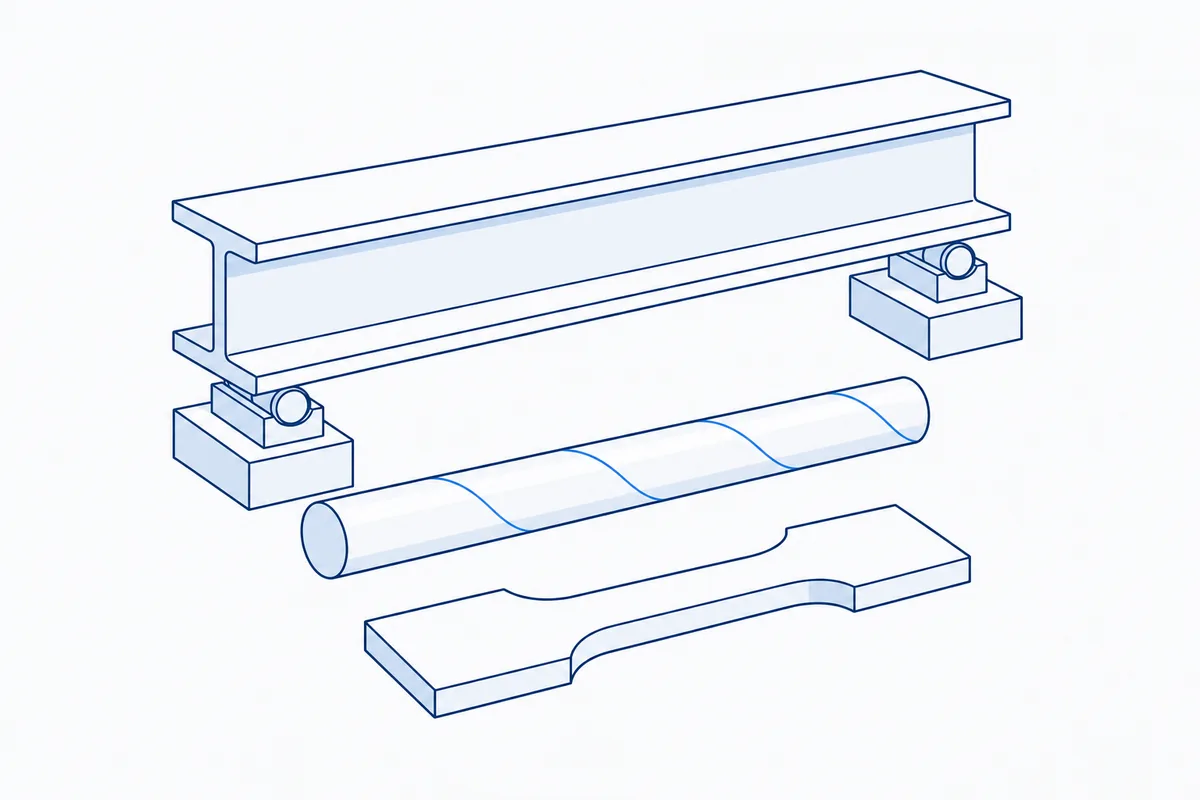
Line drawing of a steel I-beam bending slightly over two supports beside a twisted shaft and a test coupon

How Mechanics of Materials is tested

Mechanics of materials questions are short stress and deformation calculations: axial, torsion, bending, transverse shear, thermal, combined stress and column buckling. Know which formula applies to which loading and keep units consistent; the Reference Handbook section on mechanics of materials lists the beam deflection cases and the stress formulas.

On exam day the relationships you need are in the Reference Handbook section on Mechanics of Materials. The handbook is the only reference allowed, so practice finding each formula in it rather than memorizing a separate sheet.

FE Civil Mechanics of Materials practice problems

Work each problem with your calculator and the handbook, then open the solution.

Problem 1 · Stress and strain caused by axial loads

A solid steel hanger rod 20 mm in diameter and 2.5 m long carries an axial tensile load of 50 kN. Use E = 200 GPa. The elongation of the rod is most nearly:

  1. A.0.497 mm
  2. B.1.56 mm
  3. C.1.99 mm
  4. D.7.96 mm
Show the answer and solution

Answer: C: 1.99 mm

A = π(0.020)²/4 = 314.2 mm². δ = PL/(AE) = (50,000 N)(2.5 m)/[(3.1416e-04 m²)(200 × 10⁹ Pa)] = 1.989e-03 m = 1.99 mm. Using πd² instead of πd²/4 makes the area four times too large and gives 0.497 mm.

Stress and strain caused by axial loads · Reference Handbook: Mechanics of Materials

Problem 2 · Stress and strain caused by shear

A rectangular steel bar used as a short beam is 60 mm wide and 200 mm deep. At a section where the vertical shear force is 18 kN, the maximum transverse shear stress is most nearly:

  1. A.1.50 MPa
  2. B.2.00 MPa
  3. C.2.25 MPa
  4. D.3.00 MPa
Show the answer and solution

Answer: C: 2.25 MPa

For a rectangle the maximum shear stress at the neutral axis is τ = VQ/(Ib) = 3V/(2A) = 1.5(18,000 N)/(0.060 × 0.200 m²) = 2.25 MPa. The average V/A = 1.50 MPa underestimates the peak by a third.

Stress and strain caused by shear · Reference Handbook: Mechanics of Materials

Problem 3 · Deformations

A simply supported steel beam spans 30 ft and carries a uniform load of 1.5 kip/ft. Use E = 29,000 ksi and I = 1,500 in⁴. The midspan deflection is most nearly:

  1. A.0.628 in.
  2. B.1.01 in.
  3. C.6.03 in.
  4. D.7.54 in.
Show the answer and solution

Answer: A: 0.628 in.

w = 1.5 kip/ft = 0.125 kip/in., L = 360 in. δ = 5wL⁴/(384EI) = 5(0.125)(360)⁴/[384(29,000)(1,500)] = 0.628 in. Keeping w in kip/ft with L in inches inflates the answer twelvefold to 7.54 in.

Deformations · Reference Handbook: Mechanics of Materials

Problem 4 · Statically indeterminate systems

A short column is a steel tube (A_s = 3,000 mm², E_s = 200 GPa) completely filled with concrete (A_c = 40,000 mm², E_c = 25 GPa), bonded so both materials shorten equally. A 500 kN axial compressive load is applied through a rigid cap. The compressive stress in the steel is most nearly:

  1. A.1.55 MPa
  2. B.7.81 MPa
  3. C.11.6 MPa
  4. D.62.5 MPa
Show the answer and solution

Answer: D: 62.5 MPa

Compatibility: ε_s = ε_c, so σ_s/E_s = σ_c/E_c. Equilibrium: σ_sA_s + σ_cA_c = P. Then σ_s = PE_s/(A_sE_s + A_cE_c) = 500,000(200,000)/[3000(200,000) + 40,000(25,000)] = 62.5 MPa, and σ_c = 7.81 MPa. Dividing by the total area treats both materials as equally stiff and gives 11.6 MPa.

Statically indeterminate systems · Reference Handbook: Mechanics of Materials

More FE Civil practice problems from every knowledge area

Sit the full exam under the real clock

110 questions on the real 5 hours 20 minutes clock, weighted to the NCEES specifications, with a score by knowledge area and a worked solution for every answer.

Or start the free Mechanics of Materials drill

Common questions

How many Mechanics of Materials questions are on the FE Civil exam?

The NCEES FE Civil specification lists 7–11 questions on Mechanics of Materials, out of 110. Every examinee gets the same number per knowledge area.

What does Mechanics of Materials cover on the FE Civil exam?

Shear and moment diagrams; Stresses and strains (e.g., diagrams, axial, torsion, bending, shear, thermal); Deformations (e.g., axial, torsion, bending, thermal); Combined stresses, principal stresses, and Mohr’s circle.

Where are the Mechanics of Materials formulas on exam day?

In the NCEES FE Reference Handbook, which appears on screen during the exam: the Mechanics of Materials section. Practice with your free copy from MyNCEES so you know where each relationship sits.

Original independent practice questions written to the published NCEES exam specifications. Not affiliated with or endorsed by NCEES (National Council of Examiners for Engineering and Surveying).