FE Civil Materials

Knowledge area 7 of the FE Civil exam: 5–8 of the 110 questions. The subtopics NCEES lists, how they are tested and worked practice problems with solutions.

110 questions on the real 5 hours 20 minutes clock, weighted to the NCEES specifications, with a score by knowledge area and a worked solution for every answer.

Or start the free Materials drill

What the specification lists

  • Mix design of concrete and asphalt
  • Test methods and specifications of metals, concrete, aggregates, asphalt, and wood
  • Physical and mechanical properties of metals, concrete, aggregates, asphalt, and wood

From the NCEES FE Civil CBT exam specifications, knowledge area 7.

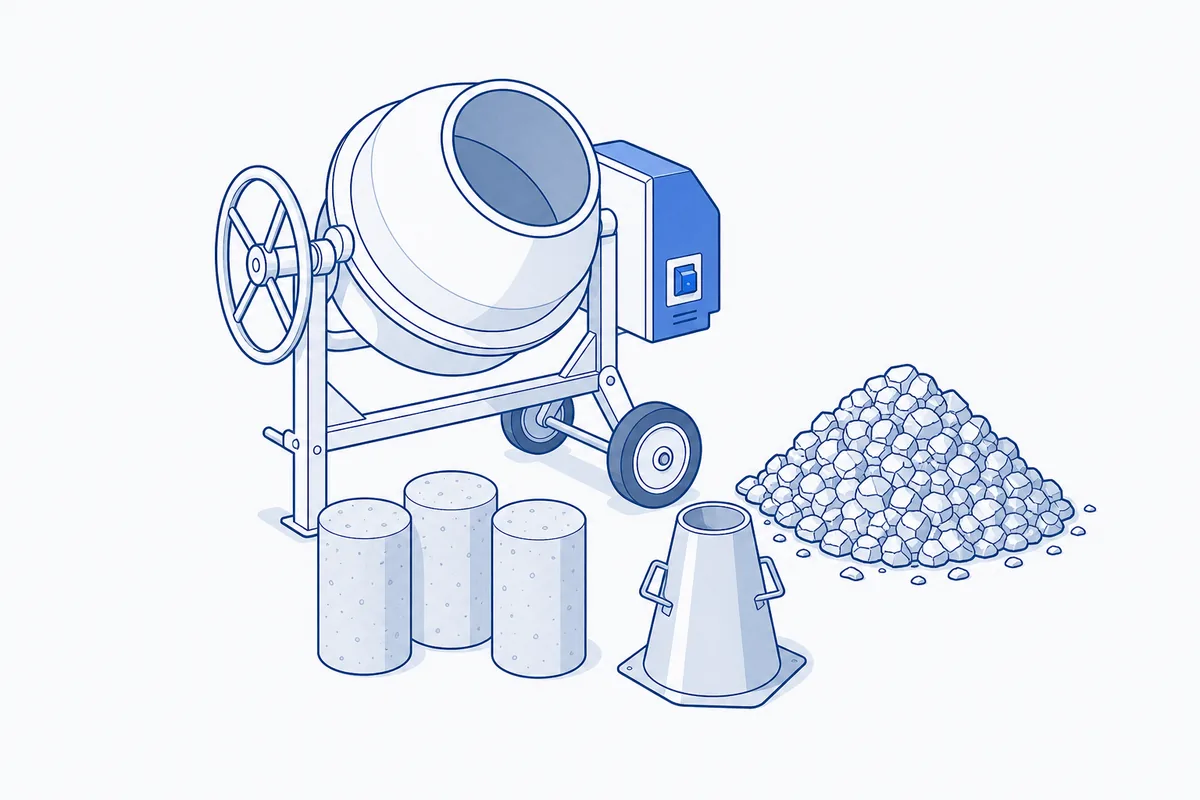
Line drawing of a concrete mixer, test cylinders, a slump cone and a pile of aggregate

How Materials is tested

Civil materials questions cover concrete mix design (water-cement ratio, absolute volume, moisture corrections), aggregate properties, asphalt mixture properties and test methods for concrete, aggregates, asphalt, metals and wood.

On exam day the relationships you need are in the Reference Handbook sections on Civil Engineering and Materials Science/Structure of Matter. The handbook is the only reference allowed, so practice finding each formula in it rather than memorizing a separate sheet.

FE Civil Materials practice problems

Work each problem with your calculator and the handbook, then open the solution.

Problem 1 · Physical and mechanical properties of metals, concrete, aggregates, asphalt, and wood

Green lumber with a moisture content of 60% is kiln dried to 12%. The fiber saturation point of the species is about 28%. Compared with the green condition, the dried lumber is:

  1. A.Weaker, because drying always splits the wood fibers
  2. B.Unchanged in strength and dimensions, because only free water in the cell cavities was removed
  3. C.Stronger and stiffer, and it has shrunk in cross section
  4. D.Larger in cross section, because the cell walls expand as they dry
Show the answer and solution

Answer: C: Stronger and stiffer, and it has shrunk in cross section

From 60% down to the fiber saturation point (~28%) only free water in the cell cavities leaves, with no change in strength or size. Below that point bound water leaves the cell walls, so the wood shrinks (most tangentially, least longitudinally) and its strength and stiffness increase. Drying from 28% to 12% therefore produces both shrinkage and a gain in mechanical properties.

Physical and mechanical properties of metals, concrete, aggregates, asphalt, and wood · Reference Handbook: Civil Engineering

Problem 2 · Test methods and specifications of metals, concrete, aggregates, asphalt, and wood

Select all that apply.

Which of the following tests are performed on fresh (plastic) concrete, before it hardens? Select all that apply.

  1. A.Slump test
  2. B.Air content by the pressure method
  3. C.Compressive strength of molded cylinders
  4. D.Splitting tensile strength test
  5. E.Unit weight (density) of the freshly mixed concrete
Show the answer and solution

Answer: A: Slump test; B: Air content by the pressure method; E: Unit weight (density) of the freshly mixed concrete

Slump measures the consistency of plastic concrete, the pressure meter measures its entrained air, and the fresh unit weight is used to compute yield and check proportions; all are run at the time of placement. Cylinders are molded from the fresh concrete but are tested for compressive and splitting tensile strength only after curing.

Test methods and specifications of metals, concrete, aggregates, asphalt, and wood · Reference Handbook: Civil Engineering

Problem 3 · Mix design of concrete and asphalt

A compacted hot-mix asphalt specimen has a bulk specific gravity Gmb = 2.390 and a theoretical maximum specific gravity Gmm = 2.480. The mix contains 5.5% asphalt binder by total mix mass, and the aggregate bulk specific gravity is Gsb = 2.650. The voids in the mineral aggregate (VMA) is most nearly:

  1. A.3.63%
  2. B.8.93%
  3. C.9.81%
  4. D.14.8%
Show the answer and solution

Answer: D: 14.8%

VMA = 100 − Gmb·Ps/Gsb = 100 − 2.390(94.5)/2.650 = 100 − 85.23 = 14.8%. The air voids are Va = 100(1 − 2.390/2.480) = 3.63%, so the voids filled with asphalt are VFA = (14.8 − 3.63)/14.8 = 75%. VMA must use the aggregate's own bulk specific gravity and its mass fraction Ps.

Mix design of concrete and asphalt · Reference Handbook: Civil Engineering

Problem 4 · Mix design of concrete and asphalt

A trial concrete batch uses four 94 lb bags of cement, 188 lb of water, 820 lb of SSD fine aggregate and 1,560 lb of SSD coarse aggregate. The fresh concrete has a measured unit weight of 145.0 lb/ft³. Enter the yield of the batch in ft³ to one decimal place.

Fill in the blank: answer in ft³.

Show the answer and solution

Answer: 20.3 ft³ (accepted 20.1 to 20.5)

Yield = total batch weight/unit weight. Batch weight = 4(94) + 188 + 820 + 1,560 = 2,944 lb. Yield = 2,944/145.0 = 20.30 ft³ ≈ 20.3 ft³ (0.752 yd³). Every ingredient, including water, is part of the batch mass.

Mix design of concrete and asphalt · Reference Handbook: Civil Engineering

More FE Civil practice problems from every knowledge area

Sit the full exam under the real clock

110 questions on the real 5 hours 20 minutes clock, weighted to the NCEES specifications, with a score by knowledge area and a worked solution for every answer.

Or start the free Materials drill

Common questions

How many Materials questions are on the FE Civil exam?

The NCEES FE Civil specification lists 5–8 questions on Materials, out of 110. Every examinee gets the same number per knowledge area.

What does Materials cover on the FE Civil exam?

Mix design of concrete and asphalt; Test methods and specifications of metals, concrete, aggregates, asphalt, and wood; Physical and mechanical properties of metals, concrete, aggregates, asphalt, and wood.

Where are the Materials formulas on exam day?

In the NCEES FE Reference Handbook, which appears on screen during the exam: the Civil Engineering and Materials Science/Structure of Matter sections. Practice with your free copy from MyNCEES so you know where each relationship sits.

Original independent practice questions written to the published NCEES exam specifications. Not affiliated with or endorsed by NCEES (National Council of Examiners for Engineering and Surveying).