FE Civil Fluid Mechanics

Knowledge area 8 of the FE Civil exam: 6–9 of the 110 questions. The subtopics NCEES lists, how they are tested and worked practice problems with solutions.

110 questions on the real 5 hours 20 minutes clock, weighted to the NCEES specifications, with a score by knowledge area and a worked solution for every answer.

Or start the free Fluid Mechanics drill

What the specification lists

  • Flow measurement
  • Fluid properties
  • Fluid statics
  • Energy, impulse, and momentum of fluids

From the NCEES FE Civil CBT exam specifications, knowledge area 8.

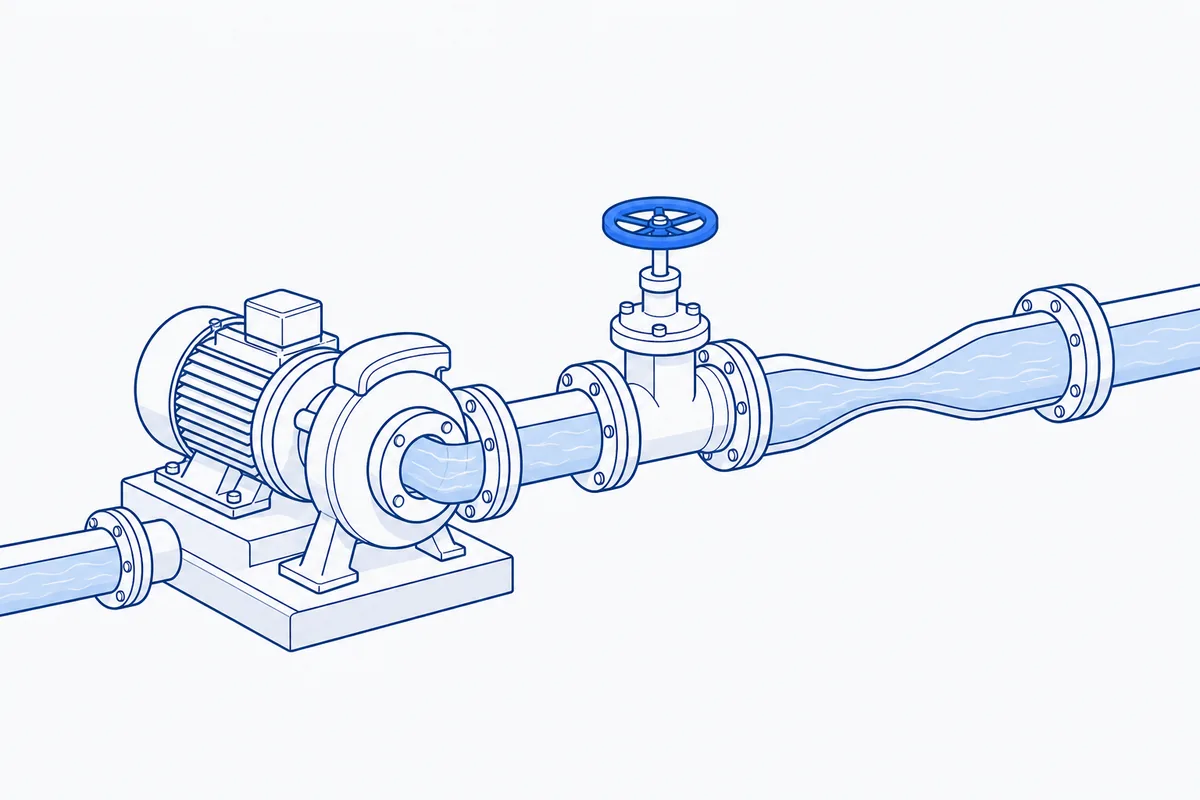
Line drawing of a centrifugal pump, a pipe with a valve and a venturi meter

How Fluid Mechanics is tested

Fluid mechanics questions cover hydrostatic pressure and forces, buoyancy, continuity, the energy (Bernoulli) equation with losses, momentum forces, pipe flow and flow meters. Write the energy equation between two points before doing anything else, and watch gauge versus absolute pressure and head versus pressure units.

On exam day the relationships you need are in the Reference Handbook section on Fluid Mechanics. The handbook is the only reference allowed, so practice finding each formula in it rather than memorizing a separate sheet.

FE Civil Fluid Mechanics practice problems

Work each problem with your calculator and the handbook, then open the solution.

Problem 1 · Flow measurement

A pitot-static tube in a water pipe is connected to a mercury differential manometer (SG = 13.6) that reads 60 mm. Take g = 9.81 m/s². The water velocity at the tube is most nearly:

  1. A.1.08 m/s
  2. B.2.72 m/s
  3. C.3.85 m/s
  4. D.4.00 m/s
Show the answer and solution

Answer: C: 3.85 m/s

The stagnation-minus-static head in meters of water is h = 0.060(13.6 − 1) = 0.756 m. V = √(2gh) = √[2(9.81)(0.756)] = 3.85 m/s. The water filling the manometer legs above the mercury is why (SG − 1) is used, not SG alone.

Flow measurement · Reference Handbook: Fluid Mechanics

Problem 2 · Energy, impulse, and momentum of fluids

Water in an 80 mm diameter horizontal pipe at 250 kPa gauge discharges to the atmosphere through a nozzle with a 50 mm exit diameter. Neglect losses and take ρ = 1000 kg/m³. The flow rate is most nearly:

  1. A.0.0337 m³/s
  2. B.0.0439 m³/s
  3. C.0.0477 m³/s
  4. D.0.122 m³/s
Show the answer and solution

Answer: C: 0.0477 m³/s

Bernoulli with continuity gives V₂ = √[(2Δp/ρ)/(1 − (d₂/d₁)⁴)] = √[500/(1 − 0.625⁴)] = √(500/0.8474) = 24.3 m/s. Q = V₂(π/4)(0.050)² = 0.0477 m³/s. Ignoring the pipe velocity gives 22.4 m/s and 0.0439 m³/s.

Energy, impulse, and momentum of fluids · Reference Handbook: Fluid Mechanics

Problem 3 · Fluid statics

A differential U-tube manometer filled with mercury (SG = 13.6) connects two points at the same elevation in a horizontal water pipe. The mercury levels differ by 150 mm. Take γ_water = 9.81 kN/m³. The pressure difference between the two points is most nearly:

  1. A.1.47 kPa
  2. B.18.5 kPa
  3. C.20.0 kPa
  4. D.185 kPa
Show the answer and solution

Answer: B: 18.5 kPa

Writing the manometer equation, the water columns above the mercury cancel except over the deflection: Δp = (SG_Hg − SG_w)γ_w h = (13.6 − 1)(9.81)(0.150) = 18.5 kPa. Using 13.6 alone overstates Δp at 20.0 kPa.

Fluid statics · Reference Handbook: Fluid Mechanics

Problem 4 · Fluid properties

A clean glass tube with an inside diameter of 1.2 mm stands vertically in water at 20°C. The surface tension is 0.0728 N/m, the contact angle is 0°, and γ = 9.81 kN/m³. The capillary rise is most nearly:

  1. A.12.4 mm
  2. B.24.7 mm
  3. C.49.5 mm
  4. D.243 mm
Show the answer and solution

Answer: B: 24.7 mm

h = 4σ cos θ/(γd) = 4(0.0728)(1)/[9810(0.0012)] = 0.0247 m = 24.7 mm. The formula 2σ cos θ/(γr) is equivalent and uses the radius; mixing the radius into the diameter form doubles the answer to 49.5 mm.

Fluid properties · Reference Handbook: Fluid Mechanics

More FE Civil practice problems from every knowledge area

Sit the full exam under the real clock

110 questions on the real 5 hours 20 minutes clock, weighted to the NCEES specifications, with a score by knowledge area and a worked solution for every answer.

Or start the free Fluid Mechanics drill

Common questions

How many Fluid Mechanics questions are on the FE Civil exam?

The NCEES FE Civil specification lists 6–9 questions on Fluid Mechanics, out of 110. Every examinee gets the same number per knowledge area.

What does Fluid Mechanics cover on the FE Civil exam?

Flow measurement; Fluid properties; Fluid statics; Energy, impulse, and momentum of fluids.

Where are the Fluid Mechanics formulas on exam day?

In the NCEES FE Reference Handbook, which appears on screen during the exam: the Fluid Mechanics section. Practice with your free copy from MyNCEES so you know where each relationship sits.

Original independent practice questions written to the published NCEES exam specifications. Not affiliated with or endorsed by NCEES (National Council of Examiners for Engineering and Surveying).