FE Civil Construction Engineering

Knowledge area 14 of the FE Civil exam: 8–12 of the 110 questions. The subtopics NCEES lists, how they are tested and worked practice problems with solutions.

110 questions on the real 5 hours 20 minutes clock, weighted to the NCEES specifications, with a score by knowledge area and a worked solution for every answer.

Or start the free Construction Engineering drill

What the specification lists

  • Project administration (e.g., documents, management, procurement, project delivery methods)
  • Construction operations and methods (e.g., safety, equipment, productivity analysis, temporary erosion control)
  • Project controls (e.g., earned value, scheduling, allocation of resources, activity relationships)
  • Construction estimating
  • Interpretation of engineering drawings

From the NCEES FE Civil CBT exam specifications, knowledge area 14.

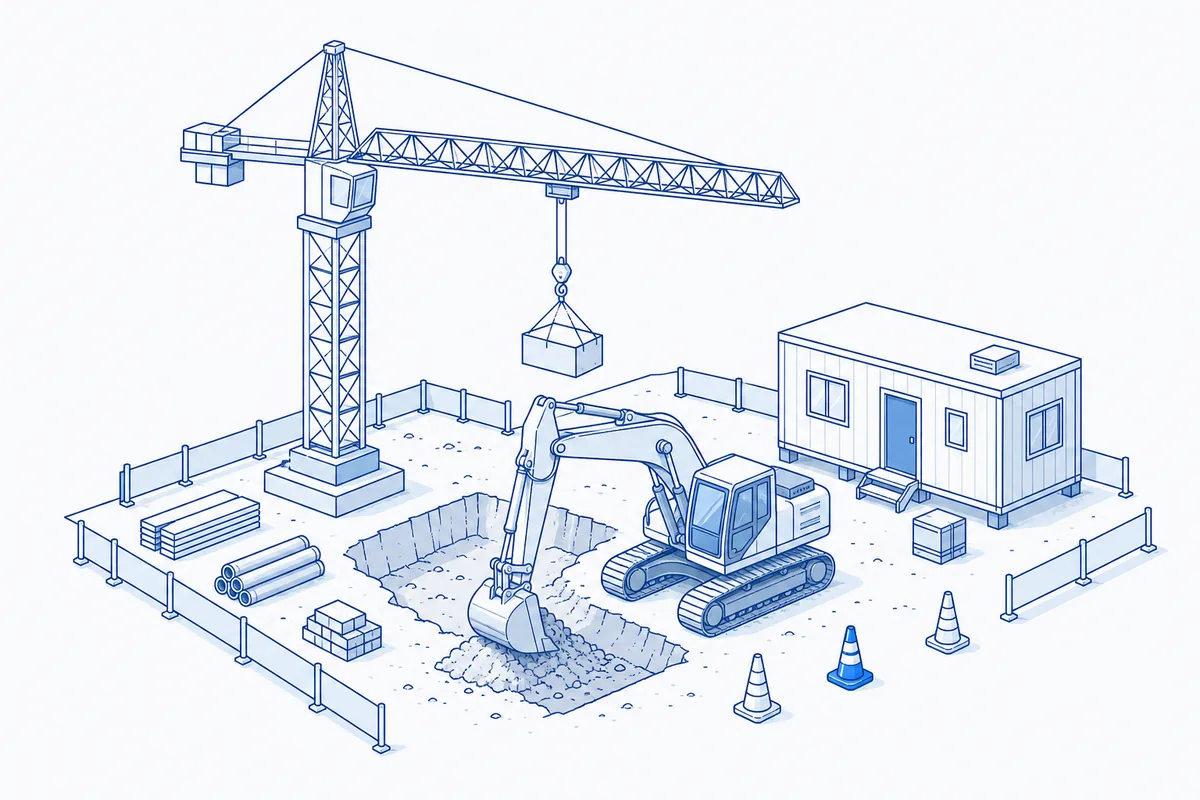
Line drawing of a construction site with a tower crane, an excavator and a site trailer

How Construction Engineering is tested

Construction questions cover project delivery and contracts, CPM scheduling (forward and backward pass, float), earned value (CPI, SPI, EAC), equipment productivity, quantity takeoff and estimating, and safety basics.

On exam day the relationships you need are in the Reference Handbook sections on Civil Engineering and Engineering Economics. The handbook is the only reference allowed, so practice finding each formula in it rather than memorizing a separate sheet.

FE Civil Construction Engineering practice problems

Work each problem with your calculator and the handbook, then open the solution.

Problem 1 · Project administration (e.g., documents, management, procurement, project delivery methods)

Select all that apply.

Which of the following are characteristics of the traditional design-bid-build delivery method on a public project? Select all that apply.

  1. A.The design is essentially complete before construction bids are solicited
  2. B.The contract is typically awarded to the lowest responsive, responsible bidder
  3. C.The owner holds separate contracts with the designer and the contractor
  4. D.The contractor provides constructability reviews throughout schematic design
  5. E.One entity provides a single point of responsibility for design and construction
Show the answer and solution

Answer: A: The design is essentially complete before construction bids are solicited; B: The contract is typically awarded to the lowest responsive, responsible bidder; C: The owner holds separate contracts with the designer and the contractor

Design-bid-build is sequential: the owner hires a designer, completes the plans and specifications, advertises for bids and awards to the lowest responsive, responsible bidder. The owner sits between two separate contracts, so the contractor is normally not involved until design is complete.

Project administration (e.g., documents, management, procurement, project delivery methods) · Reference Handbook: Civil Engineering

Problem 2 · Project controls (e.g., earned value, scheduling, allocation of resources, activity relationships)

A small bridge-repair schedule has the following activities. Activity A: 3 days, no predecessor. B: 5 days, after A. C: 4 days, after A. D: 6 days, after B. E: 2 days, after C. F: 3 days, after D and E. All relationships are finish-to-start with no lags. The project duration is most nearly:

  1. A.12 days
  2. B.14 days
  3. C.17 days
  4. D.23 days
Show the answer and solution

Answer: C: 17 days

Forward pass: A 0–3; B 3–8; C 3–7; D 8–14; E 7–9; F starts at max(14, 9) = 14 and finishes at 17. The project takes 17 days along the critical path A–B–D–F. Summing every duration (23 days) ignores that B and C run in parallel.

Project controls (e.g., earned value, scheduling, allocation of resources, activity relationships) · Reference Handbook: Civil Engineering

Problem 3 · Interpretation of engineering drawings

On a topographic site plan, a series of contour lines forms V shapes whose points aim uphill, toward higher elevations. These contours indicate:

  1. A.A ridge or spur running downhill
  2. B.A valley or drainage channel, with water flowing downhill along it
  3. C.A closed depression with no outlet
  4. D.A vertical cliff where contours merge
Show the answer and solution

Answer: B: A valley or drainage channel, with water flowing downhill along it

Where contours cross a stream or valley they bend upstream, so the V's point toward higher ground and water flows out of the V toward lower contours. Ridges show the opposite pattern, with the V's pointing downhill. Closely spaced contours indicate steep ground and widely spaced contours gentle ground.

Interpretation of engineering drawings · Reference Handbook: Civil Engineering

Problem 4 · Construction estimating

A slab on grade measures 60 ft × 40 ft and is 6 in. thick. The estimator adds 5% for waste and over-excavation. Enter the volume of concrete to order in cubic yards to one decimal place.

Fill in the blank: answer in yd³.

Show the answer and solution

Answer: 46.7 yd³ (accepted 46.3 to 47.1)

Volume = 60 × 40 × 0.5 = 1,200 ft³ = 1,200/27 = 44.44 yd³. With 5% waste: 44.44 × 1.05 = 46.67 yd³ ≈ 46.7 yd³.

Construction estimating · Reference Handbook: Civil Engineering

More FE Civil practice problems from every knowledge area

Sit the full exam under the real clock

110 questions on the real 5 hours 20 minutes clock, weighted to the NCEES specifications, with a score by knowledge area and a worked solution for every answer.

Or start the free Construction Engineering drill

Common questions

How many Construction Engineering questions are on the FE Civil exam?

The NCEES FE Civil specification lists 8–12 questions on Construction Engineering, out of 110. Every examinee gets the same number per knowledge area.

What does Construction Engineering cover on the FE Civil exam?

Project administration (e.g., documents, management, procurement, project delivery methods); Construction operations and methods (e.g., safety, equipment, productivity analysis, temporary erosion control); Project controls (e.g., earned value, scheduling, allocation of resources, activity relationships); Construction estimating; Interpretation of engineering drawings.

Where are the Construction Engineering formulas on exam day?

In the NCEES FE Reference Handbook, which appears on screen during the exam: the Civil Engineering and Engineering Economics sections. Practice with your free copy from MyNCEES so you know where each relationship sits.

Original independent practice questions written to the published NCEES exam specifications. Not affiliated with or endorsed by NCEES (National Council of Examiners for Engineering and Surveying).