ARRT Radiation Protection Practice Questions
Safety · 29 of the 200 scored questions in ARRT’s content specifications
230 questions across all eight subcategories in 230 minutes, with a score for Radiation Protection so you know where you stand.
Free Radiation Protection drillA female patient of childbearing age arrives for a lumbar spine series. What should the radiographer do before the exam?
Radiation Protection on the ARRT radiography exam
Radiation Protection has 29 of the 200 scored questions, the larger half of the Safety category. It covers how the radiographer keeps patient dose low with technique, collimation and positioning, how fluoroscopy and mobile units are controlled, and how personnel protect themselves and track their dose.
- Share of the exam
- 29 of the 200 scored questions now; 25 from March 1, 2027
- Our drill
- 10 questions from 61 Radiation Protection questions, untimed, an explanation after every answer; one free attempt, unlimited with a pass
What Radiation Protection questions test
- Patient exposure: kVp, mAs and AEC, beam restriction, positioning and communication, pediatric and large patients, filtration and its effect on skin dose and beam energy
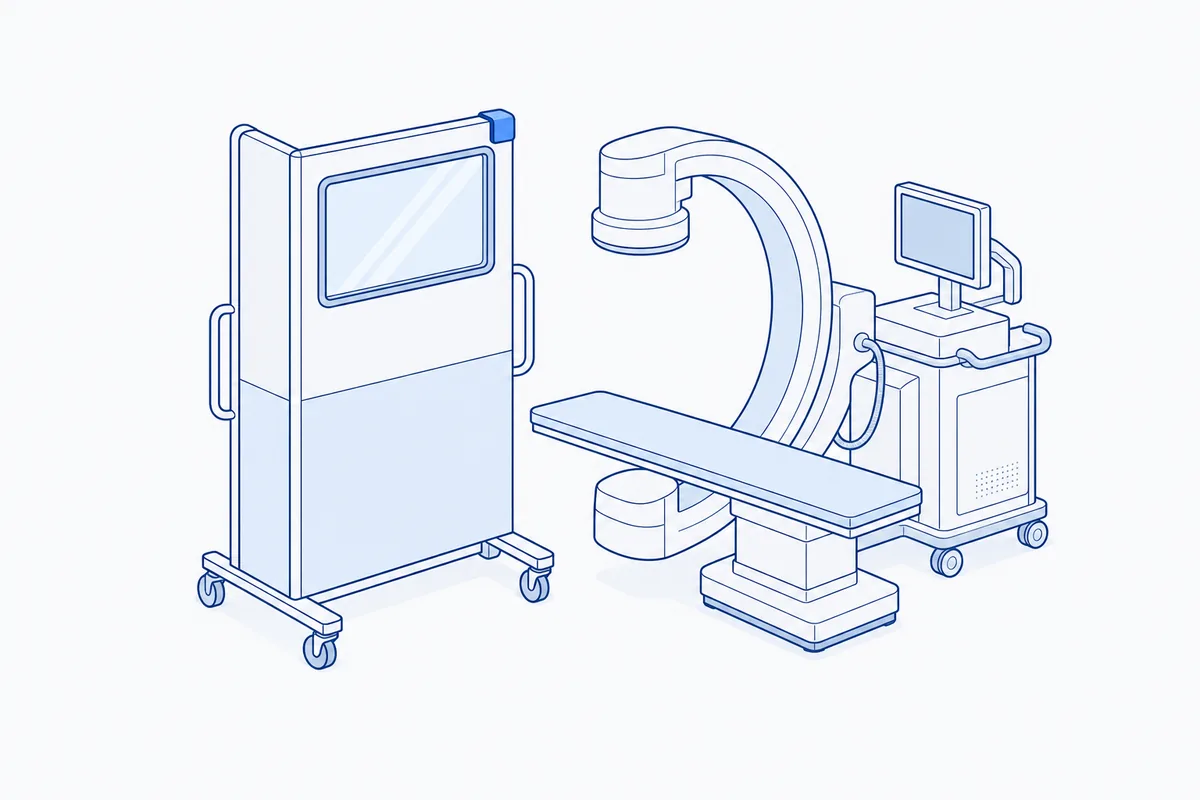
- Fluoroscopy: pulsed fluoroscopy, magnification mode, last image hold, the cumulative timer, air kerma display and minimum source-to-skin distance
- Personnel protection (ALARA): primary, scatter and leakage radiation, the patient as the main source of scatter, time, distance and shielding
- Protective devices: aprons, gloves and barriers, lead equivalent minimums, Bucky slot cover and protective drapes
- Monitoring: dosimeter types and where to wear them, NCRP Report No. 116 annual limits for workers, the public and the embryo or fetus, and dose records
Sit the full exam under the real clock
230 questions across all eight subcategories in 230 minutes, with a score for Radiation Protection so you know where you stand.
Free Radiation Protection drillHow to study it
- Memorize the NCRP Report No. 116 numbers: 50 mSv a year effective dose for workers, 1 mSv for the public with frequent exposure, 0.5 mSv a month to the embryo or fetus once a pregnancy is declared.
- Remember the fluoroscopy limits in 21 CFR 1020.32: 10 R/min (88 mGy/min) air kerma rate in normal mode and a 5-minute cumulative timer.
- For every question about lowering patient dose, look first for collimation, a higher kVp with lower mAs, and fewer repeats.
- Take the radiation protection drill until you score 85% or better.
Common questions
What is the annual occupational dose limit on the ARRT exam?
NCRP Report No. 116 recommends an effective dose limit of 50 mSv a year for occupationally exposed workers, with a cumulative limit of 10 mSv times age in years.
Is radiation protection changing in 2027?
Radiation Protection drops from 29 to 25 scored questions on March 1, 2027. The revised outline replaces “morbid obesity” with “body habitus,” adds pregnancy and exposure-reduction resources, and updates image receptor language to digital detectors.
230 questions across all eight subcategories in 230 minutes, with a score for Radiation Protection so you know where you stand.
Free Radiation Protection drillThe other ARRT radiography content areas
Sources
- ARRT: Radiography Examination Content Specifications, in force through February 28, 2027 (PDF)
- ARRT: Radiography Examination Content Specifications, effective March 1, 2027 (PDF)
- ARRT: 2026 Primary Eligibility Pathway Handbook: exam format, scoring, exam window and attempts (PDF)
- ARRT: Fees
- ARRT: Annual Exam Report 2025: passing score and approximate percent correct (PDF)
- ARRT: Updated Radiography documents (May 1, 2026), changes effective March 1, 2027
- NCRP Report No. 116, Limitation of Exposure to Ionizing Radiation
Original practice questions for exam preparation, written to the ARRT Radiography Examination Content Specifications, not ARRT exam questions. Independent practice, not affiliated with or endorsed by The American Registry of Radiologic Technologists (ARRT) or Pearson VUE. ARRT and R.T. are trademarks of the ARRT.