TExES 902 Mathematics Instruction and Processes

Competencies 001 and 006 of the Core Subjects EC–6: Mathematics (902). The competencies TEA lists, how they are tested and practice questions with explanations.

40 questions on the real 70-minute clock, with a score by competency group and an explanation for every answer.

Or start the free Mathematics Instruction and Processes drill

What the TEA framework lists

  • Competency 001, mathematics instruction: the concrete-representational-abstract sequence, manipulatives, questioning, assessment and real-world connections
  • Competency 006, mathematical processes: reasoning, reasonableness of answers, multiple representations, communication and financial literacy

Summarized from the TExES Core Subjects EC–6 (391) preparation manual, Section 3: exam framework, Competencies 001 and 006. The grouping of competencies into drill sets is ours.

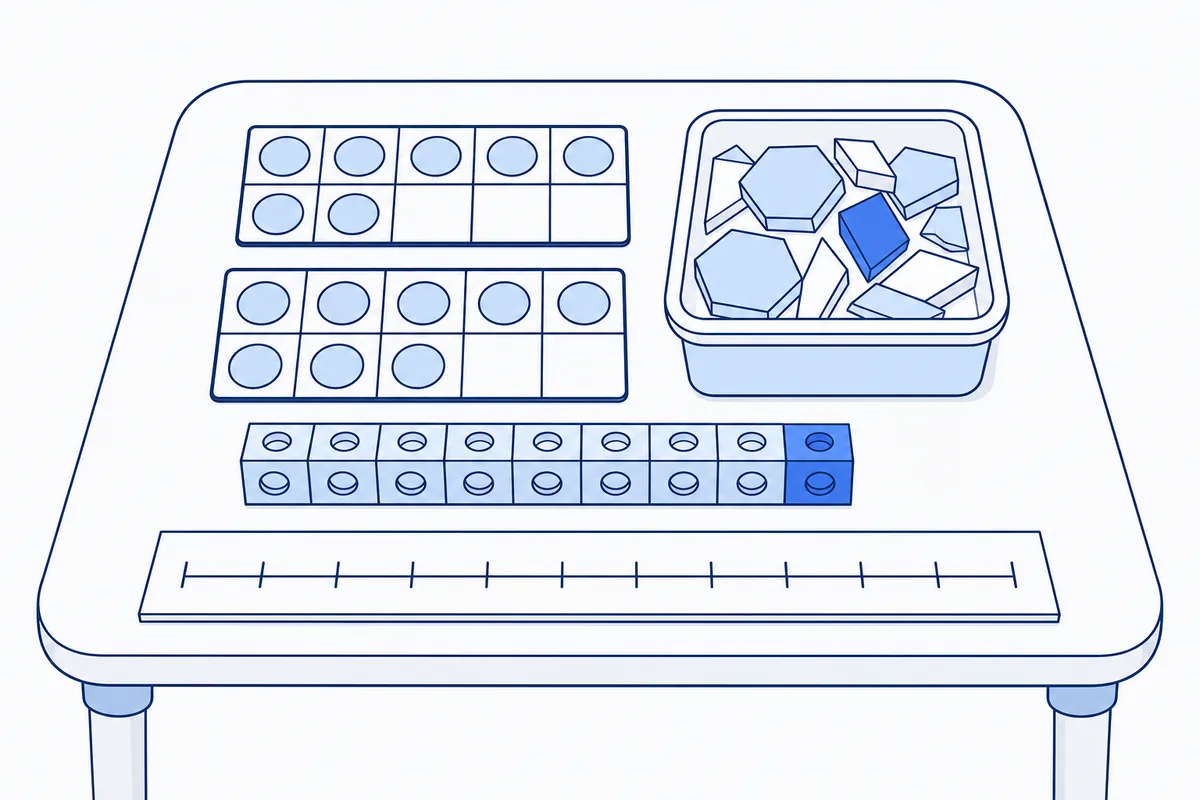
Line drawing of ten-frames with counters, linking cubes, a blank number line and pattern blocks

How Mathematics Instruction and Processes is tested

Questions describe a math lesson and ask which manipulative, sequence or question best builds understanding, or what a student’s error reveals. Know the concrete-representational-abstract progression and common misconceptions. TEA lists the competencies without weights, so our practice test spreads its questions evenly across them.

TExES 902 Mathematics Instruction and Processes practice questions

Answer each question, then open the explanation.

Question 1

A third-grade teacher uses an open number line to model 48 + 25 by jumping 20, then 5. This representation mainly helps students

  1. A.learn the vocabulary word "sum."
  2. B.understand addition as composing tens and ones.
  3. C.practice writing numerals neatly.
  4. D.memorize the addition facts to 20 so that they can recall them without counting.
Show the answer and explanation

Answer: B: understand addition as composing tens and ones.

An open number line shows how numbers can be broken into tens and ones and added in parts, building understanding of place value and mental strategies.

Question 2

Students are given the problem: "A pizza is cut into 8 slices. Maria eats 3 slices and Jon eats 2. What fraction of the pizza is left?" Which representation best helps young students solve it?

  1. A.A coordinate graph of the slices eaten
  2. B.An equation with a variable for the unknown amount
  3. C.A circle divided into 8 equal parts with the eaten slices shaded
  4. D.A table of values showing the number of slices each person ate and the slices left over
Show the answer and explanation

Answer: C: A circle divided into 8 equal parts with the eaten slices shaded

A partitioned circle models the fraction situation directly: 5 of 8 slices are shaded as eaten, so 3/8 is left. Equations and graphs are more abstract than needed.

Question 3

Which statement is an example of deductive reasoning?

  1. A.A student notices a pattern in a hundreds chart and predicts the next number.
  2. B.A student estimates the height of a tree by comparing it with a building.
  3. C.After measuring three triangles, a student guesses the angles always add to 180°.
  4. D.All squares are rectangles; this shape is a square, so it is a rectangle.
Show the answer and explanation

Answer: D: All squares are rectangles; this shape is a square, so it is a rectangle.

Deductive reasoning applies a general statement to a specific case to reach a conclusion that must be true. Generalizing from measured examples is inductive.

Question 4

Which assessment best shows whether students understand the concept of area rather than only the formula?

  1. A.Finding the area of an irregular shape on grid paper and explaining the method
  2. B.A multiple-choice question asking for the definition of area
  3. C.A timed quiz of length × width problems
  4. D.A matching worksheet that pairs each area formula with the correct shape name and a picture
Show the answer and explanation

Answer: A: Finding the area of an irregular shape on grid paper and explaining the method

Finding the area of an irregular shape and explaining the method shows that students understand area as covering a surface with square units, not only applying a formula.

Take the full test under the real clock

40 questions on the real 70-minute clock, with a score by competency group and an explanation for every answer.

Or start the free Mathematics Instruction and Processes drill

Common questions

How many Mathematics Instruction and Processes questions are on the TExES 902?

TEA lists the competencies of the TExES 902 without weights or question counts. Our 40-question practice test spreads its questions evenly across the competencies, which gives Mathematics Instruction and Processes 13 questions.

What does Mathematics Instruction and Processes cover on the TExES 902?

Competency 001, mathematics instruction: the concrete-representational-abstract sequence, manipulatives, questioning, assessment and real-world connections; Competency 006, mathematical processes: reasoning, reasonableness of answers, multiple representations, communication and financial literacy.

How should I study Mathematics Instruction and Processes for the TExES 902?

Questions describe a math lesson and ask which manipulative, sequence or question best builds understanding, or what a student’s error reveals. Know the concrete-representational-abstract progression and common misconceptions. TEA lists the competencies without weights, so our practice test spreads its questions evenly across them.

TExES is a trademark of the Texas Education Agency. Original independent practice questions written to the published TExES exam frameworks; not affiliated with or endorsed by the Texas Education Agency or Pearson.