CAPM Critical Path and Earned Value Practice Questions
The CAPM outline asks you to apply critical path methods and calculate schedule and cost variances. Practice original questions with activity tables and earned value data, with the full working for every calculation and an explanation for every option.
150 questions on the real 3-hour clock, weighted to PMI’s four domains, with the optional break after question 75, a score by domain and topic, and an explanation for every option.
Or try the free critical path and earned value drill- 34 original critical path and earned value questions, every option explained
- Predictive, Plan-Based Methodologies (17% of the exam)
- ECO tasks: II-2 Demonstrate an understanding of a project management plan schedule; II-3 Determine how to document project controls of predictive, plan-based projects
Status at the end of month 4
| Measure | Value |
|---|---|
| Budget at completion (BAC) | $200,000 |
| Planned value (PV) | $80,000 |
| Earned value (EV) | $70,000 |
| Actual cost (AC) | $90,000 |
What is the schedule performance index (SPI)?
What our critical path and earned value questions cover
- Finding the critical path and float from an activity list or network diagram
- Schedule variance (SV = EV − PV) and cost variance (CV = EV − AC)
- Schedule and cost performance indexes (SPI = EV / PV, CPI = EV / AC)
- Schedule compression: crashing and fast tracking
- Predictive artifacts: Gantt charts, milestone charts, baselines, status reports and change logs
This list is our own summary of the tasks, written for practice. PMI publishes the full task statements and enablers in the CAPM Examination Content Outline.
Drill critical path and earned value, then sit the full exam
150 questions on the real 3-hour clock, weighted to PMI’s four domains, with the optional break after question 75, a score by domain and topic, and an explanation for every option.
Or try the free critical path and earned value drillIdeas the questions test most
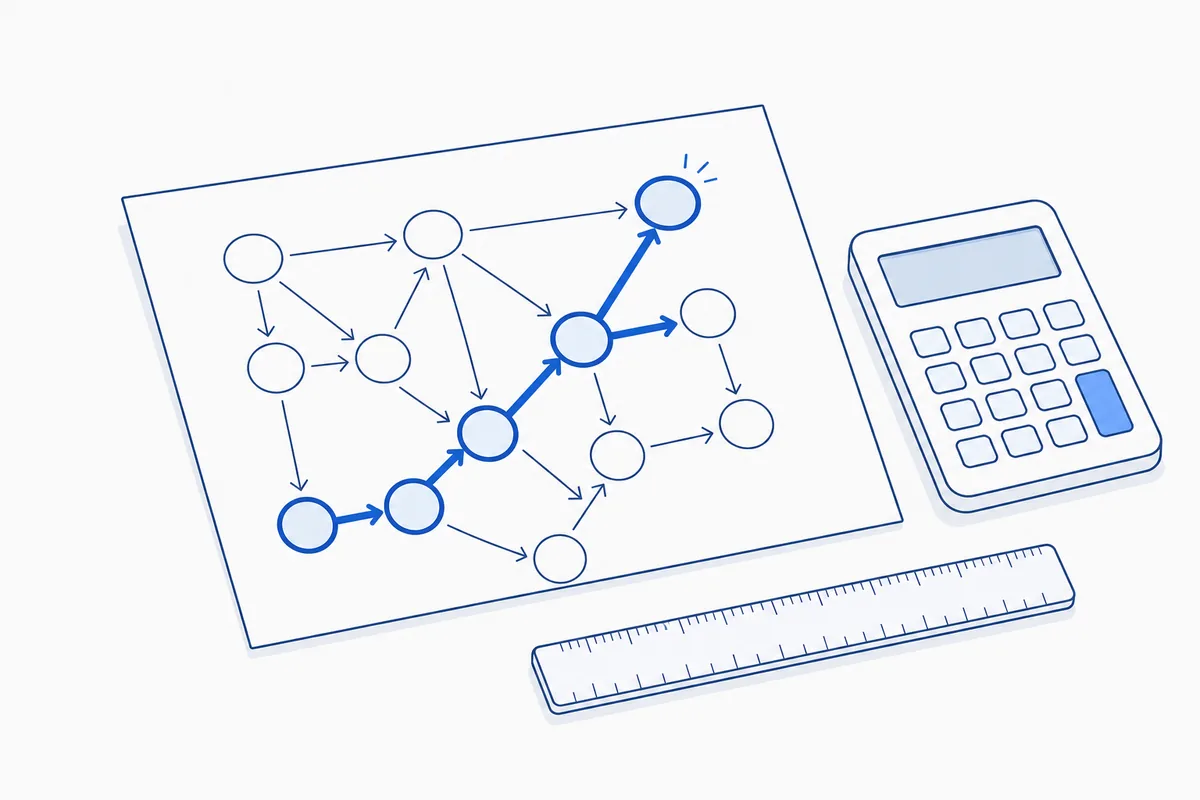
- The critical path is the longest path through the network and sets the shortest possible project duration. Its activities normally have zero total float, so delaying one delays the project.
- Total float is how long an activity can slip without delaying the project end date: late start − early start.
- SV = EV − PV and CV = EV − AC; a negative value means behind schedule or over budget. SPI = EV / PV and CPI = EV / AC; below 1.0 is unfavorable.
- Crashing adds resources to critical activities and raises cost; fast tracking runs planned-sequential activities in parallel and raises risk.
Start the free critical path and earned value drill · Predictive domain drill · Full 150-question practice exam
Common questions
Which earned value formulas are on the CAPM exam?
The outline names calculating schedule and cost variances, so know SV = EV − PV and CV = EV − AC, and the indexes SPI = EV / PV and CPI = EV / AC. A negative variance or an index below 1.0 means behind schedule or over budget.
How do you find the critical path?
Add up the durations along every path from start to finish; the longest path is the critical path and gives the project duration. Activities on it have zero float, so a delay to any of them delays the finish date.
150 questions on the real 3-hour clock, weighted to PMI’s four domains, with the optional break after question 75, a score by domain and topic, and an explanation for every option.
Or try the free critical path and earned value drillMore CAPM topics
- Life Cycles, Approaches and Ethics · Fundamentals
- Planning, Initiation and Closure · Fundamentals
- Roles, Leadership and Emotional Intelligence · Fundamentals
- Meetings and Problem-Solving Tools · Fundamentals
- Predictive Planning, WBS and Process Groups · Predictive
- When to Use an Adaptive Approach · Agile
- Iteration Planning and Agile Artifacts · Agile
- Scrum, XP, SAFe and Kanban · Agile
- Business Analysis Roles and Communication · Business Analysis
- Gathering Requirements · Business Analysis
- Product Roadmaps and Acceptance Criteria · Business Analysis
Domains, tasks and exam format: PMI: Certified Associate in Project Management (CAPM)® Examination Content Outline, 2023 Exam Update · PMI: CAPM certification page (exam length, time, domains, eligibility, retakes), checked November 2026.
CAPM®, PMP®, PMI® and PMBOK® are registered marks of the Project Management Institute, Inc. Game Assessment Prep is an independent practice site. It is not affiliated with, endorsed by or an Authorized Training Partner of the Project Management Institute (PMI). Every question is original; none is taken from PMI materials, the CAPM exam or another prep provider.