VTNE Surgical Nursing Practice Questions
Domain 2 of the VTNE · 20 of the 150 scored questions (13%)
170 questions across all ten domains in 3 hours, with a score for surgical nursing so you know where you stand.
Free surgical nursing drillDuring a splenectomy on a 20-kg dog, the team estimates 270 mL of blood loss from weighed sponges and the suction canister. Using an estimated blood volume of 90 mL/kg, what percentage of the dog's blood volume has been lost?
Surgical Nursing on the VTNE
Surgical Nursing is 20 of the 150 scored questions. It covers everything from the moment a surgery is scheduled to the moment the instruments are back on the shelf: preparing the suite and the patient, working as the sterile or the circulating technician, keeping asepsis, and cleaning, wrapping and sterilizing instruments.
- Share of the exam
- 20 of 150 scored questions (13%) on every exam form
- Task statements
- 9 (2A, 2B, 2C, 2D, 2E, 2F, 2G, 2H, 2I)
- Our drill
- 10 questions from 68 surgical nursing questions, untimed, an explanation after every answer; one free attempt, unlimited with a pass
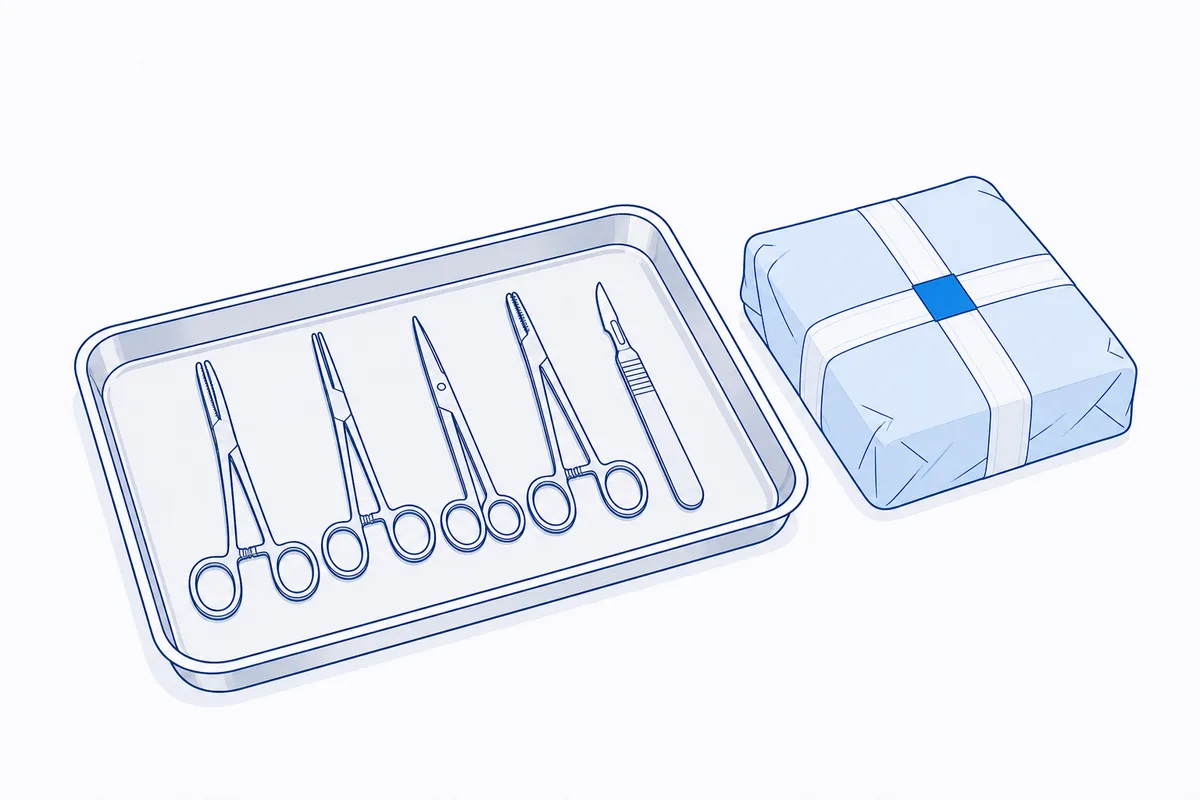
What surgical nursing questions test
- Preparing the patient: clipping margins, the surgical scrub pattern and contact time, positioning for common procedures (task 2C)
- The sterile surgical technician: scrubbing, gowning, closed and open gloving, draping, passing instruments and keeping the sterile field (tasks 2D and 2G)
- The circulating technician: opening packs, adding supplies, adjusting equipment and keeping counts (task 2E)
- Instruments by name and use, suture materials and patterns, needles, staples and tissue adhesive (knowledge areas 17 and 20)
- Cleaning instruments by hand, by soaking and in the ultrasonic cleaner, and caring for them afterward (task 2F)
- Sterilization: steam autoclave, ethylene oxide and other methods, indicators, pack wrapping and storage (task 2I)
- Common procedures in dogs, cats, horses and food animals, and the anatomy behind them (task 2A)
Sit the full exam under the real clock
170 questions across all ten domains in 3 hours, with a score for surgical nursing so you know where you stand.
Free surgical nursing drillHow to study it
- Learn instruments in groups (scissors, forceps, hemostats, needle holders, retractors) and the one feature that tells each pair apart.
- Walk through a surgery in order and say what the technician does at each step; the exam asks “what next” as often as “what is”.
- Know why every sterilization step exists. If you know what an indicator proves, you can answer any indicator question.
- Practice suture questions with the material’s properties (absorbable or not, monofilament or braided), not just its name.
Common questions
Does the VTNE have instrument identification questions?
The outline lists surgical equipment, instruments and supplies as a knowledge area, so expect questions about which instrument does what and how to care for it. Our questions describe instruments in words; learn each one’s use and distinguishing features rather than memorizing pictures.
How much of surgical nursing is sterilization?
Two of the nine surgical nursing tasks are cleaning instruments and sterilizing equipment and supplies, and a third is maintaining asepsis. Together with knowledge area 18 (sterilization techniques and quality assurance) they make sterilization one of the most tested topics in the domain.
170 questions across all ten domains in 3 hours, with a score for surgical nursing so you know where you stand.
Free surgical nursing drillThe other VTNE domains
Sources
Original practice questions for exam preparation, written to the VTNE content outline approved by the AAVSB Board of Directors in March 2023. Independent practice, not affiliated with or endorsed by the American Association of Veterinary State Boards (AAVSB). VTNE is a registered trademark of AAVSB.