VTNE Laboratory Procedures Practice Questions
Domain 4 of the VTNE · 14 of the 150 scored questions (9%)
170 questions across all ten domains in 3 hours, with a score for laboratory procedures so you know where you stand.
Free laboratory procedures drillA technician has made several cytology slides from a mass that will be stained in-house with a methanol-fixed rapid stain. How should each slide be labeled?
Laboratory Procedures on the VTNE
Laboratory Procedures is 14 of the 150 scored questions. It tests the in-house laboratory: collecting and handling samples correctly, running hematology, urinalysis, parasitology, cytology, microbiology and serology tests, recognizing normal and abnormal results, and keeping the equipment and quality control in order.
- Share of the exam
- 14 of 150 scored questions (9%) on every exam form
- Task statements
- 4 (4A, 4B, 4C, 4D)
- Our drill
- 10 questions from 50 laboratory procedures questions, untimed, an explanation after every answer; one free attempt, unlimited with a pass
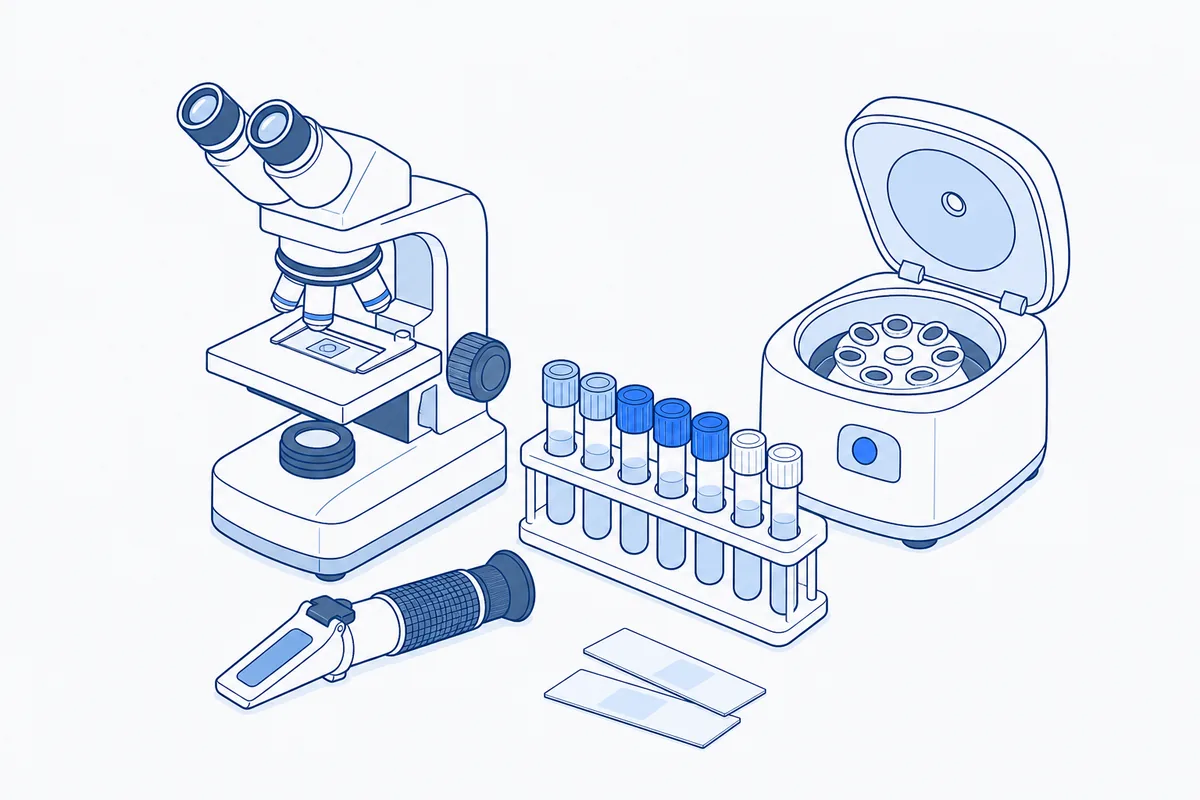
What laboratory procedures questions test
- Sample handling: tube types and anticoagulants, serum versus plasma, hemolysis and lipemia, labeling, preserving and shipping samples to an outside laboratory (task 4B)
- Hematology: PCV and total protein, blood smears, differential counts, cell morphology and reticulocytes (task 4C)
- Urinalysis: specific gravity, dipstick chemistry and sediment (cells, casts and crystals) (task 4C)
- Parasitology: fecal flotation and centrifugation, identifying eggs and parasites, heartworm testing and skin scrapings (task 4C)
- Cytology and microbiology: stains, ear and fine-needle aspirate cytology, Gram staining, culture and sensitivity (task 4C)
- Quality control: controls, calibration, centrifuge, microscope and refractometer care (task 4D)
Sit the full exam under the real clock
170 questions across all ten domains in 3 hours, with a score for laboratory procedures so you know where you stand.
Free laboratory procedures drillHow to study it
- Learn the normal range for the handful of values the exam leans on (PCV, total protein, urine specific gravity) for dogs, cats and horses, and the direction each abnormality moves.
- For every test, know what ruins the sample. Many questions are about an artifact, not a disease.
- Study parasite eggs by their distinguishing feature in words: shape, operculum, larva inside, size relative to other eggs.
- Know the order and purpose of each staining step; Gram stain questions are about why a step exists.
Common questions
What laboratory references does the VTNE use?
AAVSB’s reference list includes Laboratory Procedures for Veterinary Technicians, Diagnostic Parasitology for Veterinary Technicians, Georgis’ Parasitology for Veterinarians, Veterinary Hematology, Clinical Chemistry, and Cytology, and Cornell’s eClinPath website.
Do I need to memorize reference ranges for the VTNE?
You need to know normal values well enough to recognize a clearly abnormal result and what it suggests. Exact cutoffs vary by laboratory and analyzer, so exam questions turn on values that are clearly normal or clearly abnormal, not on the last decimal.
170 questions across all ten domains in 3 hours, with a score for laboratory procedures so you know where you stand.
Free laboratory procedures drillThe other VTNE domains
Sources
Original practice questions for exam preparation, written to the VTNE content outline approved by the AAVSB Board of Directors in March 2023. Independent practice, not affiliated with or endorsed by the American Association of Veterinary State Boards (AAVSB). VTNE is a registered trademark of AAVSB.