Temperature and Humidity Measurement Questions
Taking Temperature and Humidity Measurements is 14% of the NATE Core exam and 7% of the Support Technician exam. Practice the instruments and the psychrometric chart.
50 questions on the 90-minute clock, weighted like NATE’s Core outline, with a score for every area and an explanation for every option.
Or try the free temperature and humidity drill- 24 original temperature and humidity questions, every option explained
- Tested on: NATE Core, NATE HVAC Support Technician
What water should be used on the wick of a wet-bulb thermometer?
What our temperature and humidity questions cover
- Thermometer types (bimetal, thermocouple, thermistor, infrared) and emissivity
- Calibration in an ice bath and zeroing gauges
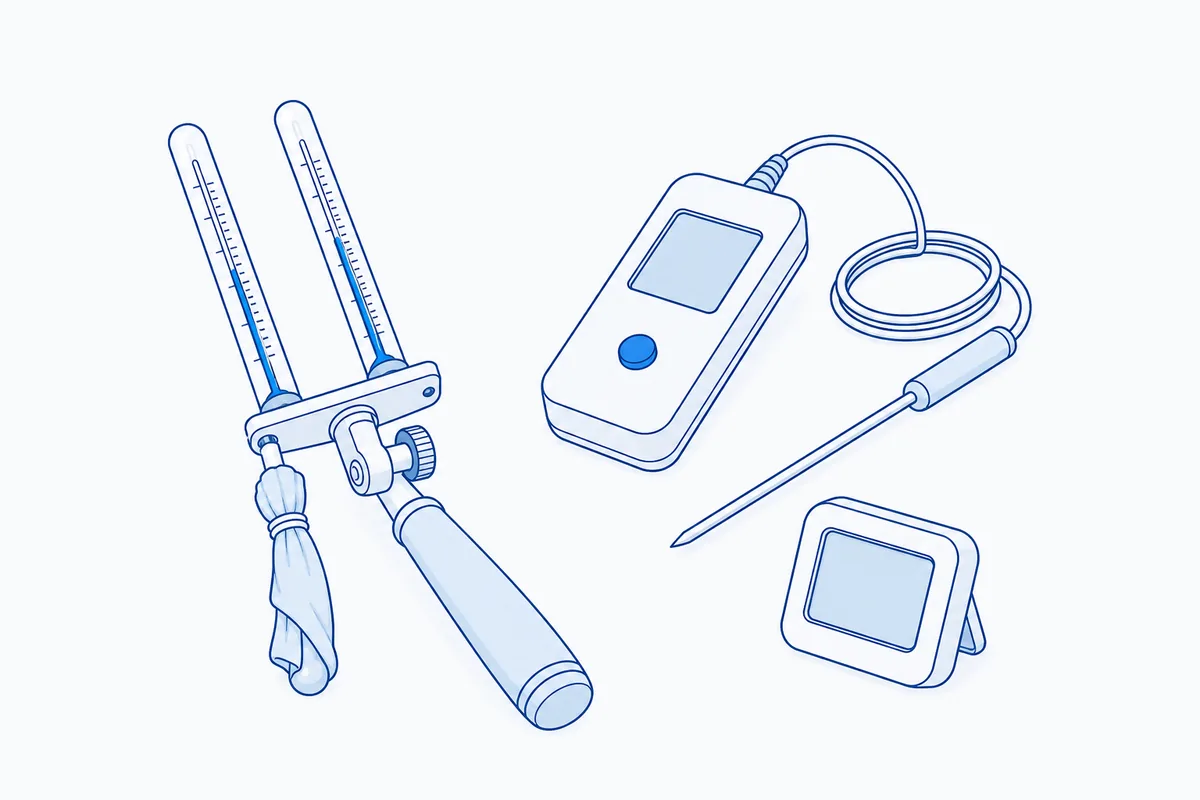
- Dry bulb, wet bulb, dew point and relative humidity; the sling psychrometer
- Reading the psychrometric chart: enthalpy, humidity ratio, heating and cooling processes
- Temperature split across a coil, probe placement and data loggers
- Total capacity from enthalpy and the sensible heat ratio
This list is our own summary, written for practice. NATE publishes the full topic lists in its Knowledge Areas of Technician Expertise (KATEs).
Drill temperature and humidity, then sit the full NATE Core exam
50 questions on the 90-minute clock, weighted like NATE’s Core outline, with a score for every area and an explanation for every option.
Or try the free temperature and humidity drillIdeas the questions test most
- At 100% RH, dry bulb, wet bulb and dew point are equal.
- An ice-water bath is a 32°F reference.
- Heating air without adding moisture lowers its RH.
- Total Btu/h (standard air) = 4.5 × CFM × enthalpy change.
- Shiny metal fools infrared thermometers because of low emissivity.
Start the free temperature and humidity drill · NATE Core practice test · NATE HVAC Support Technician practice test
Common questions
Is the psychrometric chart on the NATE Core exam?
Yes. The Core KATE lists using the psychrometric chart, the sling psychrometer, wet and dry bulb thermometers, electronic humidity measurement and enthalpy under Taking Temperature and Humidity Measurements, 14% of the exam.
What is the difference between wet bulb and dew point?
Wet bulb is the temperature of a wetted thermometer cooled by evaporation; dew point is the temperature at which the air’s moisture starts to condense. In unsaturated air, dew point is below wet bulb, which is below dry bulb.
50 questions on the 90-minute clock, weighted like NATE’s Core outline, with a score for every area and an explanation for every option.
Or try the free temperature and humidity drillMore HVAC topics
Exam format and outline checked November 2026 on natex.org: NATE: Ready-to-Work and HVAC Support Technician certificates · NATE Ready-to-Work KATE (PDF) · NATE HVAC Support Technician KATE (PDF) · NATE Core Exam KATE (PDF) · NATE: Frequently asked questions. NATE has not announced a change to this outline.
NATE is a mark of North American Technician Excellence, Inc. Game Assessment Prep is an independent practice site, not affiliated with or endorsed by NATE. Every question is original; none is taken from NATE exams, NATE study guides or another prep provider.