Basic Science Questions for HVAC
Using Basic Science is 10% of the NATE Core exam and 5% of the Support Technician exam. These questions cover the chemistry, physics and math behind the trade.
50 questions on the 90-minute clock, weighted like NATE’s Core outline, with a score for every area and an explanation for every option.
Or try the free basic science drill- 26 original basic science questions, every option explained
- Tested on: NATE Core, NATE HVAC Support Technician
About how many cubic feet of air are theoretically needed to completely burn one cubic foot of natural gas?
What our basic science questions cover
- Matter and chemistry: states of matter, oxidation, density of water, natural gas and propane
- Combustion: the fire triangle, complete and incomplete combustion, combustion air
- Pressure: psig and psia, vacuum, pressure and boiling point
- Gas laws: Boyle’s and Charles’s laws and absolute temperature
- Mechanics: levers, pulley ratios, conservation of energy, static and velocity pressure
- Math: percentages, transposing formulas, right triangles, interpolation and graphs
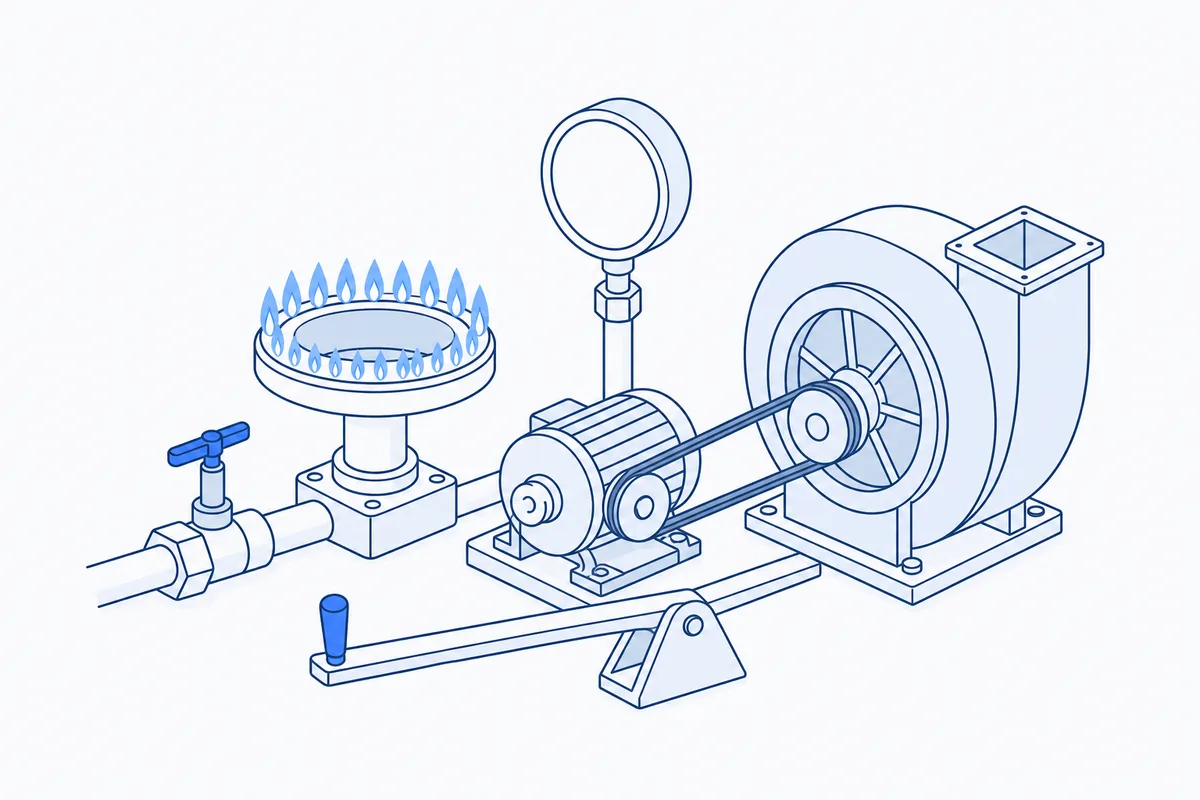
This list is our own summary, written for practice. NATE publishes the full topic lists in its Knowledge Areas of Technician Expertise (KATEs).
Drill basic science, then sit the full NATE Core exam
50 questions on the 90-minute clock, weighted like NATE’s Core outline, with a score for every area and an explanation for every option.
Or try the free basic science drillIdeas the questions test most
- Complete combustion of natural gas makes carbon dioxide and water vapor; starved combustion makes carbon monoxide.
- psia = psig + 14.7 at sea level.
- Raise the pressure and the boiling point rises.
- Belt drives: motor RPM × motor pulley = blower RPM × blower pulley.
- Natural gas rises; propane sinks and pools.
Start the free basic science drill · NATE Core practice test · NATE HVAC Support Technician practice test
Common questions
What does Using Basic Science cover on the NATE Core exam?
The Core KATE lists chemistry basics, electrons in electricity, electrical terms, magnetism, AC and DC circuits, circuit analysis, distribution, solid-state electronics, pressure, mathematics, graphs, mechanics, gas laws, load types and power. We split the electrical parts into the HVAC electrical topic.
Is there algebra on the NATE exams?
Yes, at a practical level: transposing formulas such as Ohm’s law, percentages, proportions, interpolation and right-triangle geometry appear in the Core and Support Technician KATEs.
50 questions on the 90-minute clock, weighted like NATE’s Core outline, with a score for every area and an explanation for every option.
Or try the free basic science drillMore HVAC topics
- HVAC Safety
- HVAC Electrical Safety
- HVAC Tools
- HVAC Math and Measurements
- HVAC Electrical
- HVAC Wiring Diagrams and Motors
- Heat Transfer
- Comfort and Indoor Air Quality
- Temperature and Humidity Measurement
- HVAC Components
- HVAC Installation
- Refrigeration Cycle and Service
- Construction and Blueprints
- EPA 608 practice test
Exam format and outline checked November 2026 on natex.org: NATE: Ready-to-Work and HVAC Support Technician certificates · NATE Ready-to-Work KATE (PDF) · NATE HVAC Support Technician KATE (PDF) · NATE Core Exam KATE (PDF) · NATE: Frequently asked questions. NATE has not announced a change to this outline.
NATE is a mark of North American Technician Excellence, Inc. Game Assessment Prep is an independent practice site, not affiliated with or endorsed by NATE. Every question is original; none is taken from NATE exams, NATE study guides or another prep provider.