HVAC Safety Practice Test
Safety is tested on every NATE exam: 14% of Ready-to-Work, 10% of HVAC Support Technician and 18% of Core. Practice the rules technicians use every day.
50 questions on the 90-minute clock, weighted like NATE’s Core outline, with a score for every area and an explanation for every option.
Or try the free safety drill- 34 original safety questions, every option explained
- Tested on: NATE Core, NATE Ready-to-Work, NATE HVAC Support Technician
Above what pressure does acetylene become unstable and should not be used?
What our safety questions cover
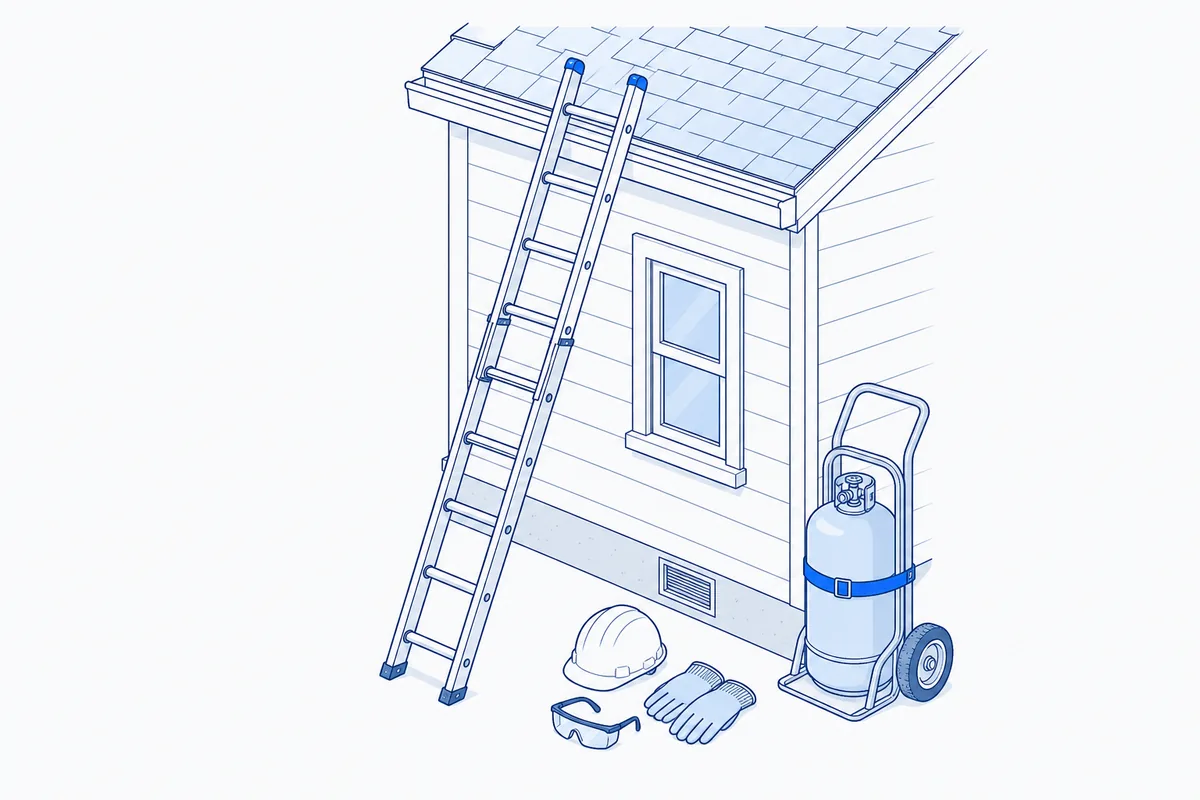
- Ladders: the 4-to-1 setup rule, extending 3 feet above the landing, fiberglass near power, step ladder use
- Personal protective equipment: eye, hand and hearing protection, clothing around belts and pulleys
- Refrigerant safety: frostbite, oxygen displacement in enclosed spaces, A2L refrigerants, decomposition near flame
- Cylinders: recovery cylinder colors, the 80% fill limit, heat limits, securing cylinders for transport
- Brazing gases: nitrogen purging and regulators, never oxygen for pressure testing, acetylene limits
- Hazard communication: Safety Data Sheet sections, signal words, DOT hazmat labels and training, fire extinguisher classes
This list is our own summary, written for practice. NATE publishes the full topic lists in its Knowledge Areas of Technician Expertise (KATEs).
Drill safety, then sit the full NATE Core exam
50 questions on the 90-minute clock, weighted like NATE’s Core outline, with a score for every area and an explanation for every option.
Or try the free safety drillIdeas the questions test most
- Most refrigerant vapors are heavier than air and displace oxygen in low, enclosed spaces.
- Pressure test with dry nitrogen through a regulator, never with oxygen or compressed air.
- Recovery cylinders are gray with a yellow top and are filled to no more than 80% of capacity.
- A2L refrigerants (such as R-32 and R-454B) are lower toxicity and mildly flammable.
- PPE for Section 8 of an SDS; Danger is the more severe GHS signal word.
Start the free safety drill · NATE Core practice test · NATE Ready-to-Work practice test · NATE HVAC Support Technician practice test
Common questions
How much of the NATE exams is safety?
NATE’s KATEs put General Safety at 14% of the Ready-to-Work exam (plus 12% Electrical Safety), Safety at 10% of the HVAC Support Technician exam and 18% of the Core exam. Safety questions cover ladders, PPE, refrigerant handling, brazing gases, confined spaces and hazardous materials.
Is refrigerant safety the same as EPA 608?
They overlap. NATE exams ask about safe handling: frostbite, oxygen displacement, cylinders and brazing. EPA Section 608 certification is a separate federal requirement for buying and handling refrigerant, with its own exam. Practice it on our EPA 608 practice test.
50 questions on the 90-minute clock, weighted like NATE’s Core outline, with a score for every area and an explanation for every option.
Or try the free safety drillMore HVAC topics
- HVAC Electrical Safety
- HVAC Tools
- HVAC Math and Measurements
- Basic Science for HVAC
- HVAC Electrical
- HVAC Wiring Diagrams and Motors
- Heat Transfer
- Comfort and Indoor Air Quality
- Temperature and Humidity Measurement
- HVAC Components
- HVAC Installation
- Refrigeration Cycle and Service
- Construction and Blueprints
- EPA 608 practice test
Exam format and outline checked November 2026 on natex.org: NATE: Ready-to-Work and HVAC Support Technician certificates · NATE Ready-to-Work KATE (PDF) · NATE HVAC Support Technician KATE (PDF) · NATE Core Exam KATE (PDF) · NATE: Frequently asked questions. NATE has not announced a change to this outline.
NATE is a mark of North American Technician Excellence, Inc. Game Assessment Prep is an independent practice site, not affiliated with or endorsed by NATE. Every question is original; none is taken from NATE exams, NATE study guides or another prep provider.