HVAC Electrical Safety Questions
Electrical Safety is 12% of the NATE Ready-to-Work exam and part of the Safety domain on the Support Technician and Core exams. Practice the procedures that keep technicians alive.
50 questions on the 90-minute clock, weighted like NATE’s Ready-to-Work outline, with a score for every area and an explanation for every option.
Or try the free electrical safety drill- 22 original electrical safety questions, every option explained
- Tested on: NATE Core, NATE Ready-to-Work, NATE HVAC Support Technician
Why should the ground prong never be removed from a three-prong tool plug?
What our electrical safety questions cover
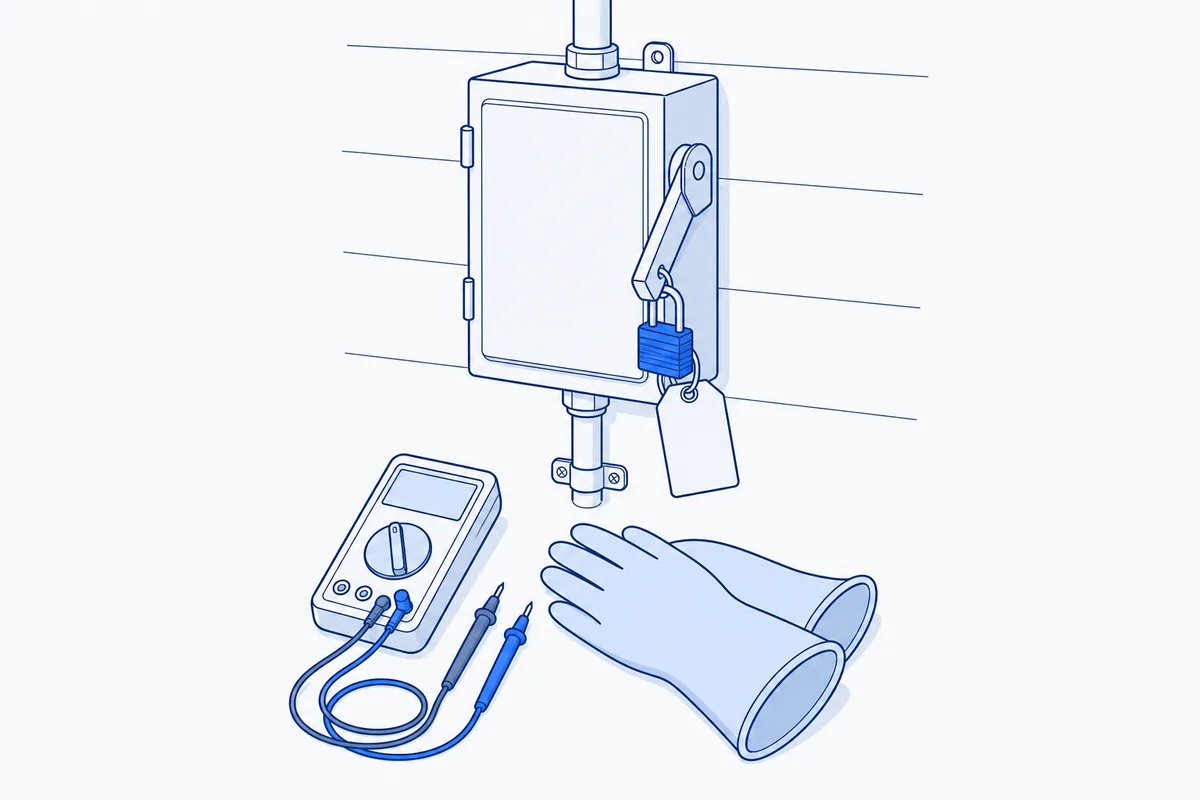
- Lockout/tagout: what it does, who removes a lock, and verifying zero voltage before touching
- Live-dead-live meter checks and damaged test leads
- Stored energy in capacitors and how to discharge them
- GFCI protection, trip levels, outdoor cords and equipment grounding
- Meter measurement categories (CAT III for building equipment) and arc flash
- Fuses, disconnects within sight of the unit and conductive jewelry
This list is our own summary, written for practice. NATE publishes the full topic lists in its Knowledge Areas of Technician Expertise (KATEs).
Drill electrical safety, then sit the full NATE Ready-to-Work exam
50 questions on the 90-minute clock, weighted like NATE’s Ready-to-Work outline, with a score for every area and an explanation for every option.
Or try the free electrical safety drillIdeas the questions test most
- Test before you touch: prove the meter on a known source, test, then prove it again.
- Capacitors keep a charge after power is off.
- A personnel GFCI trips at about 5 milliamps of ground-fault current.
- The equipment grounding conductor carries fault current, not normal current.
- Replace a fuse with the same type and rating, and find out why it blew.
Start the free electrical safety drill · NATE Core practice test · NATE Ready-to-Work practice test · NATE HVAC Support Technician practice test
Common questions
What electrical safety topics are on the NATE Ready-to-Work exam?
The Ready-to-Work KATE lists three: electrical safety procedures, electrical tool safety and circuit safety. Together they are 12% of the 50-question exam.
Which meter category should HVAC technicians use?
CAT III or higher for building distribution circuits and fixed equipment such as condensing units, furnaces and panels. The category describes how well the meter withstands voltage spikes on that kind of circuit.
50 questions on the 90-minute clock, weighted like NATE’s Ready-to-Work outline, with a score for every area and an explanation for every option.
Or try the free electrical safety drillMore HVAC topics
- HVAC Safety
- HVAC Tools
- HVAC Math and Measurements
- Basic Science for HVAC
- HVAC Electrical
- HVAC Wiring Diagrams and Motors
- Heat Transfer
- Comfort and Indoor Air Quality
- Temperature and Humidity Measurement
- HVAC Components
- HVAC Installation
- Refrigeration Cycle and Service
- Construction and Blueprints
- EPA 608 practice test
Exam format and outline checked November 2026 on natex.org: NATE: Ready-to-Work and HVAC Support Technician certificates · NATE Ready-to-Work KATE (PDF) · NATE HVAC Support Technician KATE (PDF) · NATE Core Exam KATE (PDF) · NATE: Frequently asked questions. NATE has not announced a change to this outline.
NATE is a mark of North American Technician Excellence, Inc. Game Assessment Prep is an independent practice site, not affiliated with or endorsed by NATE. Every question is original; none is taken from NATE exams, NATE study guides or another prep provider.