FE Mechanical Thermodynamics

Knowledge area 11 of the FE Mechanical exam: 10–15 of the 110 questions. The subtopics NCEES lists, how they are tested and worked practice problems with solutions.

110 questions on the real 5 hours 20 minutes clock, weighted to the NCEES specifications, with a score by knowledge area and a worked solution for every answer.

Or start the free Thermodynamics drill

What the specification lists

  • Properties of ideal gases and pure substances
  • Energy transfers
  • Laws of thermodynamics
  • Processes
  • Performance of components
  • Power cycles
  • Refrigeration and heat pump cycles
  • Nonreacting mixtures of gases
  • Psychrometrics
  • Heating, ventilation, and air-conditioning (HVAC) processes
  • Combustion and combustion products

From the NCEES FE Mechanical CBT exam specifications, knowledge area 11.

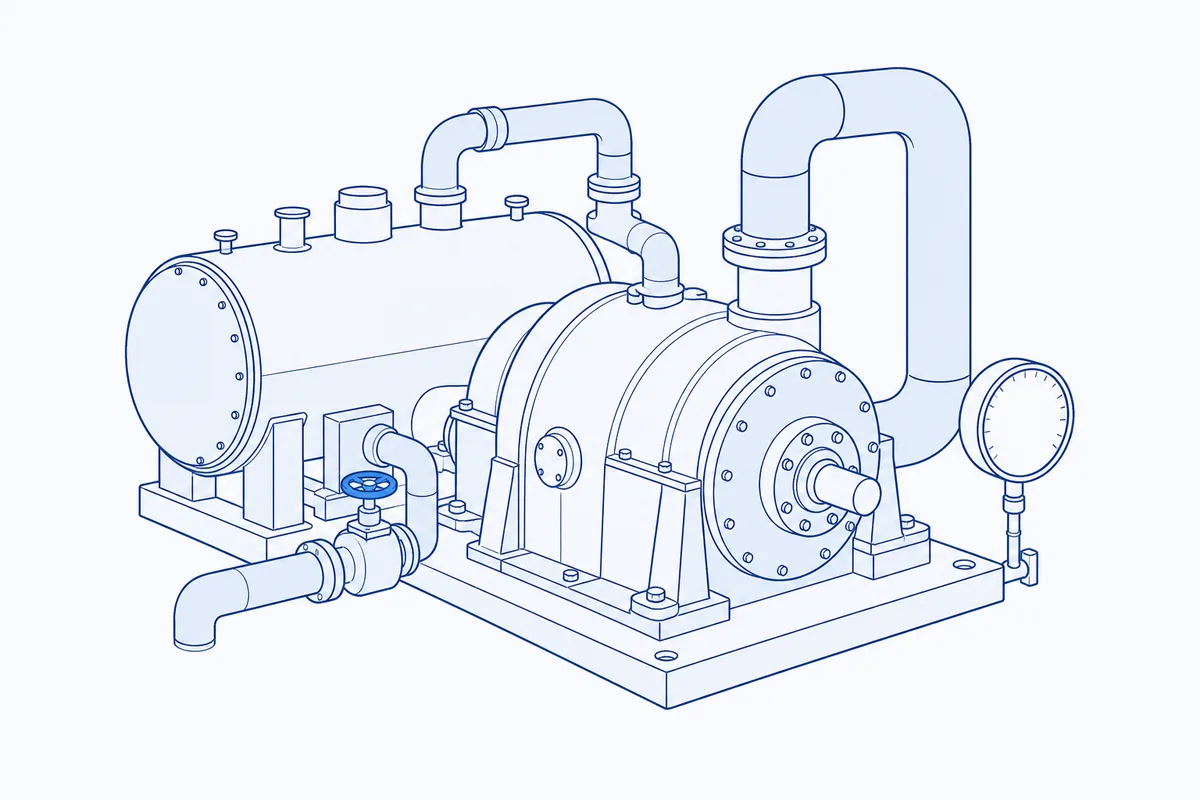
Line drawing of a steam turbine, a boiler drum and a pressure gauge

How Thermodynamics is tested

Thermodynamics questions are first-law energy balances on closed systems and on turbines, compressors, nozzles and throttles, ideal-gas processes, cycle efficiencies and COPs, psychrometrics and combustion. Learn to read steam tables and the psychrometric chart quickly; the Reference Handbook section on thermodynamics carries the tables and charts.

On exam day the relationships you need are in the Reference Handbook section on Thermodynamics. The handbook is the only reference allowed, so practice finding each formula in it rather than memorizing a separate sheet.

FE Mechanical Thermodynamics practice problems

Work each problem with your calculator and the handbook, then open the solution.

Problem 1 · Processes

A piston-cylinder device holds 0.50 kg of air at 300 K and 100 kPa. The air is compressed slowly and isothermally to 800 kPa. Take R = 0.287 kJ/(kg·K). The magnitude of the boundary work is most nearly:

  1. A.38.9 kJ
  2. B.89.5 kJ
  3. C.179 kJ
  4. D.301 kJ
Show the answer and solution

Answer: B: 89.5 kJ

For an isothermal ideal-gas process, W = mRT ln(P1/P2) = (0.50)(0.287)(300) ln(100/800) = −89.5 kJ. The negative sign means work is done on the air, so the magnitude is 89.5 kJ.

Processes · Reference Handbook: Thermodynamics

Problem 2 · Laws of thermodynamics

A heat pump keeps a house at 21°C while the outdoor air is at −5°C. The maximum (Carnot) coefficient of performance for heating is most nearly:

  1. A.0.808
  2. B.1.10
  3. C.10.3
  4. D.11.3
Show the answer and solution

Answer: D: 11.3

COP_HP,max = T_H/(T_H − T_L) = 294.15/(294.15 − 268.15) = 294.15/26 = 11.3. Absolute temperatures are required.

Laws of thermodynamics · Reference Handbook: Thermodynamics

Problem 3 · Heating, ventilation, and air-conditioning (HVAC) processes

A cooling coil handles 1.5 kg/s of dry air. Entering air: h = 76.2 kJ/kg dry air and ω = 0.0180 kg/kg dry air. Leaving air at 13°C: h = 35.8 kJ/kg dry air and ω = 0.0090 kg/kg dry air. Condensate leaves at 13°C with h = 54.6 kJ/kg. What is the rate of heat removal by the coil, including the energy carried out by the condensate? Enter the value in kW to one decimal place.

Fill in the blank: answer in kW.

Show the answer and solution

Answer: 59.9 kW (accepted 59.6 to 60.2)

Condensate flow = 1.5(0.0180 − 0.0090) = 0.0135 kg/s. Energy balance: Q = ṁ_a(h1 − h2) − ṁ_w h_w = 1.5(76.2 − 35.8) − 0.0135(54.6) = 60.60 − 0.74 = 59.86 ≈ 59.9 kW. The condensate carries some energy out of the coil, so the heat removed by the coil is slightly less than the air-side enthalpy drop.

Heating, ventilation, and air-conditioning (HVAC) processes · Reference Handbook: Thermodynamics

Problem 4 · Properties of ideal gases and pure substances

A rigid 2.0 m³ tank contains air at an absolute pressure of 500 kPa and a temperature of 27°C. Treat air as an ideal gas with R = 0.287 kJ/(kg·K). The mass of air in the tank is most nearly:

  1. A.0.401 kg
  2. B.9.26 kg
  3. C.11.6 kg
  4. D.129 kg
Show the answer and solution

Answer: C: 11.6 kg

m = PV/(RT) = (500)(2.0)/[(0.287)(300.15)] = 11.6 kg. Ideal-gas calculations need absolute pressure and absolute temperature.

Properties of ideal gases and pure substances · Reference Handbook: Thermodynamics

More FE Mechanical practice problems from every knowledge area

Sit the full exam under the real clock

110 questions on the real 5 hours 20 minutes clock, weighted to the NCEES specifications, with a score by knowledge area and a worked solution for every answer.

Or start the free Thermodynamics drill

Common questions

How many Thermodynamics questions are on the FE Mechanical exam?

The NCEES FE Mechanical specification lists 10–15 questions on Thermodynamics, out of 110. Every examinee gets the same number per knowledge area.

What does Thermodynamics cover on the FE Mechanical exam?

Properties of ideal gases and pure substances; Energy transfers; Laws of thermodynamics; Processes; Performance of components; Power cycles; Refrigeration and heat pump cycles; Nonreacting mixtures of gases; Psychrometrics; Heating, ventilation, and air-conditioning (HVAC) processes; Combustion and combustion products.

Where are the Thermodynamics formulas on exam day?

In the NCEES FE Reference Handbook, which appears on screen during the exam: the Thermodynamics section. Practice with your free copy from MyNCEES so you know where each relationship sits.

Original independent practice questions written to the published NCEES exam specifications. Not affiliated with or endorsed by NCEES (National Council of Examiners for Engineering and Surveying).