FE Mechanical Mechanical Design and Analysis

Knowledge area 14 of the FE Mechanical exam: 10–15 of the 110 questions. The subtopics NCEES lists, how they are tested and worked practice problems with solutions.

110 questions on the real 5 hours 20 minutes clock, weighted to the NCEES specifications, with a score by knowledge area and a worked solution for every answer.

Or start the free Mechanical Design and Analysis drill

What the specification lists

  • Stress analysis of machine elements
  • Failure theories and analysis
  • Deformation and stiffness
  • Springs
  • Pressure vessels and piping
  • Bearings
  • Power screws
  • Power transmission
  • Joining methods (e.g., welding, adhesives, mechanical fasteners)
  • Manufacturability (e.g., limits, fits)
  • Quality and reliability
  • Components (e.g., hydraulic, pneumatic, electromechanical)
  • Engineering drawing interpretations and geometric dimensioning and tolerancing (GD&T)

From the NCEES FE Mechanical CBT exam specifications, knowledge area 14.

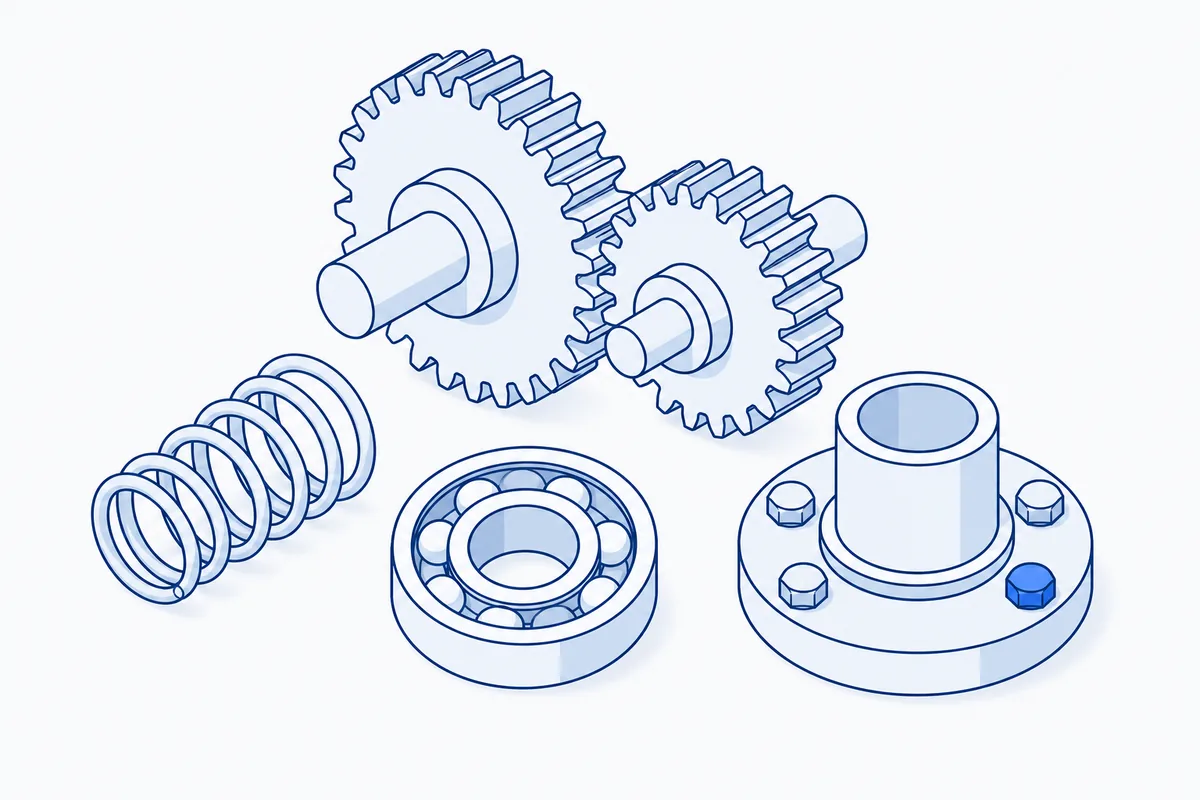
Line drawing of meshing spur gears, a helical spring, a bearing and a bolted flange

How Mechanical Design and Analysis is tested

Mechanical design questions apply stress analysis to machine elements: shafts, springs, pressure vessels, bolted and welded joints, gears and power screws, bearing life, fatigue (Goodman and Soderberg), fits and reliability. The Reference Handbook section on mechanical engineering lists the design relationships.

On exam day the relationships you need are in the Reference Handbook sections on Mechanical Engineering and Mechanics of Materials. The handbook is the only reference allowed, so practice finding each formula in it rather than memorizing a separate sheet.

FE Mechanical Mechanical Design and Analysis practice problems

Work each problem with your calculator and the handbook, then open the solution.

Problem 1 · Failure theories and analysis

A steel connecting link has S_ut = 85 ksi, S_y = 60 ksi and a fully corrected endurance limit S_e = 30 ksi. It carries an alternating stress of 10 ksi superimposed on a mean stress of 15 ksi. The factor of safety by the Soderberg criterion is most nearly:

  1. A.1.71
  2. B.1.96
  3. C.2.40
  4. D.3.00
Show the answer and solution

Answer: A: 1.71

Soderberg: σ_a/S_e + σ_m/S_y = 1/n, so 1/n = 10/30 + 15/60 = 0.333 + 0.250 = 0.583 and n = 1.71. The Goodman line uses S_ut and gives the less conservative 1.96.

Failure theories and analysis · Reference Handbook: Mechanical Engineering

Problem 2 · Manufacturability

A bushing bore is specified as 40.000 mm to 40.025 mm diameter, and the pin pressed into it as 40.043 mm to 40.059 mm diameter. The minimum interference is most nearly:

  1. A.0.018 mm
  2. B.0.034 mm
  3. C.0.043 mm
  4. D.0.059 mm
Show the answer and solution

Answer: A: 0.018 mm

Minimum interference occurs with the smallest pin in the largest bore: 40.043 − 40.025 = 0.018 mm. The maximum interference is the largest pin in the smallest bore, 40.059 − 40.000 = 0.059 mm.

Manufacturability · Reference Handbook: Mechanical Engineering

Problem 3 · Springs

A helical compression spring has squared-and-ground ends, 12 total coils, a wire diameter of 4.0 mm and an outside diameter of 36 mm. Take G = 79.3 GPa. The spring rate is most nearly:

  1. A.5.44 N/mm
  2. B.6.45 N/mm
  3. C.7.74 N/mm
  4. D.61.9 N/mm
Show the answer and solution

Answer: C: 7.74 N/mm

Mean diameter D = 36 − 4 = 32 mm; squared-and-ground ends give N_a = 12 − 2 = 10 active coils. k = Gd⁴/(8D³N_a) = 79,300(4)⁴/[8(32)³(10)] = 7.74 N/mm.

Springs · Reference Handbook: Mechanical Engineering

Problem 4 · Bearings

A deep-groove ball bearing has a basic dynamic load rating of 30 kN and carries an equivalent radial load of 6.0 kN at 1,200 rpm. Its L10 rating life is most nearly:

  1. A.69.4 h
  2. B.1,740 h
  3. C.2,970 h
  4. D.104,000 h
Show the answer and solution

Answer: B: 1,740 h

L10 = (C/P)³ × 10⁶ rev = (30/6.0)³ × 10⁶ = 125 × 10⁶ rev. In hours: 125 × 10⁶/(1,200 × 60) = 1,740 h. The exponent 3 applies to ball bearings; 10/3 is for roller bearings.

Bearings · Reference Handbook: Mechanical Engineering

More FE Mechanical practice problems from every knowledge area

Sit the full exam under the real clock

110 questions on the real 5 hours 20 minutes clock, weighted to the NCEES specifications, with a score by knowledge area and a worked solution for every answer.

Or start the free Mechanical Design and Analysis drill

Common questions

How many Mechanical Design and Analysis questions are on the FE Mechanical exam?

The NCEES FE Mechanical specification lists 10–15 questions on Mechanical Design and Analysis, out of 110. Every examinee gets the same number per knowledge area.

What does Mechanical Design and Analysis cover on the FE Mechanical exam?

Stress analysis of machine elements; Failure theories and analysis; Deformation and stiffness; Springs; Pressure vessels and piping; Bearings; Power screws; Power transmission; Joining methods (e.g., welding, adhesives, mechanical fasteners); Manufacturability (e.g., limits, fits); Quality and reliability; Components (e.g., hydraulic, pneumatic, electromechanical); Engineering drawing interpretations and geometric dimensioning and tolerancing (GD&T).

Where are the Mechanical Design and Analysis formulas on exam day?

In the NCEES FE Reference Handbook, which appears on screen during the exam: the Mechanical Engineering and Mechanics of Materials sections. Practice with your free copy from MyNCEES so you know where each relationship sits.

Original independent practice questions written to the published NCEES exam specifications. Not affiliated with or endorsed by NCEES (National Council of Examiners for Engineering and Surveying).