FE Mechanical Heat Transfer

Knowledge area 12 of the FE Mechanical exam: 7–11 of the 110 questions. The subtopics NCEES lists, how they are tested and worked practice problems with solutions.

110 questions on the real 5 hours 20 minutes clock, weighted to the NCEES specifications, with a score by knowledge area and a worked solution for every answer.

Or start the free Heat Transfer drill

What the specification lists

  • Conduction
  • Convection
  • Radiation
  • Transient processes
  • Heat exchangers

From the NCEES FE Mechanical CBT exam specifications, knowledge area 12.

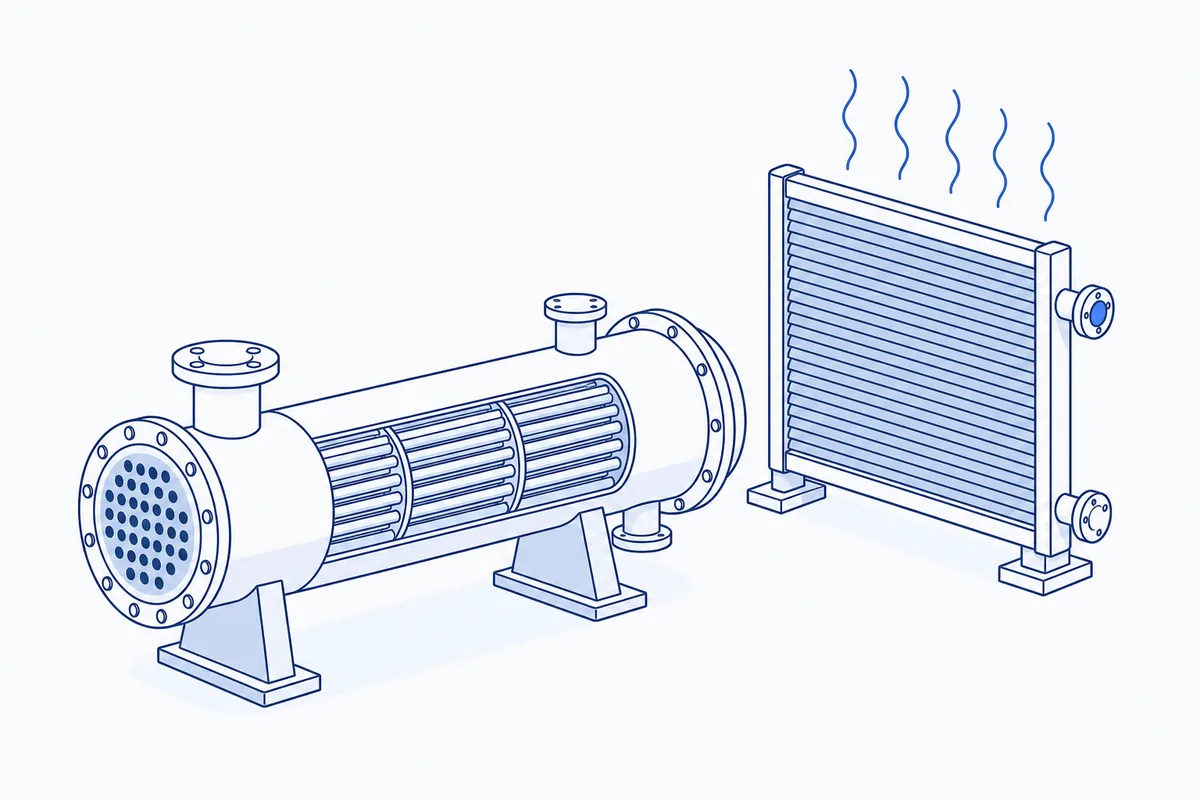
Line drawing of a shell-and-tube heat exchanger and a finned radiator

How Heat Transfer is tested

Heat transfer questions use thermal-resistance networks for conduction and convection, the Stefan–Boltzmann law for radiation, lumped-capacitance transients and heat-exchanger LMTD and effectiveness methods. Set the problem up as resistances in series or parallel and the arithmetic stays short.

On exam day the relationships you need are in the Reference Handbook section on Heat Transfer. The handbook is the only reference allowed, so practice finding each formula in it rather than memorizing a separate sheet.

FE Mechanical Heat Transfer practice problems

Work each problem with your calculator and the handbook, then open the solution.

Problem 1 · Conduction

A steam pipe with an outside diameter of 60 mm is covered with 40 mm thick insulation (k = 0.045 W/(m·K)). The inner surface of the insulation is at 150°C and its outer surface is at 35°C. The heat loss per meter of pipe length is most nearly:

  1. A.24.4 W/m
  2. B.38.4 W/m
  3. C.88.4 W/m
  4. D.113 W/m
Show the answer and solution

Answer: B: 38.4 W/m

r₁ = 30 mm and r₂ = 30 + 40 = 70 mm. q′ = 2πkΔT/ln(r₂/r₁) = 2π(0.045)(115)/ln(70/30) = 32.5/0.847 = 38.4 W/m. The cylindrical-shell resistance uses the natural log of the radius ratio, and the outer radius includes the pipe radius.

Conduction · Reference Handbook: Heat Transfer

Problem 2 · Heat exchangers

In a heat exchanger, the hot stream has a capacity rate of 2.0 kW/K and enters at 140°C. The cold stream has a capacity rate of 3.2 kW/K and enters at 30°C. The effectiveness, read from an ε-NTU chart, is 0.65. Enter the hot-stream outlet temperature in °C, to one decimal place.

Fill in the blank: answer in °C.

Show the answer and solution

Answer: 68.5 °C (accepted 67.5 to 69.5)

C_min = 2.0 kW/K (hot stream), so q_max = C_min(T_h,in − T_c,in) = 2.0(110) = 220 kW and q = 0.65(220) = 143 kW. T_h,out = 140 − 143/2.0 = 68.5°C. The hot stream's own capacity rate sets its temperature change.

Heat exchangers · Reference Handbook: Heat Transfer

Problem 3 · Convection

An electric heater rod 25 mm in diameter and 0.60 m long dissipates 150 W. At steady state its surface is at 120°C in 20°C air. Neglect radiation and heat loss from the ends. The average convection coefficient is most nearly:

  1. A.8.10 W/(m²·K)
  2. B.15.9 W/(m²·K)
  3. C.31.8 W/(m²·K)
  4. D.3,056 W/(m²·K)
Show the answer and solution

Answer: C: 31.8 W/(m²·K)

A = πDL = π(0.025)(0.60) = 0.0471 m², and h = q/(AΔT) = 150/[0.0471(100)] = 31.8 W/(m²·K). Convection acts over the lateral surface, not the cross section.

Convection · Reference Handbook: Heat Transfer

Problem 4 · Transient processes

The steel ball bearing (D = 20 mm, ρ = 7,800 kg/m³, c = 460 J/(kg·K), Bi < 0.1) starts at 650°C and is quenched in 50°C oil with h = 80 W/(m²·K). Using the lumped-capacitance model, enter the time for the ball to reach 150°C, in seconds, to the nearest second.

Fill in the blank: answer in s.

Show the answer and solution

Answer: 268 s (accepted 264 to 272)

τ = ρcL_c/h = 7,800(460)(0.00333)/80 = 149.5 s. (T − T∞)/(Tᵢ − T∞) = 100/600 = e^(−t/τ), so t = 149.5 ln 6 = 268 s.

Transient processes · Reference Handbook: Heat Transfer

More FE Mechanical practice problems from every knowledge area

Sit the full exam under the real clock

110 questions on the real 5 hours 20 minutes clock, weighted to the NCEES specifications, with a score by knowledge area and a worked solution for every answer.

Or start the free Heat Transfer drill

Common questions

How many Heat Transfer questions are on the FE Mechanical exam?

The NCEES FE Mechanical specification lists 7–11 questions on Heat Transfer, out of 110. Every examinee gets the same number per knowledge area.

What does Heat Transfer cover on the FE Mechanical exam?

Conduction; Convection; Radiation; Transient processes; Heat exchangers.

Where are the Heat Transfer formulas on exam day?

In the NCEES FE Reference Handbook, which appears on screen during the exam: the Heat Transfer section. Practice with your free copy from MyNCEES so you know where each relationship sits.

Original independent practice questions written to the published NCEES exam specifications. Not affiliated with or endorsed by NCEES (National Council of Examiners for Engineering and Surveying).