FE Mechanical Fluid Mechanics

Knowledge area 10 of the FE Mechanical exam: 10–15 of the 110 questions. The subtopics NCEES lists, how they are tested and worked practice problems with solutions.

110 questions on the real 5 hours 20 minutes clock, weighted to the NCEES specifications, with a score by knowledge area and a worked solution for every answer.

Or start the free Fluid Mechanics drill

What the specification lists

  • Fluid properties
  • Fluid statics
  • Energy, impulse, and momentum
  • Internal flow
  • External flow
  • Compressible flow (e.g., Mach number, isentropic flow relationships, normal shock)
  • Power and efficiency
  • Performance curves
  • Scaling laws for fans, pumps, and compressors

From the NCEES FE Mechanical CBT exam specifications, knowledge area 10.

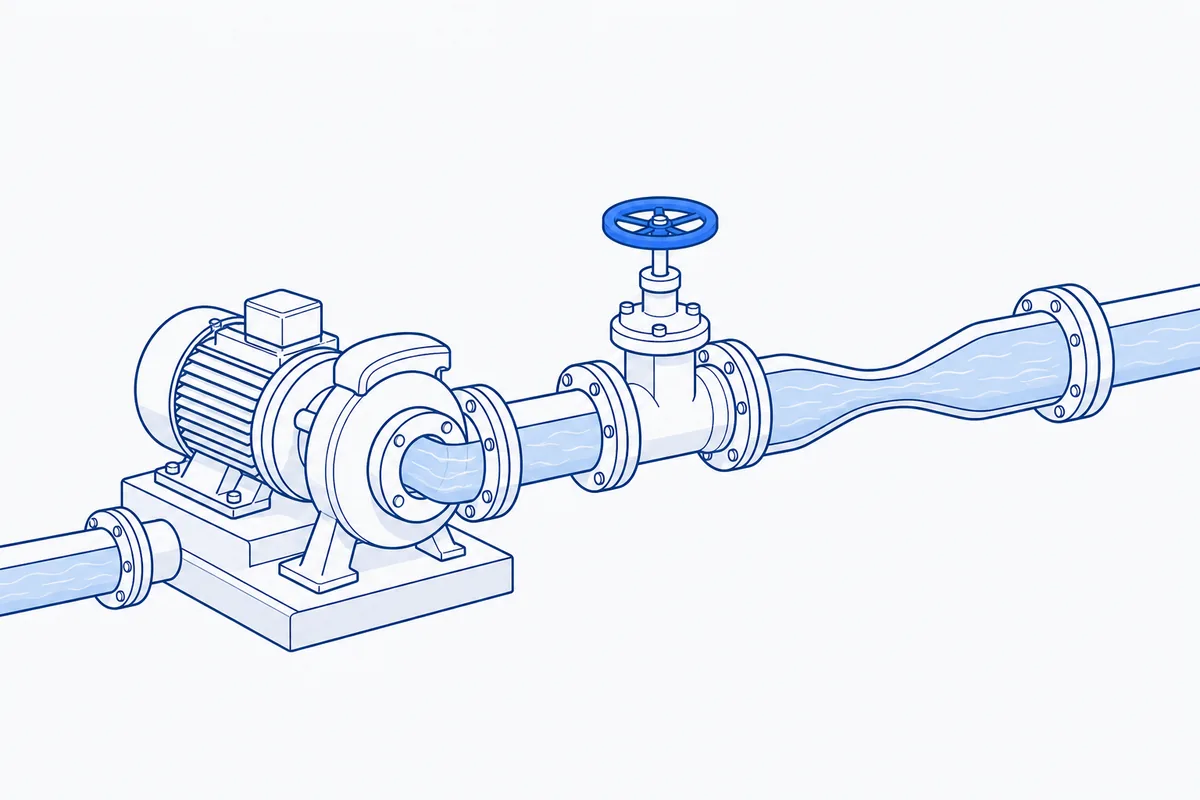
Line drawing of a centrifugal pump, a pipe with a valve and a venturi meter

How Fluid Mechanics is tested

Fluid mechanics questions cover hydrostatic pressure and forces, buoyancy, continuity, the energy (Bernoulli) equation with losses, momentum forces, pipe flow and flow meters. Write the energy equation between two points before doing anything else, and watch gauge versus absolute pressure and head versus pressure units.

On exam day the relationships you need are in the Reference Handbook section on Fluid Mechanics. The handbook is the only reference allowed, so practice finding each formula in it rather than memorizing a separate sheet.

FE Mechanical Fluid Mechanics practice problems

Work each problem with your calculator and the handbook, then open the solution.

Problem 1 · Laminar and turbulent flow

Oil with a kinematic viscosity of 1.2 × 10⁻⁴ m²/s flows at 3.0 m/s in a 50 mm diameter pipe. The Reynolds number and the flow regime are:

  1. A.Re ≈ 125,000; turbulent
  2. B.Re ≈ 625; laminar
  3. C.Re ≈ 1,250; laminar
  4. D.Re ≈ 1,250; turbulent
Show the answer and solution

Answer: C: Re ≈ 1,250; laminar

Re = VD/ν = 3.0(0.050)/(1.2 × 10⁻⁴) = 1,250. That is below the transition range of about 2,000 to 2,300, so the flow is laminar. The pipe diameter, not the radius, is the length scale for pipe Reynolds numbers.

Laminar and turbulent flow · Reference Handbook: Fluid Mechanics

Problem 2 · External flow

A car with a drag coefficient of 0.32 and a frontal area of 2.2 m² travels at 100 km/h in still air with ρ = 1.2 kg/m³. The aerodynamic drag force is most nearly:

  1. A.11.7 N
  2. B.326 N
  3. C.652 N
  4. D.4,224 N
Show the answer and solution

Answer: B: 326 N

V = 100/3.6 = 27.8 m/s. F_D = ½ρV²C_DA = 0.5(1.2)(27.8)²(0.32)(2.2) = 326 N. Using 100 km/h directly as m/s inflates the force by a factor of 3.6² ≈ 13.

External flow · Reference Handbook: Fluid Mechanics

Problem 3 · Turbomachinery

A hydroelectric turbine receives 12 m³/s of water under a net head of 45 m. The turbine efficiency is 90%. Take γ = 9.81 kN/m³. The shaft power output is most nearly:

  1. A.0.486 MW
  2. B.4.77 MW
  3. C.5.30 MW
  4. D.5.89 MW
Show the answer and solution

Answer: B: 4.77 MW

Hydraulic power = γQH = 9.81(12)(45) = 5,297 kW. A turbine delivers less than the hydraulic power, so P = ηγQH = 0.90(5,297) = 4,768 kW = 4.77 MW. Dividing by η is correct for pumps, not turbines.

Turbomachinery · Reference Handbook: Fluid Mechanics

Problem 4 · Scaling laws for fans, pumps, and compressors

A centrifugal pump with a 300 mm impeller develops 60 m of head at its best-efficiency point. The impeller is trimmed to 270 mm, and the speed is unchanged. Using the affinity laws, the head at the corresponding point is most nearly:

  1. A.48.6 m
  2. B.54.0 m
  3. C.66.7 m
  4. D.74.1 m
Show the answer and solution

Answer: A: 48.6 m

At constant speed, H ∝ D², so H₂ = 60(270/300)² = 60(0.81) = 48.6 m. Trimming reduces head, so any answer above 60 m comes from inverting the ratio.

Scaling laws for fans, pumps, and compressors · Reference Handbook: Fluid Mechanics

More FE Mechanical practice problems from every knowledge area

Sit the full exam under the real clock

110 questions on the real 5 hours 20 minutes clock, weighted to the NCEES specifications, with a score by knowledge area and a worked solution for every answer.

Or start the free Fluid Mechanics drill

Common questions

How many Fluid Mechanics questions are on the FE Mechanical exam?

The NCEES FE Mechanical specification lists 10–15 questions on Fluid Mechanics, out of 110. Every examinee gets the same number per knowledge area.

What does Fluid Mechanics cover on the FE Mechanical exam?

Fluid properties; Fluid statics; Energy, impulse, and momentum; Internal flow; External flow; Compressible flow (e.g., Mach number, isentropic flow relationships, normal shock); Power and efficiency; Performance curves; Scaling laws for fans, pumps, and compressors.

Where are the Fluid Mechanics formulas on exam day?

In the NCEES FE Reference Handbook, which appears on screen during the exam: the Fluid Mechanics section. Practice with your free copy from MyNCEES so you know where each relationship sits.

Original independent practice questions written to the published NCEES exam specifications. Not affiliated with or endorsed by NCEES (National Council of Examiners for Engineering and Surveying).