FE Mechanical Electricity and Magnetism

Knowledge area 5 of the FE Mechanical exam: 5–8 of the 110 questions. The subtopics NCEES lists, how they are tested and worked practice problems with solutions.

110 questions on the real 5 hours 20 minutes clock, weighted to the NCEES specifications, with a score by knowledge area and a worked solution for every answer.

Or start the free Electricity and Magnetism drill

What the specification lists

  • Electrical fundamentals (e.g., charge, current, voltage, resistance, power, energy, magnetic flux)
  • DC circuit analysis (e.g., Kirchhoff’s laws, Ohm’s law, series, parallel)
  • AC circuit analysis (e.g., resistors, capacitors, inductors)
  • Motors and generators

From the NCEES FE Mechanical CBT exam specifications, knowledge area 5.

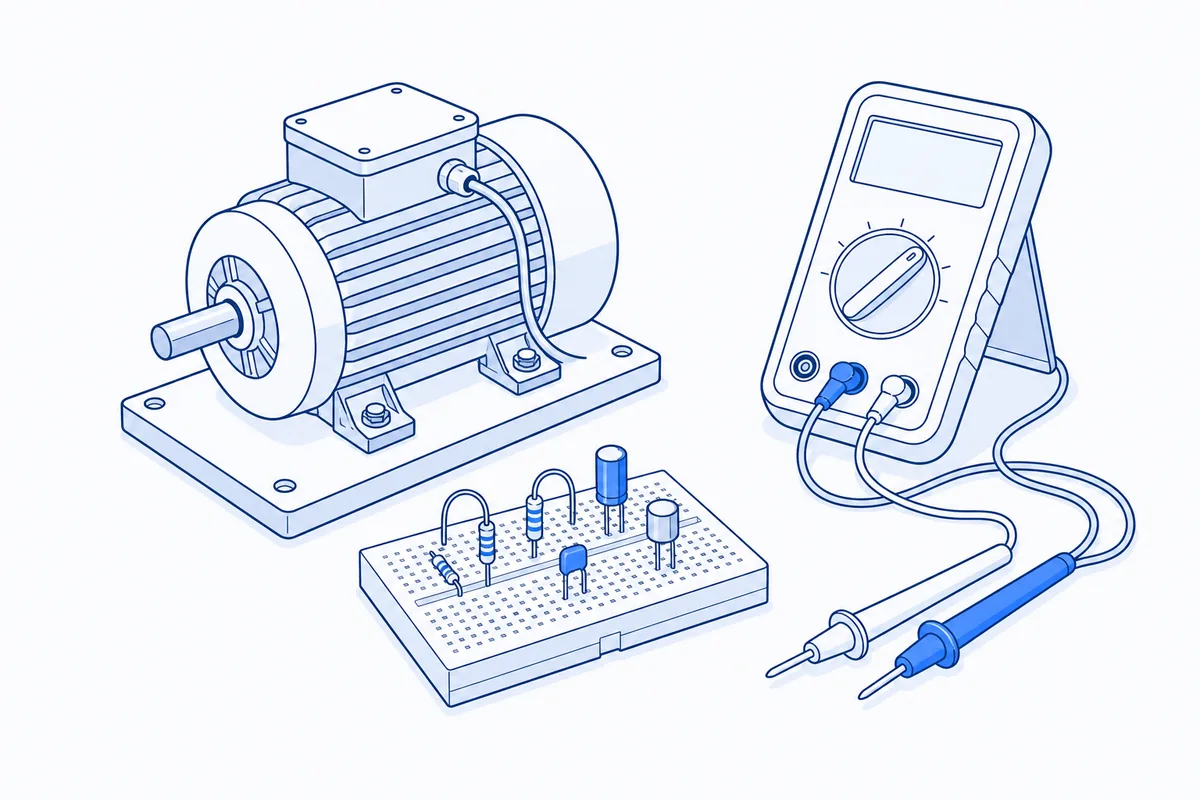
Line drawing of an electric motor, a multimeter and a breadboard with resistors and capacitors

How Electricity and Magnetism is tested

Electrical questions on the Mechanical and Other Disciplines exams are circuit basics: Ohm’s and Kirchhoff’s laws, series and parallel resistance, capacitor and inductor energy, AC impedance and power factor, three-phase power and motor speed. Practice phasor arithmetic on your calculator until it is automatic.

On exam day the relationships you need are in the Reference Handbook section on Electrical and Computer Engineering. The handbook is the only reference allowed, so practice finding each formula in it rather than memorizing a separate sheet.

FE Mechanical Electricity and Magnetism practice problems

Work each problem with your calculator and the handbook, then open the solution.

Problem 1 · Motors and generators

An 8-pole, 50 Hz induction motor runs with a slip of 4.0% at rated load. The rotor speed is most nearly:

  1. A.720 rpm
  2. B.750 rpm
  3. C.780 rpm
  4. D.1,440 rpm
Show the answer and solution

Answer: A: 720 rpm

n_s = 120f/p = 120(50)/8 = 750 rpm. The rotor runs slower than the field: n = n_s(1 − s) = 750(0.96) = 720 rpm. An induction motor always runs below synchronous speed when motoring.

Motors and generators · Reference Handbook: Electrical and Computer Engineering

Problem 2 · Electrical fundamentals

A resistive heater is rated 1,500 W at 120 V. Assuming its resistance stays constant, the power it draws when the supply voltage sags to 108 V is most nearly:

  1. A.1,094 W
  2. B.1,215 W
  3. C.1,350 W
  4. D.1,500 W
Show the answer and solution

Answer: B: 1,215 W

R = V²/P = 120²/1,500 = 9.6 Ω. At 108 V, P = 108²/9.6 = 1,215 W, which is 1,500(108/120)². Scaling linearly (1,350 W) ignores that the current also falls with the voltage.

Electrical fundamentals · Reference Handbook: Electrical and Computer Engineering

Problem 3 · DC circuit analysis

Three resistors, 2.2 kΩ, 3.3 kΩ and 4.7 kΩ, are connected in series across a 48 V DC supply. Enter the voltage across the 3.3 kΩ resistor in volts to one decimal place.

Fill in the blank: answer in V.

Show the answer and solution

Answer: 15.5 V (accepted 15.3 to 15.7)

The series total is 2.2 + 3.3 + 4.7 = 10.2 kΩ. By voltage division, V = 48(3.3/10.2) = 15.5 V. The same current (4.71 mA) flows through each resistor, so each voltage is proportional to its resistance.

DC circuit analysis · Reference Handbook: Electrical and Computer Engineering

Problem 4 · Three-phase power

A three-phase induction motor operates from a 460 V (line-to-line) supply and draws a line current of 52 A at a power factor of 0.86 lagging. Its efficiency at this load is 92%. Enter the mechanical output power in kW to one decimal place.

Fill in the blank: answer in kW.

Show the answer and solution

Answer: 32.8 kW (accepted 32.4 to 33.2)

P_in = √3·V_L·I_L·pf = √3(460)(52)(0.86) = 35.6 kW. P_out = ηP_in = 0.92(35.6) = 32.8 kW (about 44 hp).

Three-phase power · Reference Handbook: Electrical and Computer Engineering

More FE Mechanical practice problems from every knowledge area

Sit the full exam under the real clock

110 questions on the real 5 hours 20 minutes clock, weighted to the NCEES specifications, with a score by knowledge area and a worked solution for every answer.

Or start the free Electricity and Magnetism drill

Common questions

How many Electricity and Magnetism questions are on the FE Mechanical exam?

The NCEES FE Mechanical specification lists 5–8 questions on Electricity and Magnetism, out of 110. Every examinee gets the same number per knowledge area.

What does Electricity and Magnetism cover on the FE Mechanical exam?

Electrical fundamentals (e.g., charge, current, voltage, resistance, power, energy, magnetic flux); DC circuit analysis (e.g., Kirchhoff’s laws, Ohm’s law, series, parallel); AC circuit analysis (e.g., resistors, capacitors, inductors); Motors and generators.

Where are the Electricity and Magnetism formulas on exam day?

In the NCEES FE Reference Handbook, which appears on screen during the exam: the Electrical and Computer Engineering section. Practice with your free copy from MyNCEES so you know where each relationship sits.

Original independent practice questions written to the published NCEES exam specifications. Not affiliated with or endorsed by NCEES (National Council of Examiners for Engineering and Surveying).