Safety Margins Theory Test Practice Questions
One of the fourteen DVSA theory test topics · 40 practice questions with answers
50 questions from all fourteen topics in 57 minutes, with a score for safety margins so you know where you stand.
Free safety margins drillIt rains after a long spell of hot, dry weather. What should you be aware of?
Safety Margins on the theory test
Safety margins questions test how much room and time you leave, and how weather changes it. Expect numbers from the Highway Code's stopping distance chart, the two-second rule, and how far stopping distances grow on wet and icy roads.
- On the real test
- Part of the 50 multiple-choice questions; DVSA does not publish a count per topic
- On our mock
- 3 of 50 questions, with your score for this topic in the result
- Our drill
- 10 questions from 40 safety margins questions, untimed, an explanation after every answer; one free attempt, unlimited with a pass
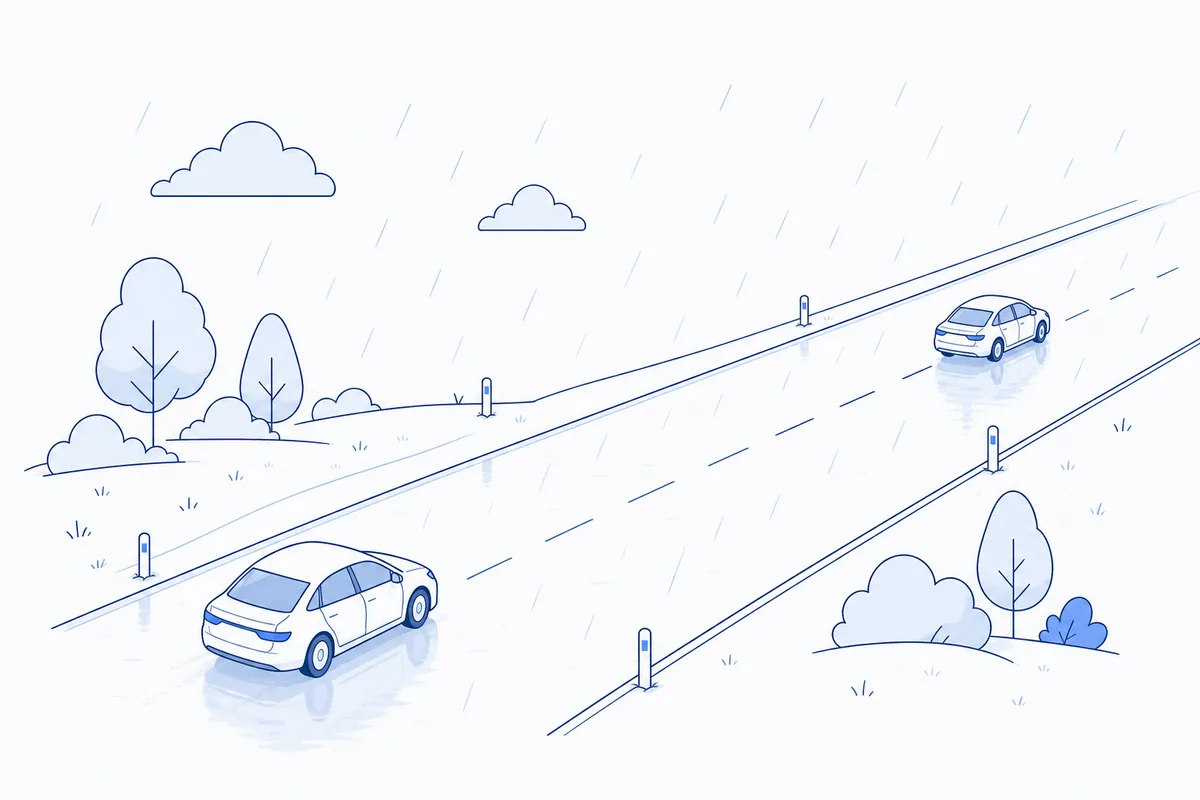
What safety margins questions test
- Typical stopping distances at 20 to 70 mph, and the thinking and braking parts of each
- The two-second gap in good conditions, and at least double that on wet roads
- Stopping distances up to ten times longer on icy roads
- Fog, heavy rain, snow and strong winds: speed, lights and gaps
- Skids, aquaplaning and ABS
- Safety margins in tunnels, on bends and when overtaking
Take all 50 questions under the real clock
50 questions from all fourteen topics in 57 minutes, with a score for safety margins so you know where you stand.
Free safety margins drillHow to revise it
- Memorise the stopping distance chart in Highway Code rule 126: 12 metres at 20 mph up to 96 metres at 70 mph.
- Learn the multipliers: double in the wet, up to ten times in ice.
- Picture each scenario before you answer: what can you see, and how long would you need to stop?
Common questions
What is the stopping distance at 30 mph?
23 metres in good conditions (9 metres thinking distance plus 14 metres braking distance), according to the Highway Code's typical stopping distance chart.
What is the two-second rule?
In good conditions, leave at least a two-second gap between you and the vehicle in front. On wet roads leave at least double that, and in icy conditions much more.
50 questions from all fourteen topics in 57 minutes, with a score for safety margins so you know where you stand.
Free safety margins drillThe other theory test topics
Sources
- GOV.UK: Theory test: cars (multiple-choice questions, 50 in 57 minutes, video questions)
- GOV.UK: Theory test: hazard perception test (14 clips, up to 5 points per hazard)
- GOV.UK: Theory test pass mark and result (43/50, 44/75, certificate valid 2 years)
- GOV.UK: Theory test revision and practice (the three DVSA books)
- GOV.UK: Book your theory test (£23)
- GOV.UK: Support for a reading difficulty, disability or health condition
- GOV.UK: The Highway Code
- GOV.UK: Driving test and theory test data: cars (DRT111A pass rates)
Original practice questions written to The Highway Code, Know Your Traffic Signs and DVSA’s published theory test topics. They are not the official DVSA revision questions and not questions from the real test. Independent practice, not affiliated with or endorsed by the Driver and Vehicle Standards Agency (DVSA).