Rules of the Road Theory Test Practice Questions
One of the fourteen DVSA theory test topics · 50 practice questions with answers
50 questions from all fourteen topics in 57 minutes, with a score for rules of the road so you know where you stand.
Free rules of the road drillWhere in the UK must you not park partially or wholly on the pavement, except in limited circumstances?
Rules of the Road on the theory test
Rules of the road is a wide topic: speed limits, junctions and roundabouts, using lanes, overtaking, pedestrian crossings, stopping, parking and lighting. It is the backbone of the Highway Code and of many theory test questions.
- On the real test
- Part of the 50 multiple-choice questions; DVSA does not publish a count per topic
- On our mock
- 5 of 50 questions, with your score for this topic in the result
- Our drill
- 10 questions from 50 rules of the road questions, untimed, an explanation after every answer; one free attempt, unlimited with a pass
What rules of the road questions test
- National speed limits for cars on single and dual carriageways and motorways
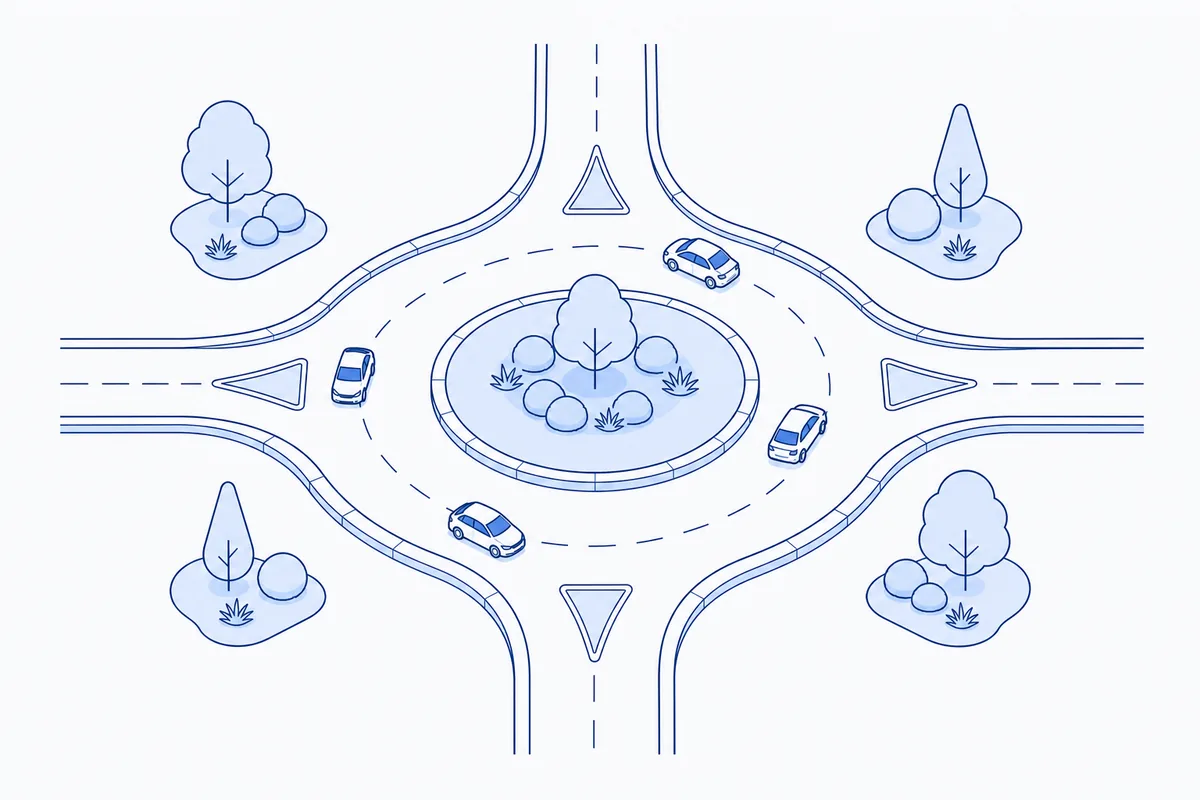
- Roundabouts: lanes, signals and giving way to traffic from the right
- Junctions, box junctions and turning right with oncoming traffic
- Zebra, pelican, puffin and toucan crossings
- Parking and waiting: where you must not stop, and parking at night
- Learner drivers: L plates and who may supervise them
Take all 50 questions under the real clock
50 questions from all fourteen topics in 57 minutes, with a score for rules of the road so you know where you stand.
Free rules of the road drillHow to revise it
- Learn the national speed limit table in Highway Code rule 124.
- Draw a roundabout and mark the signals and lanes for left, ahead and right.
- Read rules 238–252 on waiting and parking and list the places you must not park.
Common questions
What is the national speed limit for cars?
60 mph on single carriageways and 70 mph on dual carriageways and motorways, unless signs show a lower limit. In built-up areas with street lights the limit is normally 30 mph, and 20 mph is now the default in most such roads in Wales.
Who can supervise a learner driver?
Someone aged 21 or over who is qualified to drive the type of car (for example, has a full manual licence for a manual car) and has had a full licence for 3 years.
50 questions from all fourteen topics in 57 minutes, with a score for rules of the road so you know where you stand.
Free rules of the road drillThe other theory test topics
Sources
- GOV.UK: Theory test: cars (multiple-choice questions, 50 in 57 minutes, video questions)
- GOV.UK: Theory test: hazard perception test (14 clips, up to 5 points per hazard)
- GOV.UK: Theory test pass mark and result (43/50, 44/75, certificate valid 2 years)
- GOV.UK: Theory test revision and practice (the three DVSA books)
- GOV.UK: Book your theory test (£23)
- GOV.UK: Support for a reading difficulty, disability or health condition
- GOV.UK: The Highway Code
- GOV.UK: Driving test and theory test data: cars (DRT111A pass rates)
Original practice questions written to The Highway Code, Know Your Traffic Signs and DVSA’s published theory test topics. They are not the official DVSA revision questions and not questions from the real test. Independent practice, not affiliated with or endorsed by the Driver and Vehicle Standards Agency (DVSA).