Road and Traffic Signs Theory Test Practice Questions
One of the fourteen DVSA theory test topics · 60 practice questions with answers
50 questions from all fourteen topics in 57 minutes, with a score for road and traffic signs so you know where you stand.
Free road and traffic signs drillA warning sign shows a steep hill downwards with '10%' on it. What does 10% mean?
Road and Traffic Signs on the theory test
Road and traffic signs is one of the largest topics. It tests the meaning of sign shapes and colours, individual signs, road markings, traffic lights and the signals given by police officers and other authorised people.
- On the real test
- Part of the 50 multiple-choice questions; DVSA does not publish a count per topic
- On our mock
- 6 of 50 questions, with your score for this topic in the result
- Our drill
- 10 questions from 60 road and traffic signs questions, untimed, an explanation after every answer; one free attempt, unlimited with a pass
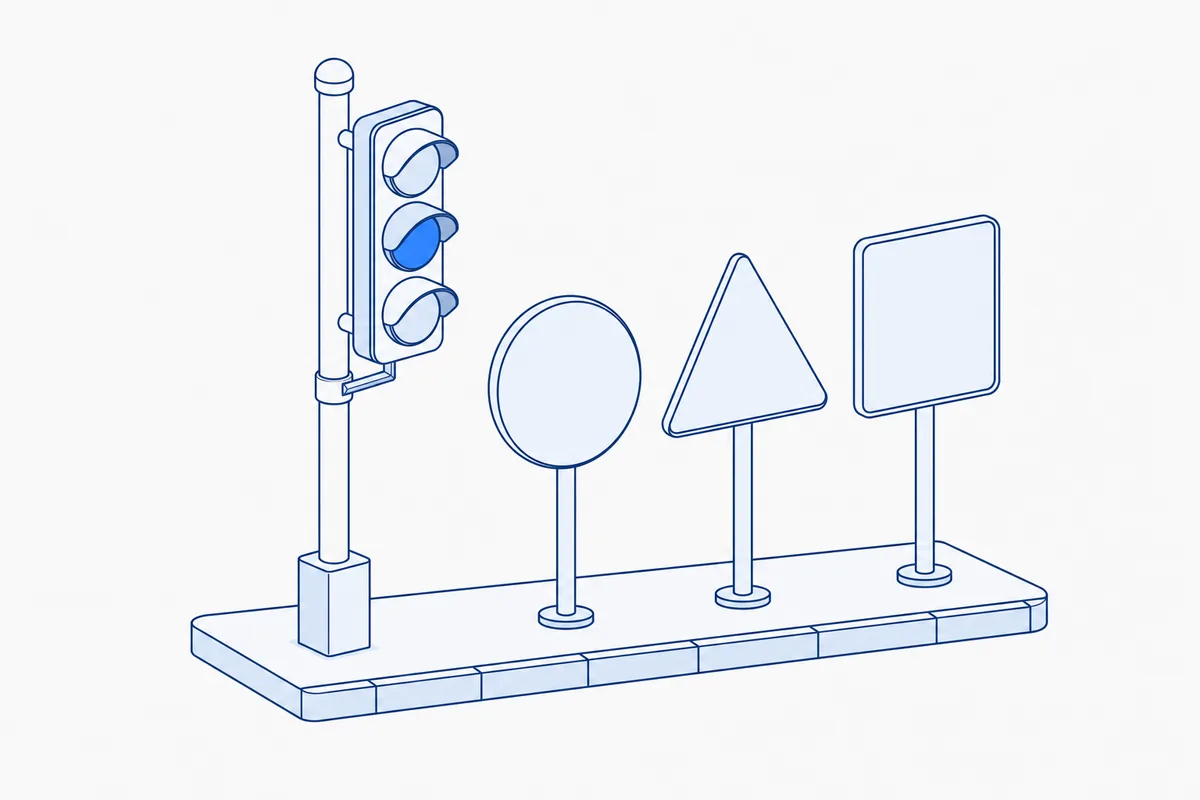
What road and traffic signs questions test
- Shapes: circles give orders, triangles warn, rectangles inform
- Colours: red circles prohibit, blue circles tell you what you must do, green signs show primary routes, blue rectangles show motorways
- Road markings: double white lines, box junctions, give way and stop lines
- Traffic light sequences, including red and amber together
- Level crossings, tram signs and bus lanes
- Signals by police officers, traffic officers and school crossing patrols
Take all 50 questions under the real clock
50 questions from all fourteen topics in 57 minutes, with a score for road and traffic signs so you know where you stand.
Free road and traffic signs drillHow to revise it
- Study Know Your Traffic Signs and the signs pages of the Highway Code by shape and colour first, then sign by sign.
- Learn the traffic light sequence in order: red, red and amber, green, amber, red.
- Test yourself on road markings: what is allowed on each side of a double white line?
Common questions
What do circular road signs mean?
Circular signs give orders. A red circle tells you what you must not do (for example, a speed limit or no entry), and a blue circle tells you what you must do (for example, turn left or the minimum speed).
What does a red and amber traffic light mean?
Stop. Do not go until green shows. Red and amber together come just before green.
50 questions from all fourteen topics in 57 minutes, with a score for road and traffic signs so you know where you stand.
Free road and traffic signs drillThe other theory test topics
Sources
- GOV.UK: Theory test: cars (multiple-choice questions, 50 in 57 minutes, video questions)
- GOV.UK: Theory test: hazard perception test (14 clips, up to 5 points per hazard)
- GOV.UK: Theory test pass mark and result (43/50, 44/75, certificate valid 2 years)
- GOV.UK: Theory test revision and practice (the three DVSA books)
- GOV.UK: Book your theory test (£23)
- GOV.UK: Support for a reading difficulty, disability or health condition
- GOV.UK: The Highway Code
- GOV.UK: Driving test and theory test data: cars (DRT111A pass rates)
Original practice questions written to The Highway Code, Know Your Traffic Signs and DVSA’s published theory test topics. They are not the official DVSA revision questions and not questions from the real test. Independent practice, not affiliated with or endorsed by the Driver and Vehicle Standards Agency (DVSA).