USMLE Step 1 Respiratory and Renal Practice Questions
11–15% of Step 1 · 42 practice questions with a note on every option
280 questions in 14 timed 30-minute blocks, with your score in respiratory and renal and every other content area.
Free respiratory and renal drillA 40-year-old man is brought to the emergency department in January after he was found confused in a closed garage where a gasoline generator was running. He has a headache and nausea. Pulse oximetry shows an oxygen saturation of 98%, and arterial PaO2 is 98 mm Hg on room air. Co-oximetry shows a carboxyhemoglobin level of 28% (N < 3% in nonsmokers). Which of the following best describes his arterial blood compared with normal?
Respiratory & Renal/Urinary Systems on Step 1
Respiratory & Renal/Urinary Systems is 11–15% of Step 1, one of its largest categories. Both halves reward physiology: ventilation and perfusion, compliance and lung volumes; filtration, tubular transport, acid-base and electrolytes.
- Share of Step 1
- 11–15% of the exam, per the USMLE content outline
- On our mock exam
- 35 of 280 questions, with your score for this system in the result
- Our drill
- 10 questions from 42 respiratory and renal questions, untimed, a note on every option; one free attempt, unlimited with a pass
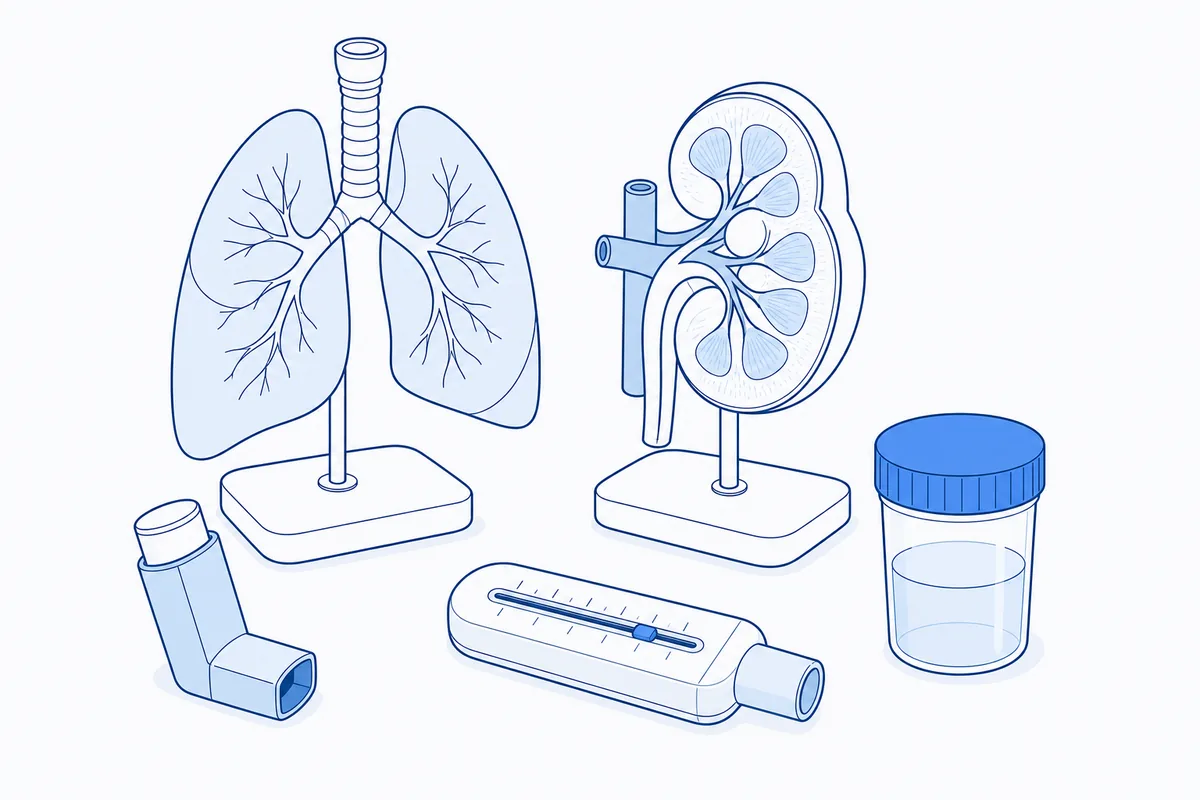
What Step 1 respiratory and renal questions test
- Pulmonary physiology: V/Q mismatch, the A-a gradient, lung volumes, compliance and oxygen-hemoglobin binding
- Obstructive and restrictive lung disease and pulmonary function tests
- Pneumonia, tuberculosis, lung cancer, pulmonary embolism and pneumothorax
- Renal physiology: GFR, clearance, filtration fraction and transport in each nephron segment
- Acid-base disorders with the anion gap and compensation, and sodium, potassium and calcium disorders
- Glomerular disease, acute kidney injury, kidney stones, urinary tract disease and diuretics by site of action
Sit all 280 questions in timed blocks
280 questions in 14 timed 30-minute blocks, with your score in respiratory and renal and every other content area.
Free respiratory and renal drillHow to study it
- Solve acid-base questions with the same three steps every time: primary disorder, compensation, anion gap.
- Map each diuretic and each inherited tubular disorder to a nephron segment.
- Learn nephritic versus nephrotic syndromes with their biopsy findings.
Common questions
Why are lungs and kidneys in one Step 1 category?
The USMLE content outline groups Respiratory & Renal/Urinary Systems together at 11–15% of Step 1. Our mock and drill score them as one category to match.
Do I need to calculate on Step 1?
Some questions need simple arithmetic, such as clearance, filtration fraction or the anion gap. Step 1 has no calculator, so learn the formulas well enough to work them by hand.
280 questions in 14 timed 30-minute blocks, with your score in respiratory and renal and every other content area.
Free respiratory and renal drillThe other Step 1 systems
Sources
- USMLE: Step 1 (blocks, items, testing day, break time)
- USMLE: Step 2 CK (blocks, items, testing day, break time)
- USMLE: Test delivery software updates for Step 2 CK and Step 1 (May 2026)
- USMLE: Step 1 content outline and specifications
- USMLE: Step 2 CK content outline and specifications
- USMLE: Examination results and scoring (minimum passing scores)
- USMLE Bulletin: Scoring and score reporting (about 60% correct to pass; result timing)
- USMLE Bulletin: Eligibility (attempt limits)
- USMLE: Apply for exams (2026 and 2027 fees, FSMB registration, region fees)
- USMLE: Performance data (pass rates)
- Intealth ECFMG: Fees overview (ECFMG Certification)
Original practice questions written to the USMLE content outlines and current standard references. USMLE® is a joint program of the Federation of State Medical Boards (FSMB) and NBME. Independent practice, not affiliated with or endorsed by the FSMB, NBME or Intealth (ECFMG). Follow current guidelines in clinical practice.