ServSafe Temperature Chart and Practice Questions
Every time and temperature rule in one chart, from the FDA Food Code, with a free ten-question drill
90 questions across all seven content areas in 2 hours, with a score for every area so you know where you stand.
Free temperatures drill- 81 original temperatures questions, every option explained
- Written to the FDA Food Code and ServSafe’s 2021 blueprint
Why should hot-holding equipment never be used to reheat food?
Temperatures on the food manager exam
Temperature questions appear in almost every content area of the ServSafe Manager exam: receiving, cooking, cooling, holding, reheating and sanitizing all turn on a number. The chart below lists the FDA Food Code values the exams test. The 2026 Food Code kept every one of these cooking, holding, cooling and reheating values.
- Our drill
- 10 questions from 81 temperatures questions, untimed, an explanation after every answer; one free attempt, unlimited with a pass
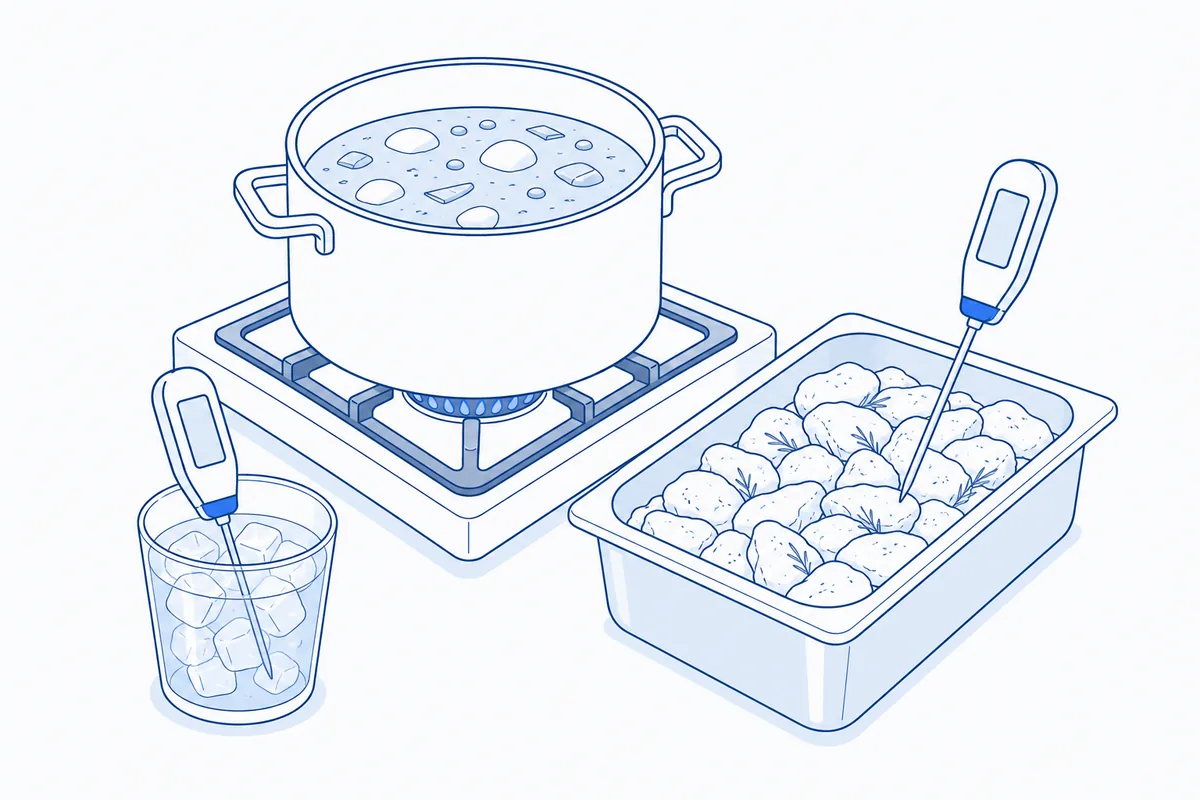
Minimum internal cooking temperatures
| Food | Temperature | Time |
|---|---|---|
| Poultry (chicken, turkey, duck), stuffing with meat or fish, stuffed meat, fish, pasta or poultry, wild game | 165°F | <1 second |
| Ground meat and ground fish, injected or mechanically tenderized meat, ratites, eggs that will be hot held | 155°F | 17 seconds |
| Ground meat: alternatives | 145°F / 150°F / 158°F | 3 minutes / 1 minute / <1 second |
| Seafood, steaks and chops of beef, pork, veal and lamb, eggs cooked for immediate service | 145°F | 15 seconds |
| Whole roasts of beef, pork, corned beef, lamb and ham | 145°F (or 130°F) | 4 minutes (or 112 minutes) |
| Fruits, vegetables, grains and legumes cooked for hot holding | 135°F | No time |
| Raw animal food cooked in a microwave | 165°F | Cover, rotate or stir, stand 2 minutes |
Sit the full exam under the real clock
90 questions across all seven content areas in 2 hours, with a score for every area so you know where you stand.
Free temperatures drillHolding, cooling and reheating
| Rule | Temperature | Time |
|---|---|---|
| Hot holding | 135°F or above | Roasts cooked to the roast chart: 130°F |
| Cold holding | 41°F or below | Ready-to-eat TCS food: 7 days, day of prep = day 1 |
| Cooling cooked food | 135°F to 70°F, then to 41°F | 2 hours, 6 hours in total |
| Cooling food made from room-temperature ingredients | To 41°F | 4 hours |
| Reheating for hot holding | 165°F | 15 seconds, reached within 2 hours |
| Reheating commercially processed, packaged ready-to-eat food | 135°F | Within 2 hours |
| Time as a public health control | Start at 41°F or below or 135°F or above | 4 hours, then serve or discard |
| Time as a public health control, cold food | Start at 41°F or below, never above 70°F | 6 hours, then serve or discard |
Receiving, thawing, freezing and cleaning
| Rule | Temperature | Notes |
|---|---|---|
| Cold TCS food at receiving | 41°F or below | Milk and shellfish follow their own laws, then are cooled to 41°F within 4 hours |
| Hot TCS food at receiving | 135°F or above | |
| Shell eggs at receiving and in storage | Air at 45°F or below | |
| Thawing under running water | 70°F or below | Or in a cooler at 41°F, in a microwave before cooking, or as part of cooking |
| Parasite destruction for fish served raw | -4°F or below | 7 days in a freezer (or -31°F options) |
| Handwashing sink water | At least 100°F | |
| Manual warewashing: wash solution | At least 110°F | Or the detergent label temperature |
| Manual hot-water sanitizing | At least 171°F | 30 seconds |
| Dishmachine hot-water final rinse | 180°F (165°F stationary-rack, single-temperature) | Not above 194°F |
| Food thermometer accuracy | ±2°F | Air and water thermometers: ±3°F |
How the exam asks about temperatures
- A food and a number: “What is the minimum internal temperature for ground pork?” (155°F for 17 seconds).
- A time calculation: a soup reached 70°F in 1 hour 30 minutes; how long is left to reach 41°F? (4 hours 30 minutes, because the total is 6 hours).
- A failed check: chili is at 120°F on the steam table and the time it dropped below 135°F is unknown (throw it out).
- A procedure: how to calibrate a thermometer (ice water, 32°F) or where to put it (the thickest part of the food).
How to learn the numbers
- Group cooking temperatures by number: 165, 155, 145, 135. Each number covers a family of foods.
- Learn the danger zone (41°F to 135°F) first; holding, receiving and time control all hang on those two numbers.
- Take the temperatures drill until you can answer every question in a few seconds.
Common questions
What is the temperature danger zone?
The range between 41°F and 135°F, where pathogens grow fastest. TCS food is held cold at 41°F or below or hot at 135°F or above.
Did the 2026 FDA Food Code change any of these temperatures?
No. FDA’s summary of changes for the 2026 Food Code lists no changes to cooking, holding, cooling or reheating temperatures. It added a cooling method (food no more than 2 inches deep) and a minimum 75°F temperature for sanitizers other than chlorine, iodine and quats.
Are the ServSafe temperatures the same as the FDA Food Code?
ServSafe and the other accredited food manager exams test the FDA Food Code values. Your state or county may have adopted a different edition, so local rules can differ.
90 questions across all seven content areas in 2 hours, with a score for every area so you know where you stand.
Free temperatures drillMore ServSafe Manager practice
- Management of Food Safety Practices
- Hygiene and Health
- Safe Receipt, Storage, Transportation and Disposal of Food
- Safe Preparation and Cooking of Food
- Safe Service and Display of Food
- Cleanliness and Sanitation
- Facilities and Equipment
- Food Protection Manager Practice Test
- ServSafe Manager practice exam (90 questions)
Sources
- ServSafe: ServSafe Manager (ANAB-CFP accreditation, test options)
- ServSafe: Exam Development FAQs (80 operational + 10 pilot items, blueprint from the 2021 Job Task Analysis)
- ServSafe Knowledge Center: passing scores (Food Protection Manager 70%)
- ServSafe Knowledge Center: number of questions on ServSafe exams
- ServSafe: Online Proctor Exam Instructions (2-hour time limit, retest policy, equipment)
- ServSafe Knowledge Center: Food Protection Manager retest policy
- ServSafe Knowledge Center: how long ServSafe certificates are valid
- ServSafe: ServSafe Manager Exam (Online Proctor), $99.00
- FDA Food Code (2026 edition and summary of changes; 2022 edition)
Original practice questions for exam preparation, written to the FDA Food Code and ServSafe’s published exam blueprint; they are not the official exam questions. Independent practice, not affiliated with or endorsed by the National Restaurant Association, ServSafe, NRFSP, StateFoodSafety, 360training or ANAB. ServSafe is a registered trademark of the National Restaurant Association.