MBLEx Kinesiology Practice Questions
Content area 2 of the MBLEx · about 12 of the 100 questions (12%)
100 questions across all seven content areas in 110 minutes, with a score for kinesiology so you know where you stand.
Free kinesiology drillA client has weakness lifting her thigh toward her chest. Which pair of muscles are synergists for hip flexion and share a common tendon on the lesser trochanter?
Kinesiology on the MBLEx
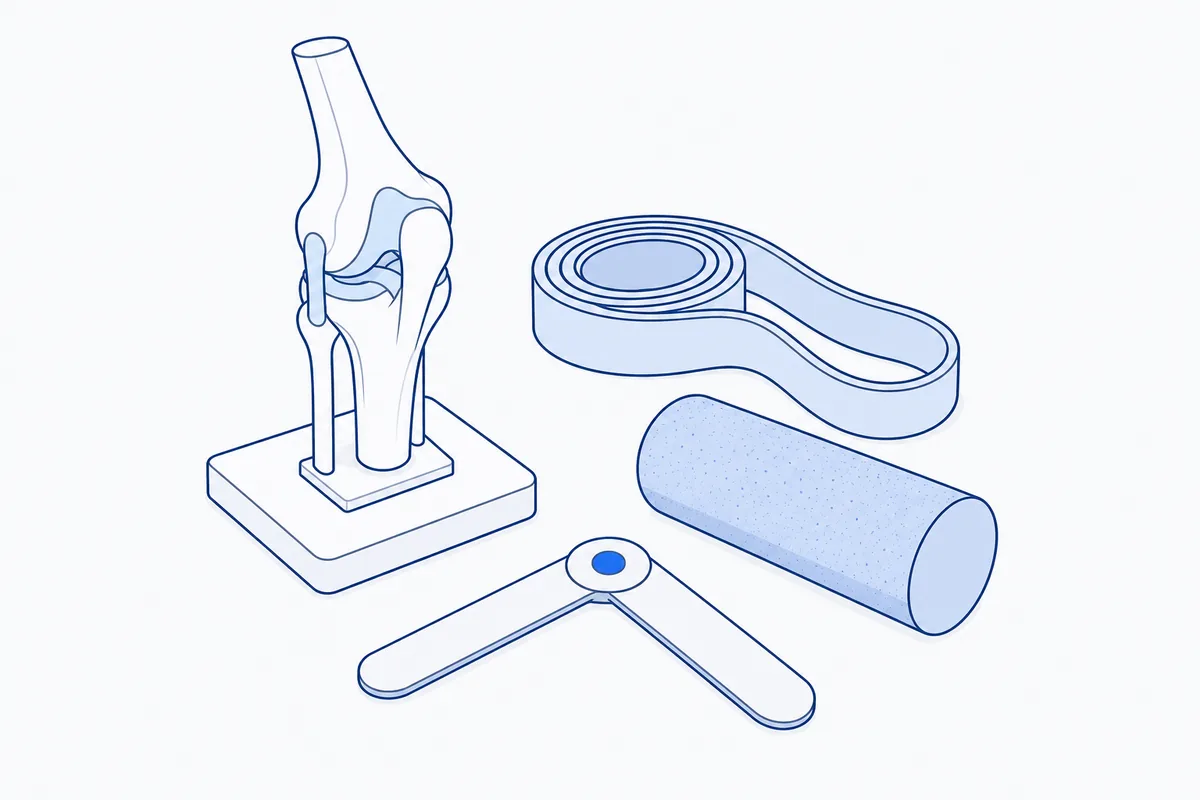
Kinesiology is about 12 of the 100 questions. It is the study of movement: how skeletal muscle is built and contracts, how proprioceptors sense position and tension, where muscles attach and what they do, how joints are built, and how to test range of motion. Muscle origins, insertions and actions are the most memorized part of the whole exam.
- Share of the exam
- 12% of the content outline, about 12 of the 100 questions
- Outline subtopics
- 6 (parts A, B, C, D, E, F)
- Our drill
- 10 questions from 125 kinesiology questions, untimed, an explanation after every answer; one free attempt, unlimited with a pass
What kinesiology questions test
- Skeletal muscle components and characteristics: fascicles, fibers, myofibrils, sarcomeres, and fiber types (2A)
- Concepts of contraction: the sliding filament mechanism, concentric, eccentric and isometric contractions, agonists, antagonists, synergists and stabilizers (2B)
- Proprioceptors: muscle spindles, Golgi tendon organs and joint receptors, and the reflexes that rely on them, such as reciprocal inhibition (2C)
- Skeletal muscle locations, attachments (origins and insertions) and actions, from the head and neck to the foot (2D)
- Joint structure and function: fibrous, cartilaginous and synovial joints, the six synovial joint types, planes and axes of movement (2E)
- Range of motion: active, passive and resisted movement (2F)
Sit the full exam under the real clock
100 questions across all seven content areas in 110 minutes, with a score for kinesiology so you know where you stand.
Free kinesiology drillHow to study it
- Learn muscles in groups that share a job (rotator cuff, hamstrings, quadriceps, hip adductors, deep lateral rotators). Attachments are easier to remember when you know the group’s action.
- For every muscle, say its action from its line of pull: a muscle that crosses the front of the hip flexes it.
- Palpate on yourself or a study partner while you study attachments; the bony landmarks stick once you have felt them.
- Use the free muscles drill for origins, insertions and actions, and the kinesiology drill for contraction, proprioceptors and joints.
Common questions
Do I need to know origins and insertions for the MBLEx?
Yes. Part D of the Kinesiology area is skeletal muscle locations, attachments (origins and insertions) and actions. Learn the major muscles of every region with their primary actions; the exam asks which muscle attaches where and what it does.
Is there a separate muscles drill?
Yes. Besides the kinesiology drill, we have a free ten-question drill only on muscle locations, origins, insertions and actions, drawn from our muscle questions across every body region.
100 questions across all seven content areas in 110 minutes, with a score for kinesiology so you know where you stand.
Free kinesiology drillThe other MBLEx content areas
Sources
Original practice questions for exam preparation, written to the FSMTB MBLEx content outline. Independent practice, not affiliated with or endorsed by the Federation of State Massage Therapy Boards (FSMTB). MBLEx is a registered trademark of FSMTB.